
A community foundation uses a language model to draft an informational notice about a small grant program. The notice must include who can apply, the deadline, an exception for applicants needing accessible formats, and a clear statement that submitting a form is not an award. If a model response stops early, a smooth-looking paragraph can still omit the essential exception. The OpenAI Responses API exposes status and incomplete_details fields that applications can check before treating generated content as a completed draft. This hypothetical workflow prevents unfinished text from being sent as an official notice.
Define the minimum complete notice outside the model
Write a controlled requirements sheet before making an API call: eligible applicants, exclusions, source policy revision, submission deadline, accommodation process, named contact and an explicit no-award-guarantee statement. These fields come from approved grant documents, not from the model’s confidence. Give each requirement a source reference so a human can compare any draft. A system that simply asks for a ‘friendly summary’ has no reliable way to distinguish a shortened but complete notice from one missing a legally important condition.
Choose a delivery rule that is fail-closed. A response should remain in internal draft state until all required fields and sources have been checked, regardless of how natural the prose sounds. The model may still hallucinate policy language in a response marked completed, so status is only the first gate. Maintain separate editorial approval for accuracy, accessibility and whether the foundation has authorized publication.
Inspect the response object and incomplete_details
The OpenAI Responses API documents response statuses including completed, incomplete, failed and in_progress. An incomplete response can carry incomplete_details.reason; documented reasons include max_output_tokens and content_filter, with additional states depending on interface and features. Treat any status other than completed as non-publishable. Do not infer success from an HTTP request that returned an object containing some readable text.
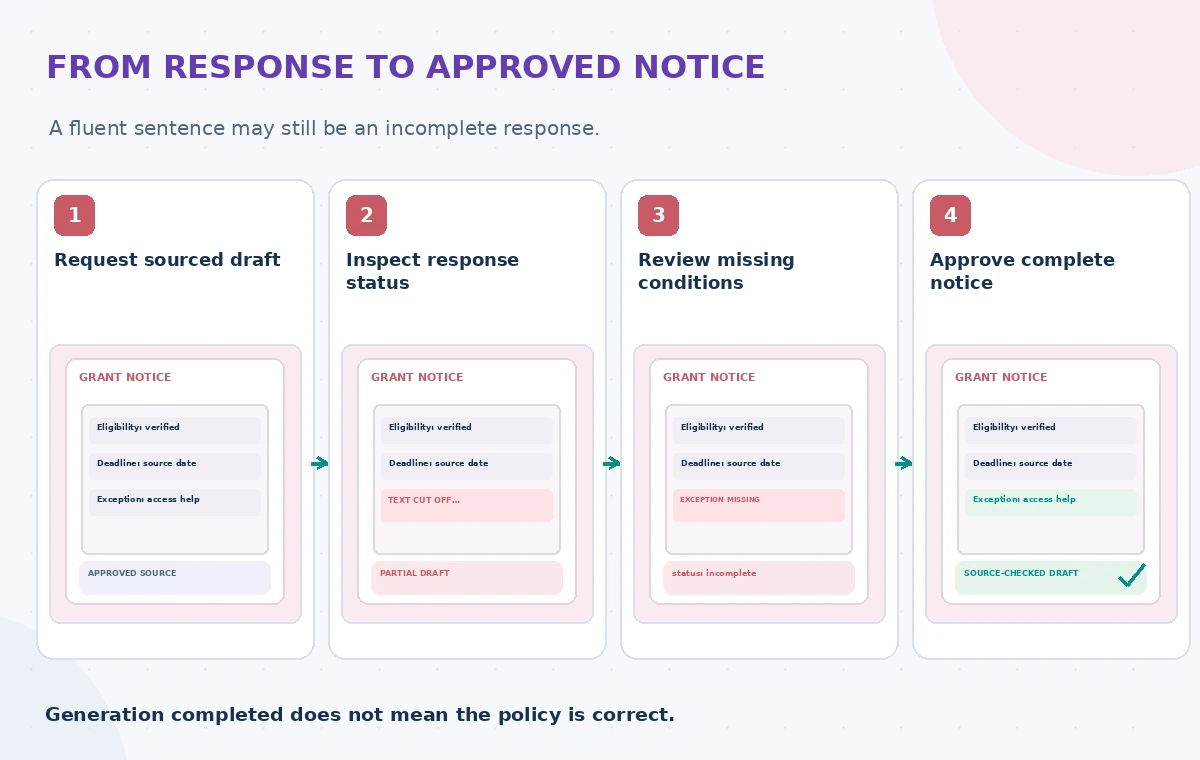
For streaming requests, the API documents a response.incomplete event. Collect terminal events and final status rather than displaying the last text delta as a complete answer. Some outputs also have item-level status fields, so client code should inspect the appropriate response and item structures. Keep a clear ‘generation interrupted; reviewer needed’ state instead of silently converting an incomplete record into an approved draft.
Plan token budgets for visible and non-visible work
The max_output_tokens parameter caps output generation, including tokens that may be used for reasoning and other non-visible structure. OpenAI’s token-counting guide warns that reported output tokens can exceed visible text length. A limit chosen by counting only the words in the desired notice can therefore stop a response before its conclusion. Set limits with measured behavior of the selected model and response format, not an arbitrary fixed multiple of word count.
Do not respond to a cutoff by repeatedly sending the same grant notice for automatic publishing until the model eventually returns more words. Identify why the response was incomplete and whether it is appropriate to retry under the same data and cost policy. If the limit is too low, adjust it in a controlled test; if content filtering caused the stop, route to an authorized human rather than trying to bypass a safety restriction.
Keep generation separate from final policy assembly
Consider a structured internal checklist for grant terms: required headings and citations are validated against the source record after text generation. If a source policy contains a late paragraph about accessibility, the review system must inspect that paragraph even when the draft omits it. Separate a source extraction phase from writing; a second model’s agreement does not replace the original policy or approval record.
Require exact deadlines and eligibility exceptions to be copied from approved documents and checked by a person. Avoid assuming the model knows current grant dates. If an approved rule is changed, retire the earlier template or mark it obsolete before preparing a new notice. The completed field means generation finished, not that the notice became accurate, legally sufficient or cleared for publication.
Illustrate the difference between fluent and complete
Draw a hypothetical grant notice with a visible cutoff below the eligibility heading, an intermediate API status panel reporting incomplete with reason max_output_tokens, and a final reviewer-approved notice where the eligibility exception and deadline are visible. Do not portray the first draft as a service failure rate or fabricate an observed model trace. The important change is the application’s refusal to send unverified partial text.
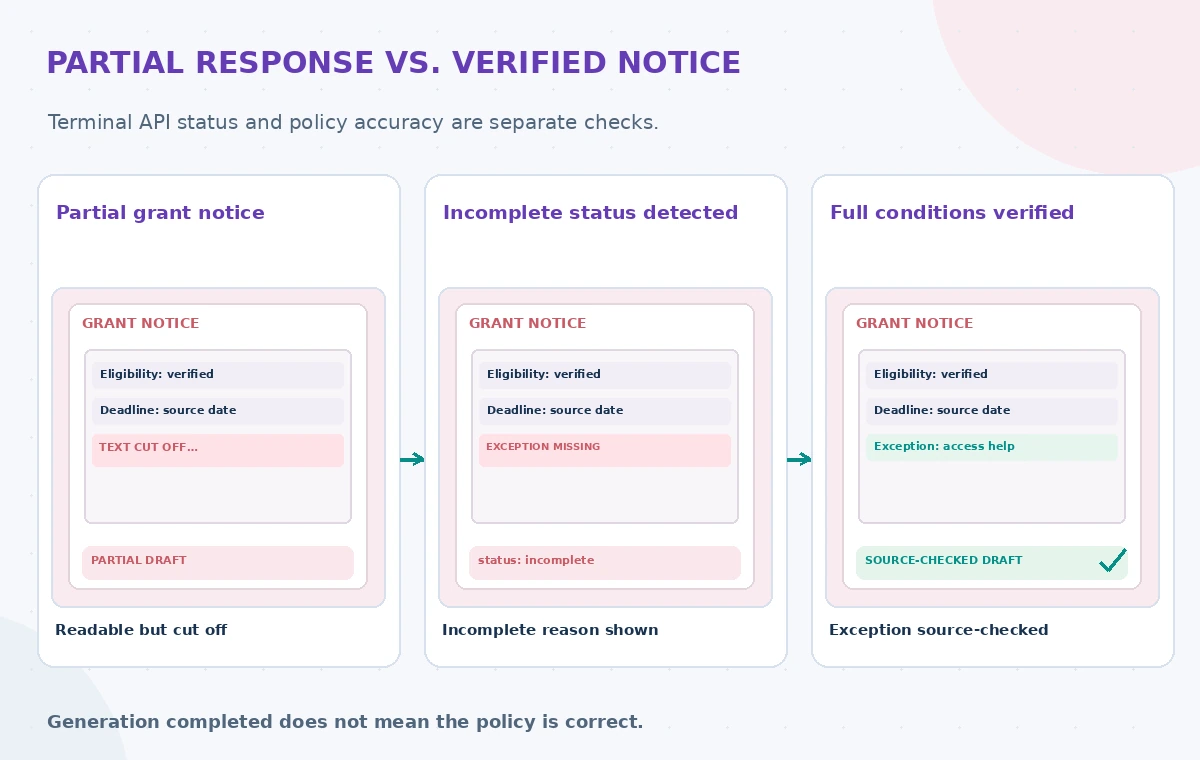
Check that the final panel contains the same source requirements, not merely a ‘COMPLETE’ badge. A notice can be fully generated but still wrong, so use two distinct gates: terminal response status and human verification against the original grant rules. A recipient must never see a text fragment labeled ‘approved’ simply because it ends with a period or provides a confident recommendation.
Test the interrupted-output path
Prepare synthetic policy fixtures that include an exception near the end, a long list of exclusions and a multi-paragraph accessibility instruction. In local integration tests, simulate incomplete responses with appropriate documented shapes and verify that the application blocks delivery. Also test failed, canceled and timeout paths according to the specific API and transport in use. Preserve the status, reason and source version in logs without exposing private applicant details.
Test the success path separately with complete but factually incorrect simulated text; it should still fail source review. Use a mock response instead of spending money on repeated live calls if the purpose is only testing client state handling. Track whether the system held an item, informed the editor and avoided an unintended email or publication. Do not report real-world detection rates unless actual test data and outcomes are recorded.
Keep retries and notifications idempotent
Attach each generation attempt to a draft ID and an approved policy revision. If a request is retried after a timeout, inspect the application state before creating another notice or triggering another email. The generation process should never call a publication tool merely because it produced a sentence that looks final. Route incomplete drafts to a review queue with a reason and an action for staff rather than initiating automatic release.
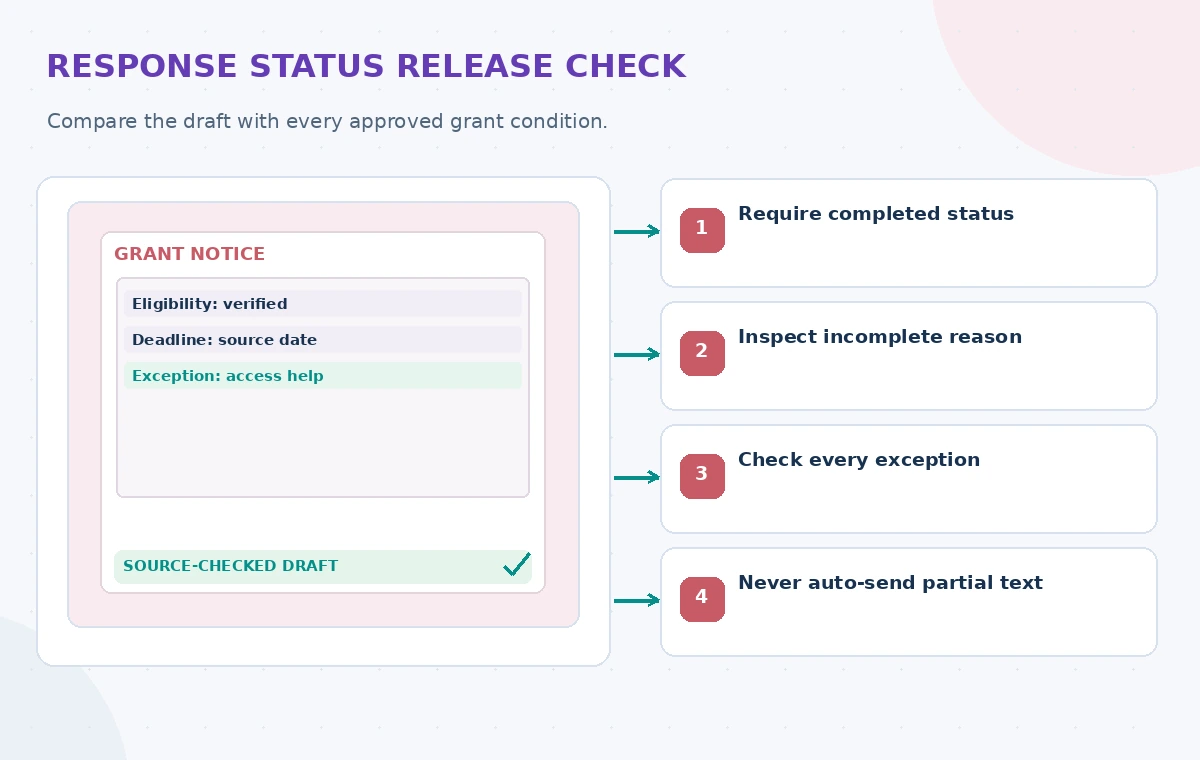
Where a streaming UI is used, label incremental text as an in-progress preview, not a public grant decision. Only after a terminal completed status, policy-field review and authorized sign-off should an item move to the published queue. Preserve a change history so a reviewer can distinguish a new full response from text spliced onto a partial response. Avoid claiming a grant hold, approval or award unless the relevant administrative system confirmed it.
Release a complete, traceable notice
Before publication, compare every mandatory clause with its controlling source, verify dates and contacts, inspect accessibility wording and review the audience. The content owner should sign off on a stable version and the system should publish exactly that version, not re-generate it just before sending. If a source changes, invalidate the approval and redo the review. A complete response is one prerequisite, never final authority.
The diagrams in this guide are conceptual client-side states rather than actual OpenAI API screenshots, and no live response, latency measurement or grant policy was tested. Check the current model and API reference, usage limits, logging rules and organizational approval requirements before implementing the workflow. Designing for incomplete status protects readers from an avoidable class of truncated notices while still requiring rigorous factual verification.
How We Research
For this November 2026 article, we examined named, official documentation: OpenAI Responses create reference; OpenAI Responses streaming events; OpenAI token counting guide; OpenAI reasoning models guide. We cross-checked response shapes, feature boundaries, and stated limitations, then built a clearly hypothetical nonprofit example to explain manual verification and permission controls. This was documentation-based editorial research only: we did not process real records, run vendor experiments, measure success rates or imply that machine-generated text is approved. The original teaching diagrams are schematic, not product screenshots or tested outcomes. Recheck current API documentation, pricing, region availability, input rights, and internal release policies before implementation.
Frequently Asked Questions
Yes. Check response.status and incomplete_details, not just whether text was returned.
Generation reached the configured output-token budget, which includes non-visible tokens.
No. It only marks generation completion; every rule and exception needs source review.
No. Display it as an in-progress preview and wait for a terminal completed state and approval.
It may retry under controlled policy, but must avoid duplicate side effects and never turn a retry into automatic grant approval.