
A neighborhood seed exchange collects written feedback in English, Spanish and occasional mixed-language comments. Staff want each response to reach a reviewer who can understand its full meaning; they do not want a language detector to decide whether a volunteer’s complaint is valid. Amazon Comprehend DetectDominantLanguage returns candidate language codes and scores for text. Used carefully, those results can support a routing queue, not substitute for interpreting a sentence. The example is hypothetical, and none of the sample comments or percentages below come from a live API run.
Start with a human-readable source record
Give each submitted comment a stable, non-identifying reference, the date received, the consent and retention rules, and the untouched source text. A seed exchange might receive a note containing Spanish descriptions of missing seed packets followed by an English request for a callback. Routing only the first sentence could lose the service request. Establish whether translation is actually needed, who is authorized to read feedback, and which languages staff can review competently before using automation.
Treat names, addresses and phone numbers as separate restricted fields rather than embedding them into the language-analysis input. A small community organization may not need to send private contact details to determine a comment’s likely language. Preserve punctuation and diacritics in the source, because simplifying those characters can remove clues and alter quoted plant-variety names. A routing decision must always retain a link to the unchanged original for an authorized person.
Read the API output as candidate languages, not proportions
The DetectDominantLanguage request accepts a UTF-8 Text value. Its response includes a Languages array of LanguageCode and Score objects, sorted by score with the dominant candidate first. AWS says each score reflects confidence in that language inference and does not indicate the percentage of the document in that language. This distinction matters for mixed-language notes: a top candidate is a machine prediction about the whole input, not an inventory of every sentence.

AWS recommends at least 20 characters for useful detection; the documented maximum text size is 100 KB. Short labels such as ‘OK’ or a single botanical name deserve an unknown or manual-review status, not a forced language. Keep RFC 5646 codes such as en and es associated with a display label; do not silently convert a regional variant into a claim about the writer’s nationality. Review supported languages against the current AWS list.
Split long and mixed-language material with care
An entire bilingual letter may be classified by its longest passage. AWS suggests breaking longer documents into smaller pieces when language composition matters. For community feedback, logical boundaries such as sentences or paragraphs are preferable to arbitrary character chunks; cutting a negation or a cultivar name in half makes review harder. Assign each segment its source offsets and preserve sequence, then collect the set of language candidates without discarding any segment.
Do not present the segment labels as measured language percentages unless actual aggregation methods and input coverage are documented. A Spanish-language sentence that contains an English cultivar name is not necessarily an English request. Conversely, a note that begins in English may include a crucial Spanish warning about mold or an allergy. Route the whole record to a qualified reviewer when a mixed-language risk flag appears, and preserve uncertainty rather than overwriting text.
Build a routing policy with a review lane
Define a small, auditable mapping from supported language codes to reviewer queues. An English-only comment can go to the regular triage queue; a clearly mixed-language note goes to a bilingual reviewer; unsupported or uncertain input goes to a general human-review lane. This logic is a local administrative policy and is not supplied by the Comprehend API. Keep the raw candidate scores for troubleshooting but do not display them as staff performance ratings.
Make accessibility and urgency independent of language. A message mentioning an inaccessible entrance, an allergy concern or a missing safety label must remain eligible for prompt human triage even when classification is uncertain. Avoid automatic translation into an official response; the translator should first understand the request, check names and quantities against records, and decide whether any answer is needed. Do not assume a dominant-language label represents the user’s preferred reply language.
Compare wrong routing with reviewed routing
A useful comparison starts with a complete hypothetical bilingual comment; the intermediate panel identifies different sentence-level language candidates, and the final panel shows the same complete comment assigned to a bilingual queue. The real improvement is preserving context and selecting a reviewer, not an increased numerical accuracy score. The output should visibly distinguish machine suggestions from a human-confirmed route; never draw a fabricated provider confidence value as if it came from an observed API response.
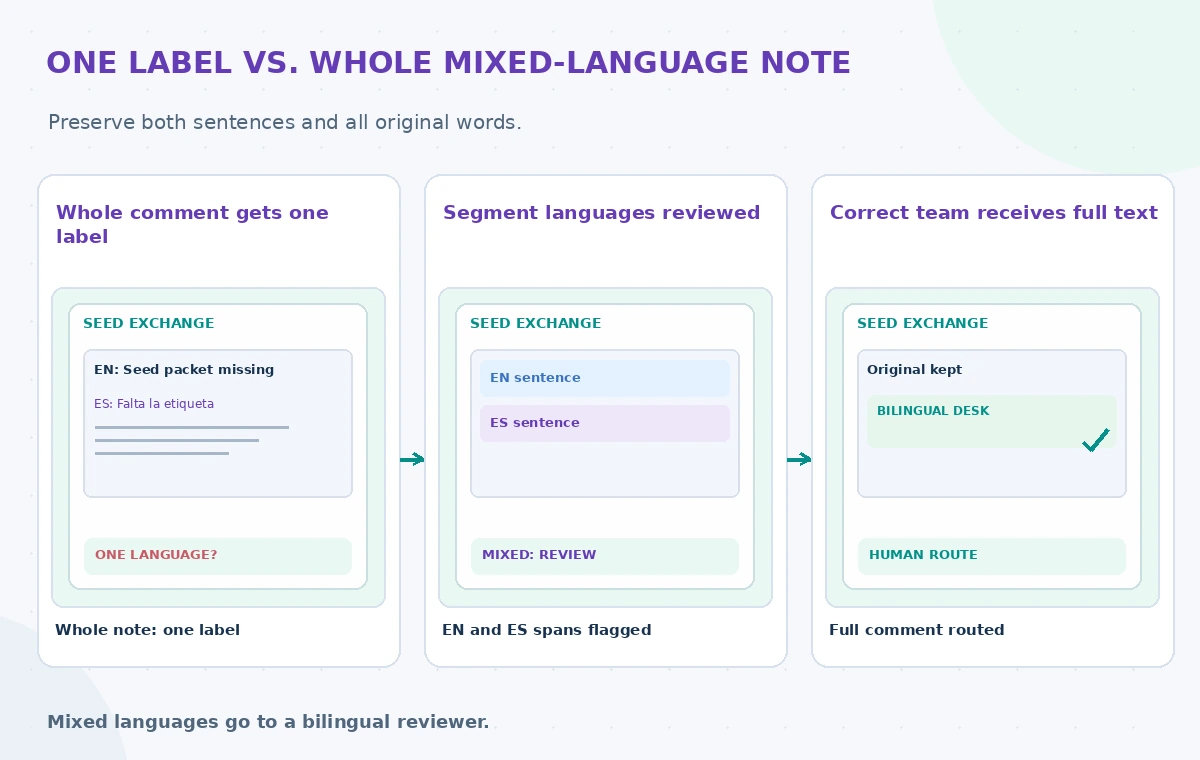
Check the decision against the original text before downstream automation. If an English initial sentence requests a replacement seed packet but a Spanish final sentence names the delivery location, both need consideration. A reviewer should see the full message and a reversible routing label. A misrouted item should be reassigned without rewriting the submission or guessing the writer’s background.
Evaluate with permitted edge cases
Assemble fictional, permission-cleared examples containing mixed punctuation, short thanks, proper nouns, transliterated words, closely related languages and comments that alternate languages within a sentence. Ask bilingual staff to label which queue should receive each example. Compare routing decisions, missed mixed-language cases and unnecessary escalations rather than inventing a model accuracy figure. Document the test set, date, locale and rule changes if measurements are later collected.
AWS notes difficulty with close language pairs and does not support phonetic-language detection in the way some users may expect. A romanized phrase may receive a surprising label; do not correct the user’s words automatically to force a better prediction. Use a manual fallback for language names absent from the organization’s reviewer list, and record a reason whenever a staff member overrides routing.
Minimize data and review the operation
Determine whether comments can be processed in the selected AWS region and whether the organization’s privacy notice covers the proposed handling. Avoid logging full comments in error traces or exposing the language queue to unrelated volunteers. Restrict access by responsibility and apply a retention period to both originals and derived analysis. The service does not establish consent to publish, translate or share a participant’s remarks.
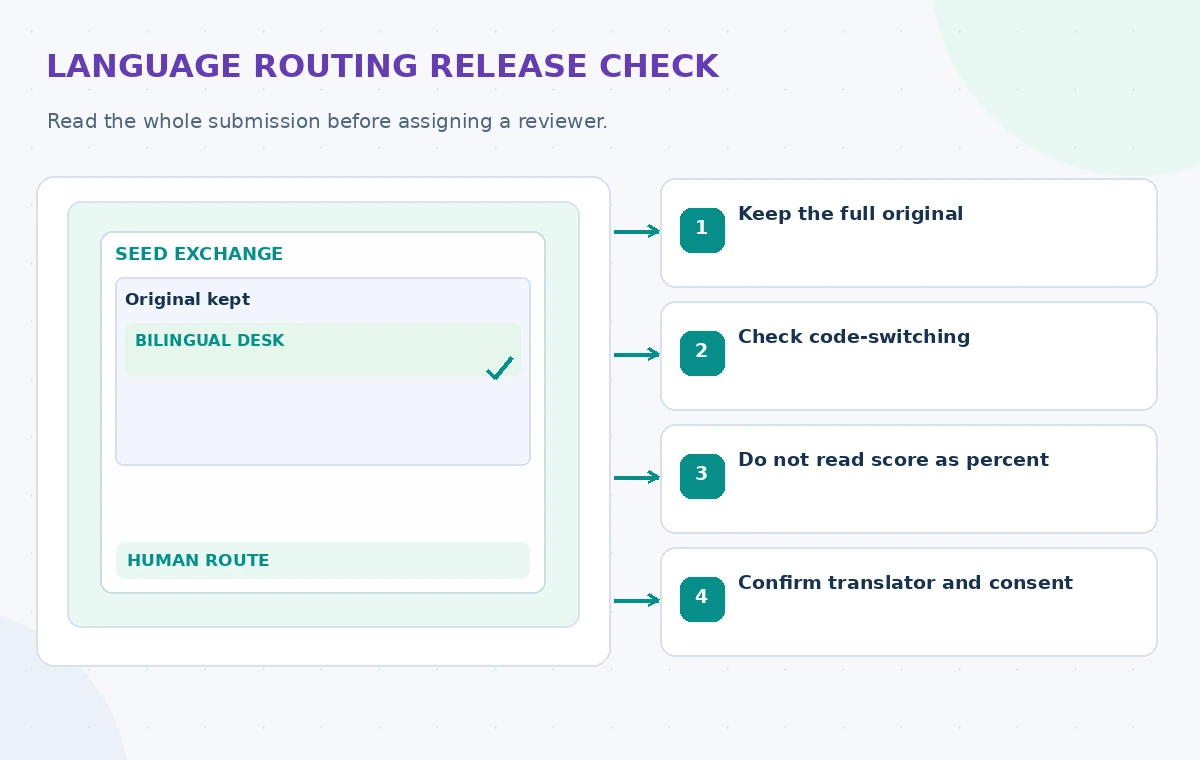
Keep an operational record of application version, source ID, processing time, detected codes and assigned queue; strip personal details from monitoring dashboards. If the API fails, do not assume English or close the ticket. Hold the submission in a manual-review state so service staff can still respond. Document whether reprocessing is safe and ensure retries do not create duplicate requests.
Release a human-reviewed feedback handoff
A ready-to-use workflow ends when an authorized reviewer sees the original submission, any segment annotations, and a clear route decision. The review screen should allow correction, including ‘language unknown’ or ‘multiple languages.’ Ensure that a translated reply is separately checked for dates, addresses and plant-variety names before it is sent. A language detector can direct work; it cannot establish meaning, priority, translation quality or the writer’s identity.
Revisit routing tables when volunteer language coverage changes, and audit whether unusual or minority-language comments are disproportionately delayed. The drawings in this article are original teaching diagrams, not AWS console screenshots or real test results. Before a deployment, review current AWS restrictions, consent requirements, processing costs and the organization’s language-access commitments.
How We Research
For this November 2026 article, we examined named, official documentation: AWS DetectDominantLanguage API; AWS dominant language guide; AWS language support by feature. We cross-checked response shapes, feature boundaries, and stated limitations, then built a clearly hypothetical nonprofit example to explain manual verification and permission controls. This was documentation-based editorial research only: we did not process real records, run vendor experiments, measure success rates or imply that machine-generated text is approved. The original teaching diagrams are schematic, not product screenshots or tested outcomes. Recheck current API documentation, pricing, region availability, input rights, and internal release policies before implementation.
Frequently Asked Questions
No. AWS documents scores as confidence indicators, not language proportions.
No. It identifies likely languages; translation is a separate task requiring context review.
Route it for manual review instead of forcing a confident label; AWS recommends longer inputs.
No. Segmenting can help, but mixed phrases, transliteration and close language pairs remain difficult.
No. Review the original meaning, contact preferences and permission to reply or publish first.