
A neighborhood seed exchange gathers short comment cards after a weekend workshop. Organizers want to learn whether visitors mentioned confusing labels, damaged envelopes or limited access hours, but they cannot treat an AI-generated phrase list as a survey result. Amazon Comprehend DetectKeyPhrases returns candidate noun phrases with confidence values and character offsets. This hypothetical workflow uses those candidates to help a reviewer locate source text, assess privacy, and write a defensible improvement report without claiming any real comments were analyzed.
Start with the actual research question
Define what the team needs to decide before running text extraction. For example, is the priority to identify recurring physical supply problems or to discover terms visitors use for the seed shelf? Create separate columns for source comment ID, consent scope, date, phrase, reviewer conclusion and resulting action. This prevents the presence of a noun phrase from being mistaken for a validated complaint.
Do not start by ranking the most frequent output strings. A phrase such as “long Saturday hours” might praise the schedule or criticize a single unexpected closure. Reviewers need sentence context and sometimes adjacent comments to interpret it. Tell contributors what feedback data is collected, who reviews it and how long it is retained.
Understand what DetectKeyPhrases actually returns
AWS defines a key phrase as a noun phrase that describes a particular thing. DetectKeyPhrases accepts text plus a supported language code, returning a KeyPhrases list with Text, Score, BeginOffset and EndOffset. The score expresses confidence that the span is a noun phrase; it is not a satisfaction measure, urgency rating, confidence in a factual claim or proof that the issue occurred.
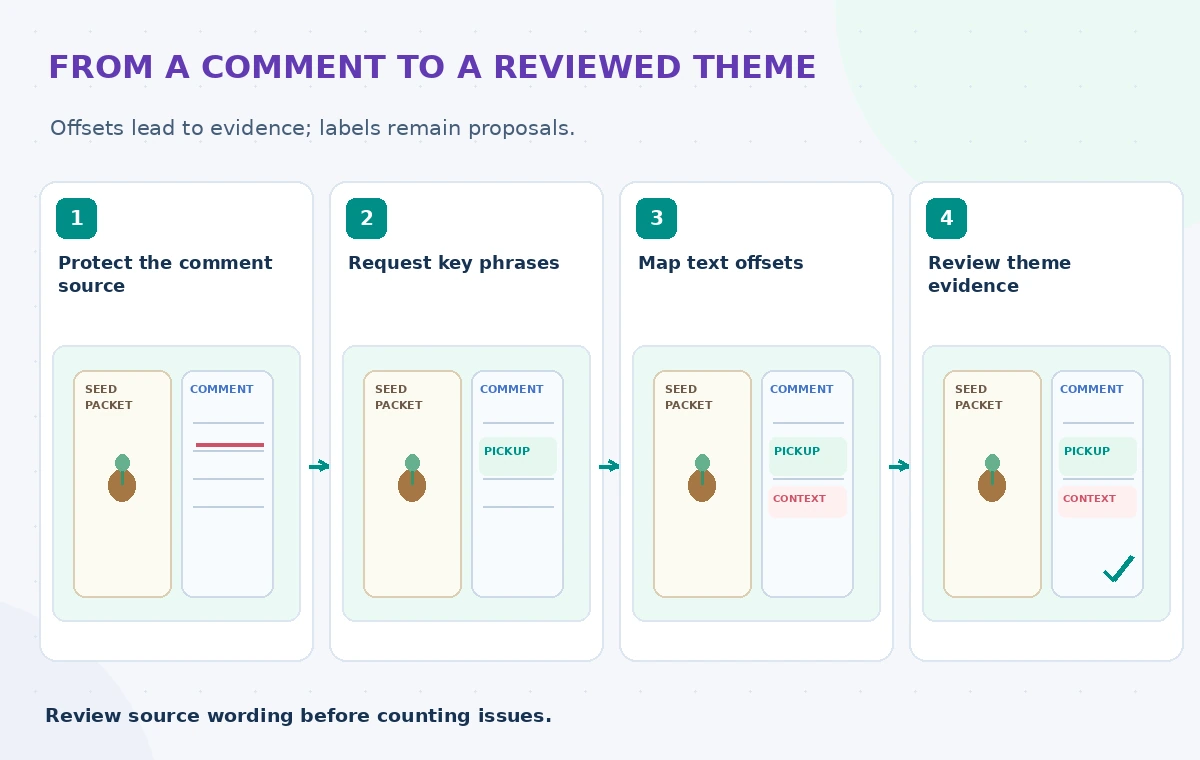
For a fictional note such as “The seed envelopes were clear, but the pickup table was hard to find,” a detector might propose “seed envelopes” and “pickup table.” Those candidates point to subjects worth reviewing; they do not preserve the contrast between compliment and complaint. Keep the full sentence accessible to authorized reviewers alongside each extraction.
Prepare language and document boundaries
Select an appropriate supported language code for the document instead of treating a multi-language stack of survey cards as one English paragraph. AWS requires text in a request to match the specified language; batch processing likewise needs a consistent language expectation. Separate translated derivatives from originals and ask a qualified reviewer to interpret dialect terms when the comments code-switch.
Keep each comment as its own record with a stable internal ID. Combining twenty visitor messages into one input can make phrase offsets difficult to relate back to individual respondents, and might accidentally join details that were never written together. Validate length limits and encoding against current API documentation before processing sensitive material.
Use text offsets to return to the evidence
The API response includes character offsets for each candidate phrase. Store the source version, extracted text, offsets and language with the result. In the review interface, highlight the phrase in the exact stored text and show a few words on both sides. Offsets can become unreliable when preprocessing changes punctuation, Unicode normalization or line breaks after the extraction call.
A reviewer should see a conceptual sequence like source comment, extracted “pickup table,” then an evidence-linked note saying “wayfinding concern.” The published report should cite the approved anonymized quotation rather than a standalone model label. If the phrase spans a name, number or personal detail, remove or restrict the identifying content before public analysis.
Group topics without manufacturing agreement
Build a small, human-maintained topic dictionary for seed labels, supplies, pickup access and workshop instructions. A model may produce related but nonidentical phrases such as “seed packet,” “packet labels” and “brown envelopes.” Merge them only after reading representative source passages. Preserve rejected mappings as well, because an over-broad category can hide a difference between readability and physical packaging.
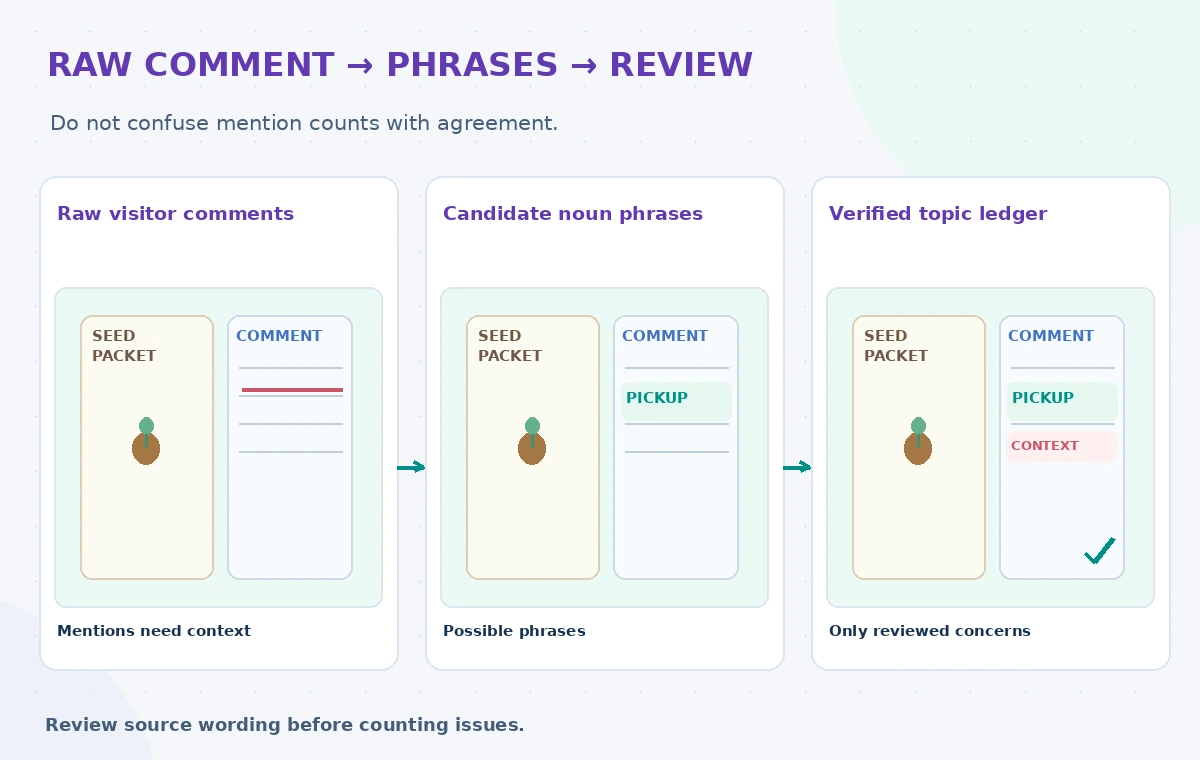
Document the denominator: number of comments eligible for review, number mentioning a particular topic and number containing a verified concern. Never say “most visitors disliked the labels” merely because “labels” was a common key phrase. Silence on a topic is not an endorsement, and the sample is not necessarily representative of everyone who attended.
Separate extraction confidence from editorial judgment
High noun-phrase scores do not establish that a comment is true. A visitor might remember a pickup location incorrectly, describe an older event or quote somebody else. Review the underlying operational log before changing a public claim about hours or lost materials. Add separate verdicts such as supported, disputed, historical or not enough context.
Use a small negative-example set that includes praise, sarcasm, questions, negation and phrases with private details. Ask reviewers whether the resulting topic grouping would make them take a different action. The system should surface uncertainty instead of suppressing it in a polished dashboard. For accessibility requests, route the full approved issue to an owner rather than relying on phrase frequency.
Respect the data and API limits
Minimize personal information before using an external NLP service. Confirm an organizational data-processing basis and avoid uploading raw contact cards simply because extraction is convenient. AWS offers single-text, batch and asynchronous key-phrase operations, each with distinct inputs and output handling; verify service quotas, language support and regional policy at deployment time.
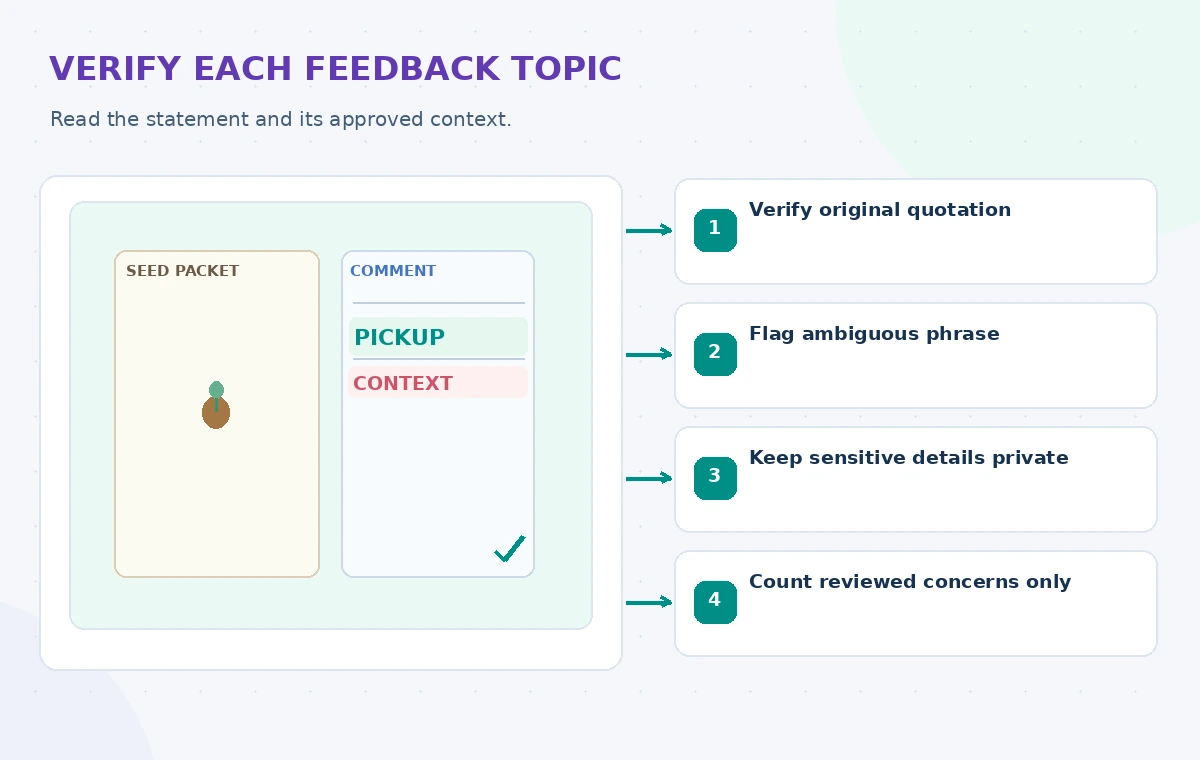
Do not assume DetectKeyPhrases performs PII redaction or sentiment analysis. If those tasks are needed, design separate reviewed steps and keep the protected originals out of public exports. Secure the batch output location, audit access, and do not include contact emails in dashboard labels or error logs. A successful API request does not approve publication.
Publish a reviewable improvement ledger
Close the loop with a simple ledger showing topic, number of reviewed mentions, an optional consented quotation, status and responsible person. For example, “pickup sign visibility: reviewed and referred to site coordinator” is more defensible than an AI-generated headline claiming universal confusion. Record changes to the phrase dictionary so subsequent feedback cycles can be compared fairly.
Revisit the extraction workflow after survey questions change; a newly prompted question can inflate phrase frequency without reflecting a new problem. This article uses fictional seed-exchange examples and illustrative drawings only. To decide whether the tool is useful, compare reviewer effort and agreement on a permitted test set, not an invented accuracy number or an attractive list of phrases.
How We Research
For this November 2026 article, we reviewed vendor documentation: AWS: Key phrases in Amazon Comprehend; AWS: DetectKeyPhrases API; AWS: BatchDetectKeyPhrases API. We compared the documented inputs, outputs, workflow boundaries and limitations with a clearly hypothetical community-service use case. No private records were processed, paid API calls performed, real system benchmark measured, or permission granted on behalf of an organization. Every illustration is original explanatory artwork, not a vendor screenshot or experimental result. Before deployment, confirm the current API, feature eligibility, regional availability, security rules, source permissions and local operating requirements.
Frequently Asked Questions
No. It estimates how confidently the phrase is identified as a noun phrase, not the emotional or factual status of a comment.
Check supported languages and process each source with an appropriate language code; multilingual cards require separate review.
They help link a proposed phrase back to its exact source span, provided the source text has not changed.
No. Handle privacy and redaction independently, including a review before any external or public release.
No. Count reviewed source comments with a clear denominator and avoid population claims from a convenience sample.