
A small museum receives requests to reproduce images from its archives. Some requests ask for publicly reusable photographs, while others concern donor-restricted collections. Amazon Bedrock Flows can route a structured request through a Condition node so the appropriate information or reviewer receives it. This article uses an entirely fictional policy and request set. It explains workflow architecture, not a tested deployment or a decision about actual image rights.
Identify the decision a flow is allowed to make
Separate a routing decision from a rights decision. A flow may select the public-information response, the manual-review queue, or an incomplete-request branch. It must not grant a reproduction license simply because a category field says “public.” The actual rights record, purpose of use, image version and organizational policy remain the authority.
Start with a plain-language decision table reviewed by collections staff. For example, a request without an accession number goes to clarification, a record with a donor restriction goes to a reviewer, and a record confirmed as approved for reuse may receive a link to the published terms. Leave disputed or missing fields unresolved rather than inventing a convenient default.
Create a typed input contract before configuring nodes
The Input node receives the document supplied in an InvokeFlow call. Design the request as structured data with explicit fields such as accession_id, intended_use, requester_role and rights_status. Treat free-form comments as untrusted context, not as a field that can override access policy. Validate required values in the application that calls the flow, including lengths and allowed enumerations.
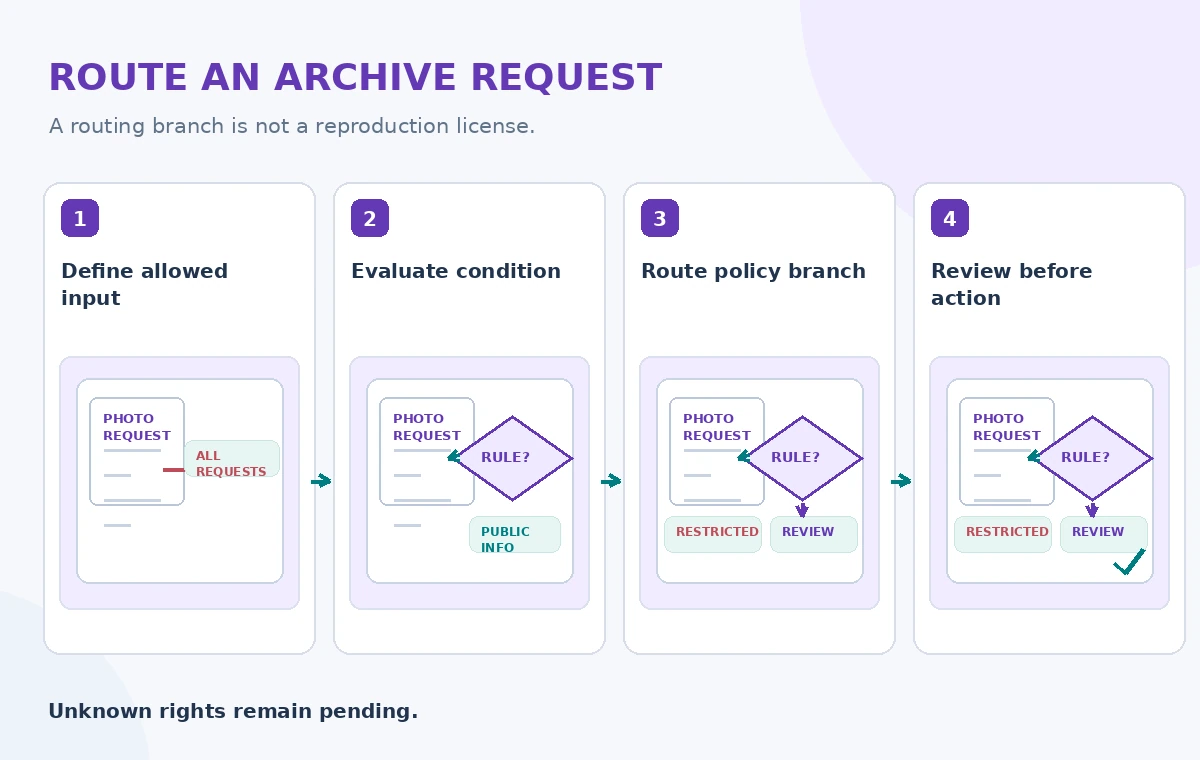
Do not derive permission from a generated summary of an email. If the request mentions a private donor, route that information through the minimum authorized service and avoid adding it to public prompts or logs. Record a stable request identifier separately from personal details. The process diagram shows this boundary before the Condition node because a neat branch after malformed input cannot repair missing facts.
Configure a Condition node with ordered expressions
AWS documents a Condition node with named inputs and expressions that compare values using relational and logical operators. If multiple conditions are satisfied, conditions are evaluated in order and the earlier match takes precedence. That detail is critical: a broad “archival image” condition placed first could catch a restricted record before the exception branch. Put safety-critical exception cases ahead of general informational routes.
Use clearly named outputs such as restricted_review, missing_metadata and public_terms, and wire them to downstream nodes with the appropriate capabilities. Each branch should lead to an understandable result. Test null values, inconsistent status strings and combinations that could match more than one condition. Never create an implicit permissive else branch merely to ensure every call produces a polished response.
Keep flow outputs inside an authorization boundary
A Condition node selects a path. It does not independently verify that a requester may see the referenced asset, and a language-model Prompt node cannot substitute for record-level authorization. Read-only retrieval should enforce collection permissions before returning any text. Keep email sending, license issuance and publication outside the flow unless a separate authenticated system and human approval explicitly authorize them.
For a fictional restricted photograph, the acceptable automated response might explain how to request a curator review, without exposing the private rights memo. A branch that reveals that memo but says “not permitted” has already failed. In tests, compare outputs for a general visitor and a staff account. A routing chart that shows the same protected document in both paths is not a valid access-control design.
Illustrate three outcomes without pretending to measure accuracy
The comparison diagram follows one imagined request through three conceptual designs: naive keyword routing, explicit exception-aware routing and an approved human outcome. These are examples of potential workflow states, not screenshots of Bedrock or observed error rates. The useful distinction is whether a rule sends an uncertain case to review, not whether the returned prose sounds confident.
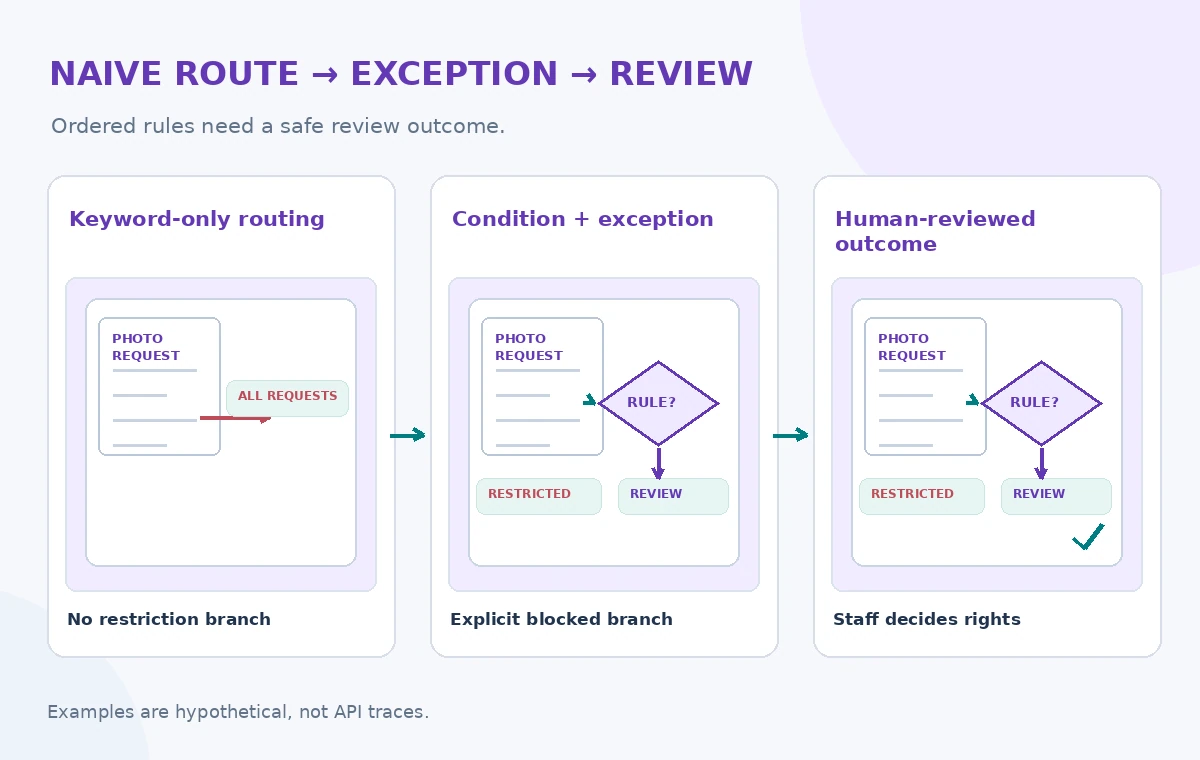
Maintain a short acceptance table: missing accession ID should ask for clarification; restricted status should halt public retrieval; allowed public-use status should link to an authoritative policy page; contradictory metadata should fail closed. If your rules require data not present in the request, return a pending state. Add a test where both a general condition and a restriction condition match.
Review flow versions and operational failure states
Changes to a condition’s order can silently alter outcomes. Store the policy owner, a versioned decision table and the flow definition together in change control. Run the test set when an input name, branch expression or downstream service changes. Before switching a production alias or integration, verify the currently documented AWS flow versioning and invocation behavior.
Network failure, quota errors and unexpected node output should not fall through to “approved.” Provide a safe error response that retains the request identifier and directs staff to a manual procedure. Avoid logging personal requests wholesale just to make debugging easier. Keep only access-controlled diagnostic metadata and a record of which policy version was evaluated.
Carry out a field-by-field quality review
The verification illustration calls out four checkpoints: schema validation, condition order, unknown-value handling and the no-auto-approval rule. Have a reviewer trace a synthetic restricted example by hand through every node. Then check that the same case cannot take a public path by altering capitalization, omitting a field or adding an instruction to free text.
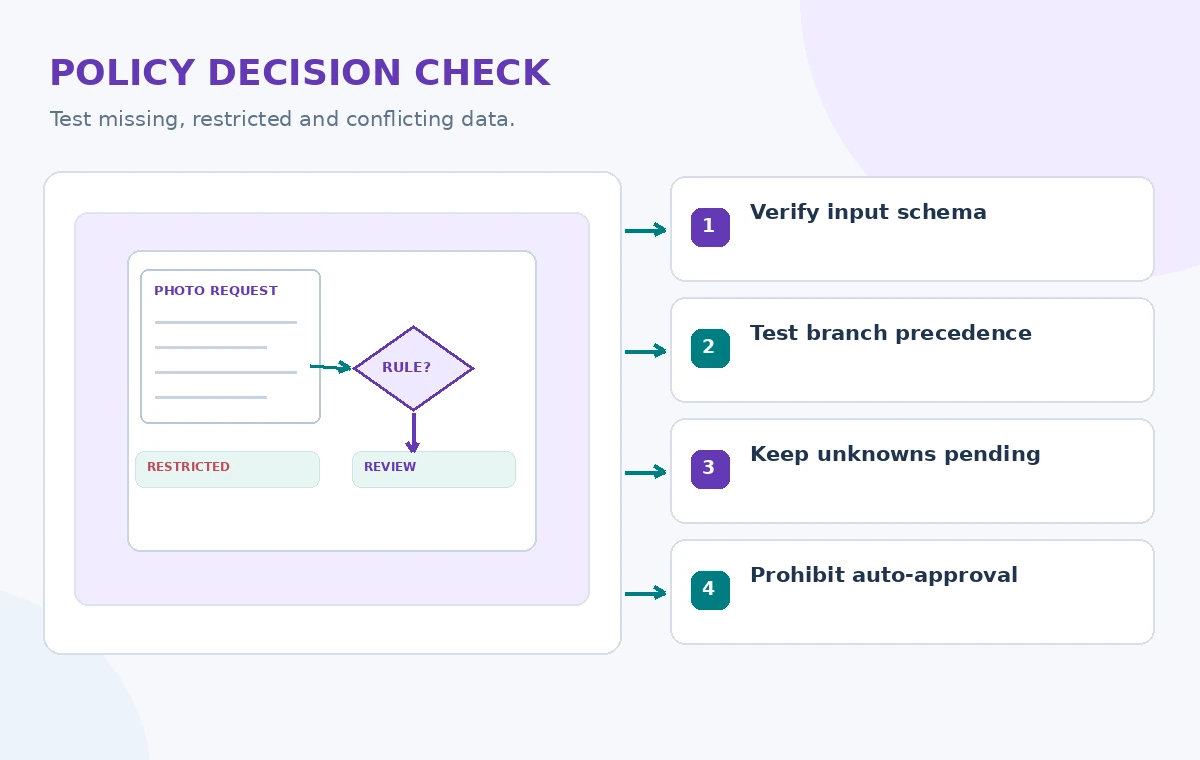
Ask the reviewer to explain each branch in ordinary language. A label like “true” on a Condition output does not explain which eligibility condition was satisfied. For any output that references a policy, include its approved revision identifier rather than a model-invented citation. Human reviewers should check the actual policy document and not simply trust the flow diagram.
Launch a routing assistant that remains reversible
A cautious rollout starts in a read-only or advisory mode. Compare each routed result with a staff classification before permitting automatic informational replies. Document a kill switch, escalation contact and rollback procedure. If a museum later changes donation restrictions, re-evaluate affected request categories rather than assuming old branch tests remain valid.
Flows are useful when a task has stable inputs and explicit branches. They are less suitable for granting ambiguous legal or curatorial permissions. Keep the underlying source of truth and authorized staff decision visible. An automated route can help a visitor reach the right desk more quickly; it cannot make an undocumented reproduction right appear.
How We Research
For this November 2026 editorial review, we consulted official vendor references: AWS Bedrock Flows node types; AWS example condition flow; AWS Flow overview. We mapped feature scope, input/output rules, failure conditions and developer guidance to a hypothetical community-service scenario. We did not execute paid API requests, upload private personal data, publish a real catalog record, run a security attack or measure service performance. The diagrams show original educational examples, not screenshots or recorded service results. Documentation, permissions, regional availability and service configuration can change; verify them in the current official reference and an authorized test before deployment.
Frequently Asked Questions
No. It evaluates configured expressions and routes data; a licensed staff process must decide copyright or reproduction permission.
AWS documents ordered evaluation: the earlier satisfied condition takes precedence. Test overlapping branches deliberately.
Only if the connected systems explicitly authorize that access. A flow branch is not a substitute for record-level permissions.
No. Missing or contradictory rights metadata should lead to clarification or authorized human review.
No. They are original instructional examples showing expected governance boundaries, not API test output.