
A community repair workshop is digitizing an old safety manual. A short handwritten warning sits in the page margin, next to a diagram of a damaged cable. If all text is flattened into one uninterrupted string, the warning may appear after the instruction it qualifies. Mistral OCR 4.1 can return paragraph-level structural blocks with bounding boxes and labels through `include_blocks`. This guide uses a fictitious manual page; no real workshop documents were uploaded or processed.
Keep the page image as the authority
Save the original scan, page identifier, scan date, source revision and permission to use the manual. A searchable derivative should never replace the image as the sole evidence for a warning. Preserve the page dimensions and orientation so reviewers can map machine-extracted coordinates back to the document. Rotate or deskew a working copy only with a documented transformation that does not silently change the original.
Prepare a small representative collection of pages with sidebars, two columns, diagrams, captions and faded marks. In a repair manual, “disconnect power” in the margin may apply to the step adjacent to it rather than to the following section. A fluent OCR paragraph can misplace that relationship. Select pages for review based on risk and layout complexity, not just which pages are easiest to read.
Use OCR 4.1 block extraction deliberately
Mistral documents `include_blocks=True` to return a `blocks` array for each page in OCR 4 or newer. Current OCR 4.1 models support structural labels such as `title`, `text`, `list`, `table`, `image`, `caption`, and `aside_text`. Each block includes box coordinates, a type and its extracted content. Older models may accept the parameter but return an empty block list; do not treat an empty array as proof of an empty page.
For reproducibility, record an explicit model version such as `mistral-ocr-4-1` rather than assuming the `mistral-ocr-latest` alias will always refer to the same behavior. Confirm the format of the input document and the applicable data-processing terms before uploading any privately held scan. If margins contain a person’s contact information, limit or redact it according to the archive’s policy before using an external service.
Match coordinates to the actual scan
Mistral block entries include `top_left_x`, `top_left_y`, `bottom_right_x`, and `bottom_right_y`. Overlay those locations on the exact processed page to show which text region was identified. When a scan is resized for a preview, scale both coordinates with the same image transformation; otherwise the rectangle can point at the wrong sentence. A bounding box is a detected region, not a statement that a warning is correctly associated with a step.
Inspect clipped boxes, overlapping columns and narrow margin notes. A block label of `aside_text` is useful context, but a safety reviewer must decide which instruction the note modifies. Retain page-level context and any nearby arrow, figure or numbered callout. A low-resolution preview alone can obscure a tiny negation such as “not,” so open the source scan at full working resolution when verifying text.
Build a four-stage scan-to-review handoff
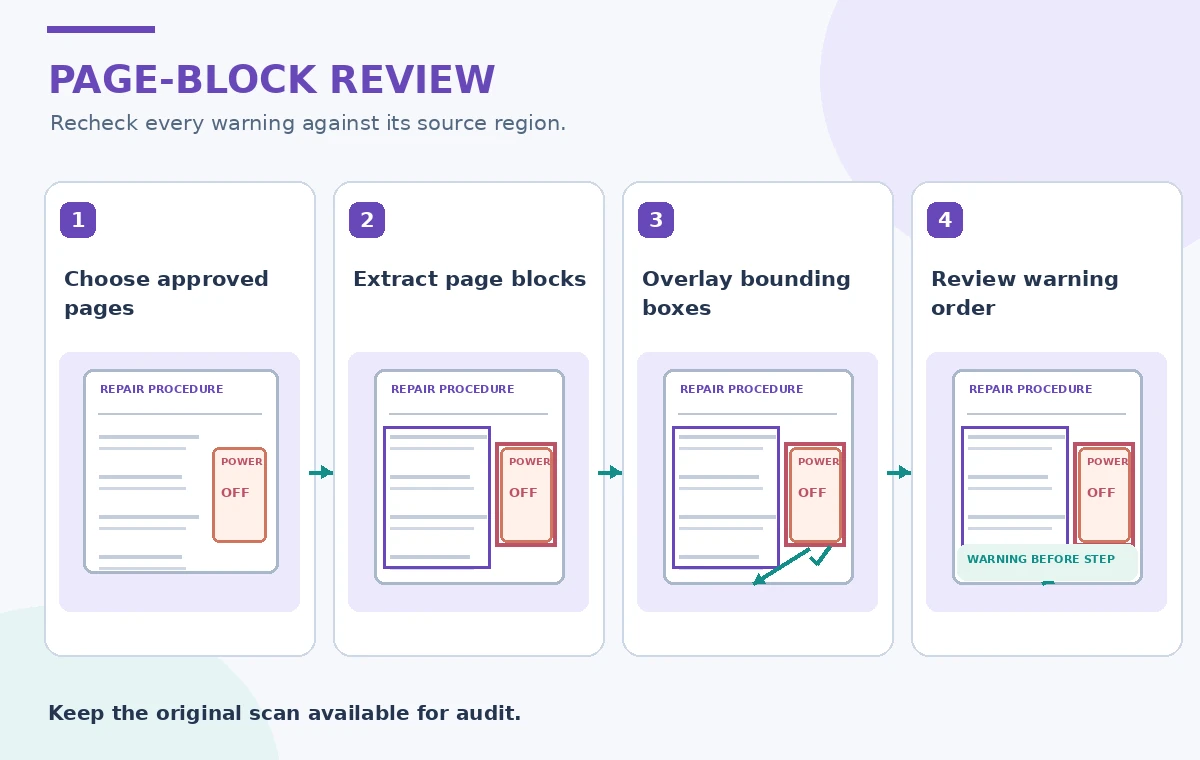
The workflow image moves from selecting approved source pages to block extraction, a box overlay, and a reading-order review. Put the original page on one side of the review workspace and a numbered list of extracted blocks on the other. Clicking a block should highlight its source region. This lets an editor compare both words and spatial relationships without trusting the model’s reading order uncritically.
For a hypothetical instruction, the central list says “Clean the terminal,” while the margin note says “Disconnect supply first.” Those fragments must not become an unsafe sequence. Preserve the warning with the relevant step in the searchable edition or link the two explicitly. A reviewer should be able to explain the association using the source page, not solely because the OCR system assigned matching labels.
Compare flattened text, extracted blocks and approved order
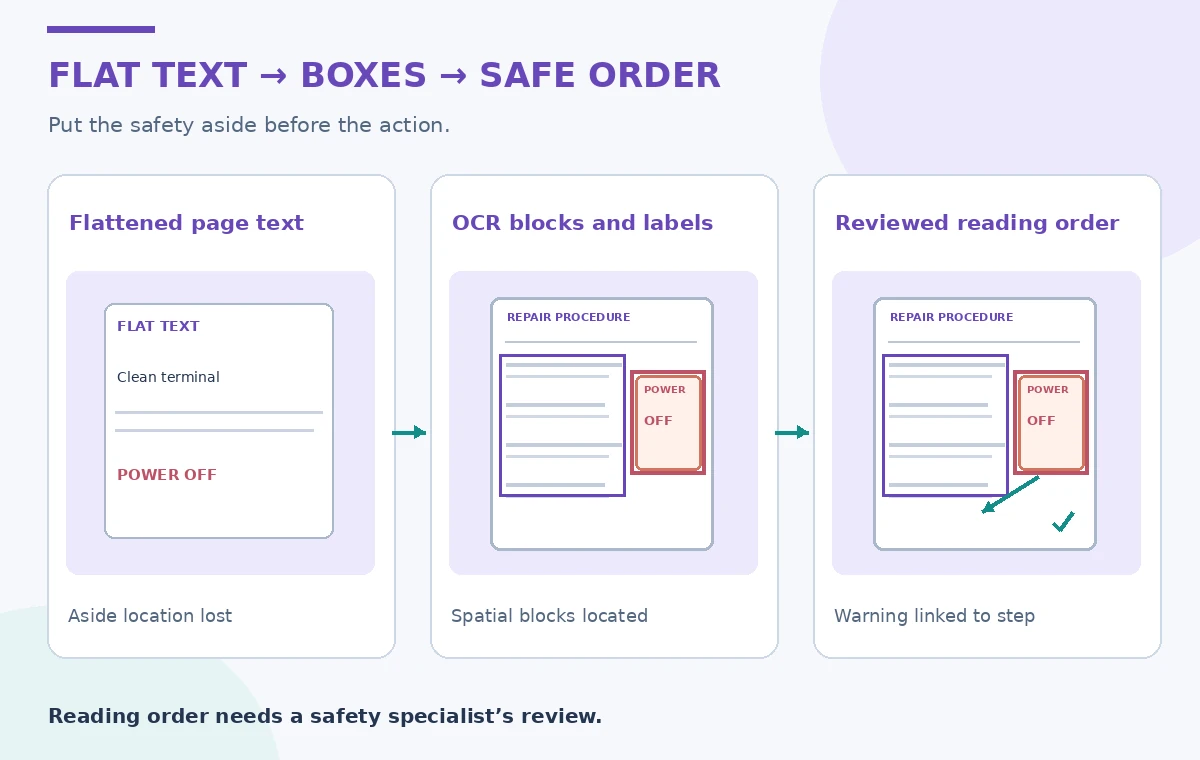
The first comparison state shows a flat transcript that loses the margin note’s location. The second shows a page diagram with separate block boxes and an aside label. The third shows a reviewed reading order with the warning placed before the action it qualifies. These are conceptual states, not Mistral screenshots or measured OCR results. The value of the graphic is the visible change in contextual linkage.
Do not silently “fix” unclear handwriting. If a number or negation remains ambiguous after zooming, retain the uncertain reading and ask a knowledgeable workshop reviewer to interpret it. A machine-extracted order is a starting point for editorial reconstruction. If a figure is damaged or missing, explain that limitation in the published derivative rather than inventing an intact step from surrounding prose.
Use confidence scores for triage, not certification
The Mistral OCR API supports `confidence_scores_granularity` set to `page`, `word`, or `block`. With block extraction and block granularity, output can include average and minimum content-confidence values and a block-type confidence. Some nontextual blocks have null content-confidence values. Those fields help prioritize review, but they do not verify safety, historical accuracy or the correct association between a note and a procedure.
Consider a high-confidence recognition of the word “disconnect” that has been inserted after a hazardous action. Recognition confidence does not correct the sequence. Similarly, a low-confidence caption may be important even if the main paragraph is clear. Set review priority using risk and source layout, not a single arbitrary score cutoff. Keep the confidence value as metadata rather than displaying it as a certainty badge on a public manual.
Check four source-preserving release points
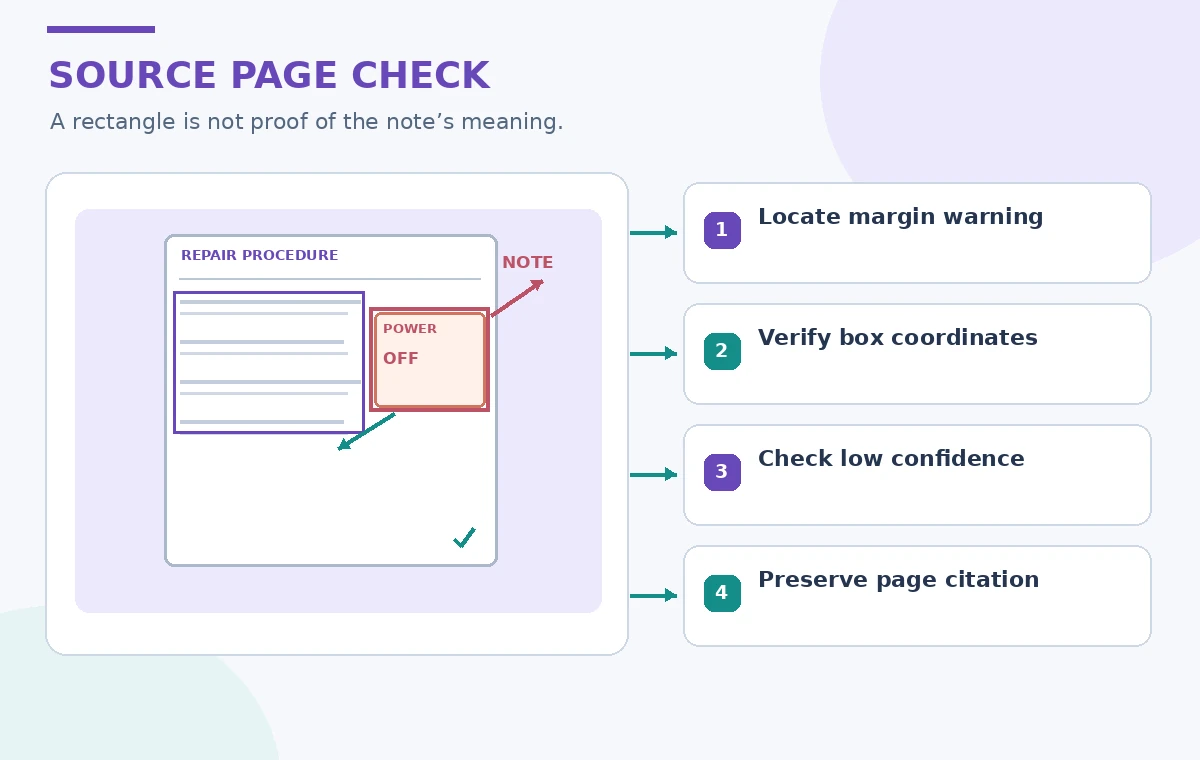
The verification scheme calls out the margin warning, block coordinates, uncertain content and page citation. Reviewers must locate the warning on the full scan, confirm that box coordinates correspond to the region shown, check words whose OCR output is questionable, and retain a way to open the original page. A corrected transcription should be recorded as an editorial revision, not disguised as original machine output.
For searchable chunks, store document ID, page number, block type, source coordinates and review status. Prevent unpublished or unlicensed source pages from being included in a public search index. A system that retrieves the instruction without its warning creates a new hazard even if the original OCR was accurate. Test the actual retrieval unit, not only the individual extracted paragraph.
Publish a readable and traceable derivative
Supply a clean transcript that places approved warnings with their associated steps, alt text for necessary figures, and a citation back to the scanned page where rights allow. For accessibility, reading order should make sense without seeing spatial boxes. Let editors flag disputed words and return to the source image. Keep the OCR model, parameters, page revision and reviewer in internal records without printing technical model metadata inside every public diagram.
OCR 4.1 block extraction can reduce the manual effort of locating page regions, but it cannot certify the safe use of workshop equipment. The final maintenance or safety instructions require an appropriate subject-matter review. For a single page with a critical handwritten note, careful human transcription may be safer than automating an entire pipeline. Use OCR where its structure helps review rather than where it merely produces more text.
How We Research
For our November 2026 source review, we consulted these named official developer references: Mistral Document AI OCR processor; Mistral OCR 4.1 model description; Mistral OCR API reference. We compared published feature scope, technical parameters, product restrictions and operational caveats with a fictional museum, archive or community-service example. We did not run paid API calls, test a live deployment, measure recognition quality, upload private documents or capture actual vendor screenshots. The 20 illustrations in this batch are original schematic teaching drawings, not measured model output. Service availability, terms, model versions and prices may change; verify the latest official documentation, permissions and an authorized local test before public deployment.
Frequently Asked Questions
No. Mistral documents structural block extraction for OCR 4 or later; older models can return an empty blocks array.
No. Boxes locate detected regions, while a human reviewer must establish the note’s meaning and relationship to nearby steps.
No. Confidence describes model extraction signals, not the correctness of safety procedures or reading order.
Keep at least document ID, page, coordinate region, recognized text, review status and source revision.
No. Preserve access to the original page where permitted so unclear words and spatial relationships can be audited.