
A hypothetical city museum receives a visitor note: ‘The gallery guide was excellent, but the coat check was slow.’ A single positive or negative label for the whole comment would hide the distinction that staff need. Amazon Comprehend Targeted Sentiment identifies entity mentions and associates sentiment with those mentions in supported text. Its output can help route feedback toward the correct team, but it does not determine whether a complaint is true, fair, urgent, or attributable to a particular employee.
Define the decision before using sentiment
Separate the museum’s questions into service improvement, safety escalation, and individual complaints. For this example, a curator wants to count mentions of a gallery guide and coat check separately, while the visitor-services lead wants to read any comment about a broken accessible entrance immediately. These jobs have different risks. A sentiment score must never be the sole signal for an accessibility incident or personnel decision.
Draft a taxonomy using names visitors actually say: ‘coat check,’ ‘cloakroom,’ and ‘bag desk’ might refer to one service, whereas the café and gift shop have separate managers. Keep those mappings as museum-controlled metadata. Do not assume the model knows the organizational chart. Define a route for ambiguous or unnamed subjects rather than forcing each sentence into an attractive dashboard category.
Understand the targeted sentiment output
AWS distinguishes overall document sentiment from targeted sentiment at the entity-mention level. The DetectTargetedSentiment response contains entities with mention spans, entity types, confidence values, and a sentiment label and scores for each mention. Mention groups can connect co-references, but a group should be checked before merging remarks about different people or locations. The capability is documented for English-language text.
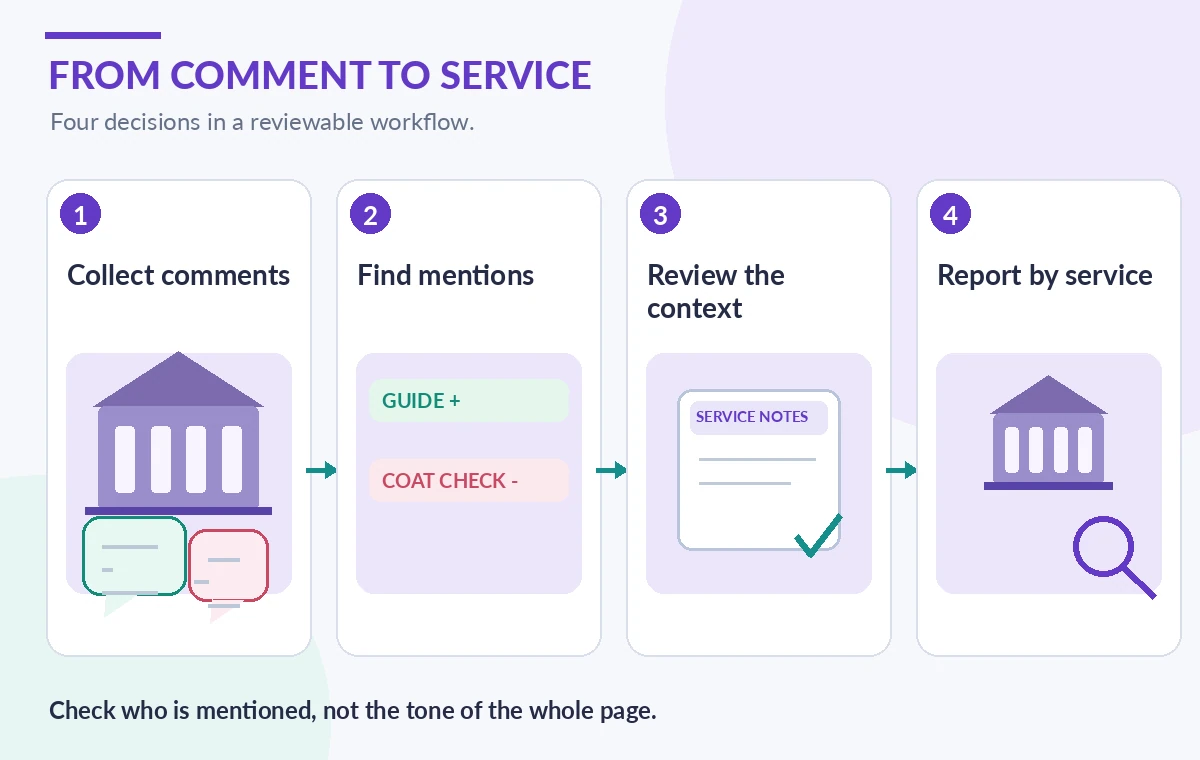
A synchronous API request supplies text and a language code; the documented per-request text limit is 5 KB. Larger feedback collections need a compatible batch or asynchronous approach, with an explicit record of source order and failures. A successful response is structured data, not evidence that the museum met a service standard. Preserve the original submitted wording so human staff can inspect what each offset and label refers to.
Prepare a minimal feedback sample
Use fictional examples in training and send only feedback that the museum is authorized to process. Remove unnecessary email addresses, phone numbers, membership IDs and precise visit times before any external analysis. Record which text edition was evaluated; even normalizing punctuation can shift character offsets. Keep private originals in a controlled system and pass a reduced excerpt when a legitimate purpose allows it.
Build several balanced examples: explicit praise, mild criticism, a mixed sentence, a quoted third-party opinion, and a comment with no recognizable entity. Add the phrase ‘not terrible’ to test negation and an indirect pronoun such as ‘it’ after a named service. Mark an expected routing outcome for each example before the model is run. These labels are training fixtures for a reviewer, not model evaluation results reported by LabFin.
Map each mention back to a real service
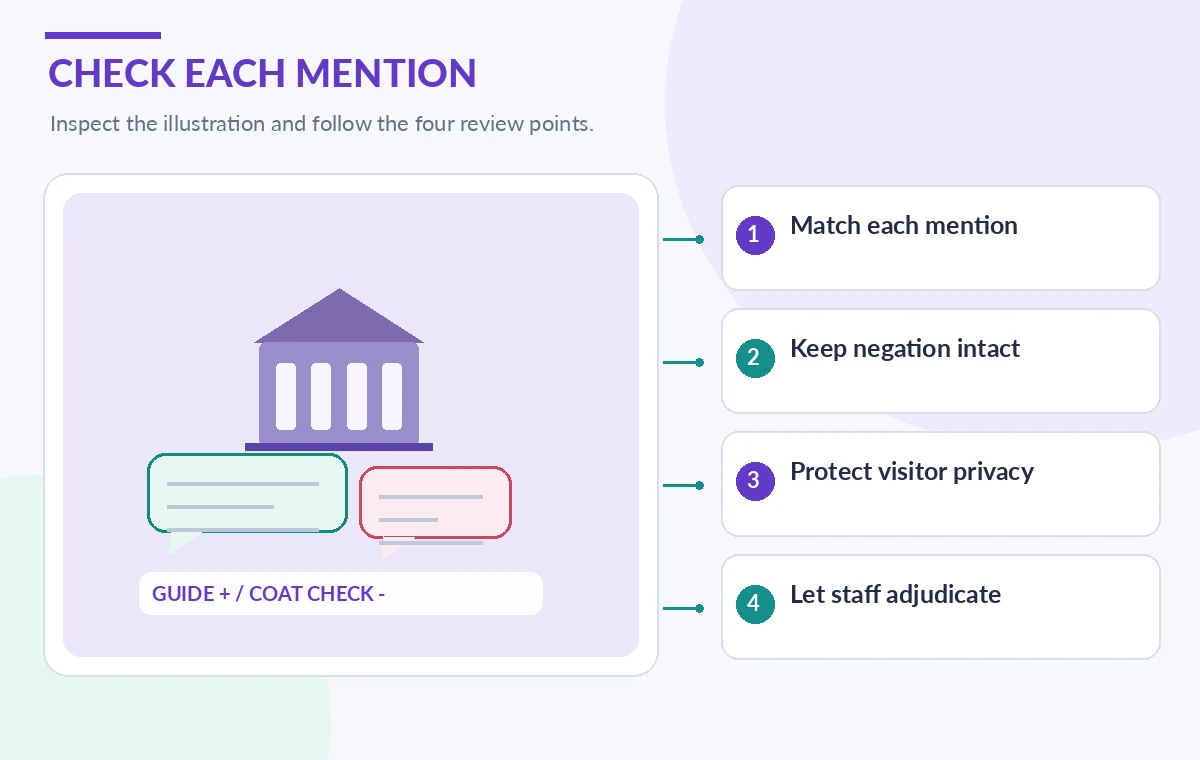
Treat output offsets as pointers into the exact analyzed text. Display the highlighted phrase beside the neighboring sentence, the original visitor wording, and a tentative service mapping. For ‘the guide was excellent, but the coat check was slow,’ a useful review screen should show two separate mentioned subjects and not decorate the entire note with one red or green score.
If an entity name is missing, duplicated or confused with a person, mark it unresolved. For example, ‘Jordan was helpful’ could name an employee, a visitor or part of a place name. Staff can consult available, appropriately permitted context, but they should not infer an individual’s identity from a model’s entity type. Preserve the difference between a model-detected mention and a museum-confirmed service.
Compare overall tone with entity-level evidence
An overall sentiment panel may say MIXED and still fail to answer which part of a visit worked. Targeted analysis can display separate candidate labels for coat check and guide, but the review stage must read every relevant clause, especially contrast words like ‘although’ or ‘except.’ A quoted complaint from an earlier review should not become a new visitor’s direct assessment.
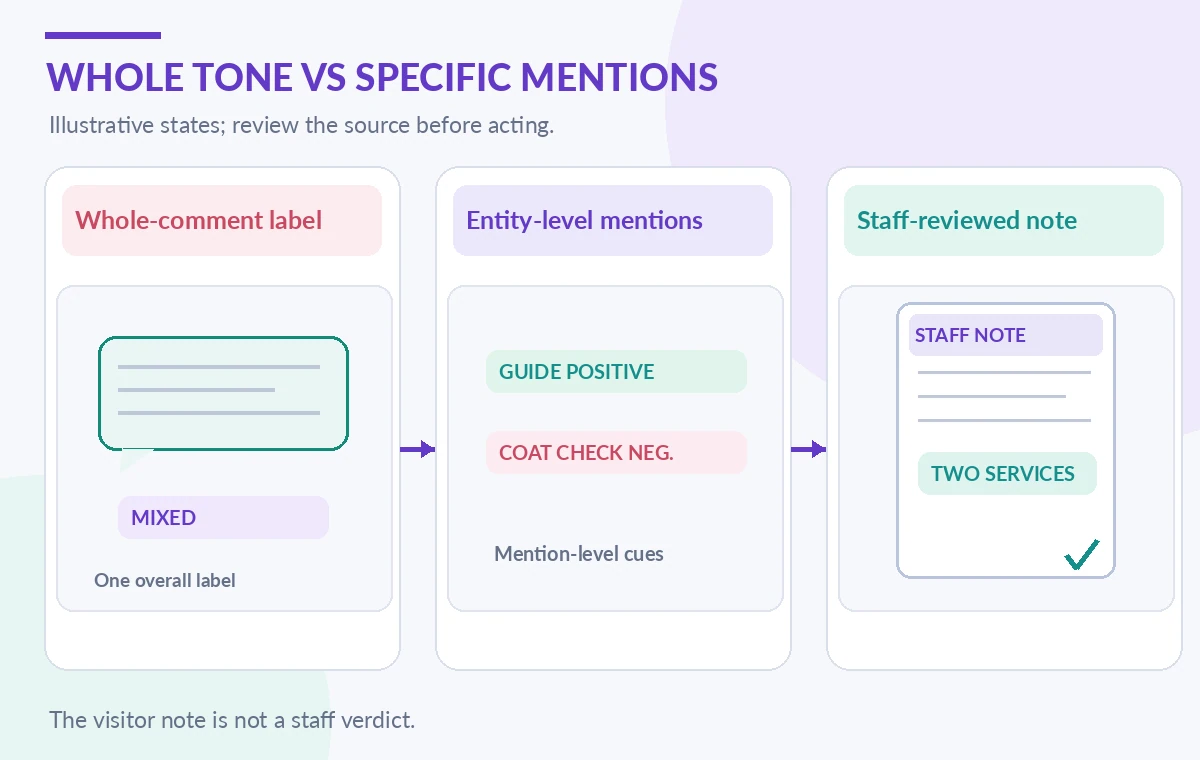
Use a conceptual three-state comparison: one whole-message label, two service-specific annotations, and a staff-approved case note. The third state should add attribution and context rather than simply making sentiment look more positive. Do not draw invented accuracy numbers or claim that the intermediate model output was produced by a live AWS call; this article provides an instructional scenario only.
Handle negative feedback without punishing people
A service-level critique can help decide where to improve staffing, signage or opening procedures. It is not a reliable employee performance score. Group small counts cautiously: exposing one negative note about a volunteer on a particular shift may reveal the writer or the person criticized. Summarize themes without publishing personal identifiers, and keep any escalation connected to the original complaint and applicable policy.
Invite staff to review comments the model mislabels. Sarcasm, culturally specific phrasing, a double negative or a note copied from a friend can reverse the intended meaning. Offer a plain-language way for a visitor to correct a recorded comment. When feedback raises immediate safety or accessibility concerns, a person should read it promptly regardless of whether Comprehend returned neutral or positive sentiment.
Evaluate mention quality rather than inventing scores
Create a small, consent-appropriate offline review set covering the actual vocabulary of visitor services. Have two reviewers independently mark subject spans, service mapping and intended sentiment, then resolve disagreements before comparing automated suggestions. Measure missing entities, incorrect co-reference links, wrong service mapping and missed negations as separate errors. A single aggregate accuracy figure would conceal the operational problems that matter.
Keep the evaluation tied to an immutable sample revision, input language, API settings and human rubric. If the organization later changes its public services, update the mapping and tests. A model’s confidence can help prioritize inspection, but low confidence does not establish a negative statement is harmless. Do not silently discard empty Entities arrays; they are an expected documented outcome for text without supported targeted entities.
Publish only defensible service insights
Before releasing a quarterly report, compare the labeled themes against the raw comments and remove or aggregate rare identifiers. Use wording such as ‘reviewed comments about coat check’ rather than ‘the AI proved coat check is poor.’ Include response volume, dates and caveats so readers understand which visitors submitted comments and which did not. Avoid implying that detected mentions form a representative survey.
Name a staff owner for corrections and an access-controlled route back to the original feedback. Retain only what the institution needs under its privacy schedule. The practical value of targeted sentiment is a better review queue and better-organized evidence—not automated judgment about the museum’s reputation, its visitors, or its workers.
How We Research
For our November 2026 editorial review, we consulted the named official developer sources: AWS targeted sentiment guide; AWS DetectTargetedSentiment API. We compared documented feature scope, parameters, supported inputs, workflow boundaries and important failure cases with a hypothetical, nonproduction museum or library scenario. We did not run paid API calls, access personal visitor records, independently benchmark model quality, conduct a real deployment, capture vendor interface screenshots or verify a particular institution’s permissions. All figures are original conceptual instructional drawings, not live results. Readers should verify current documentation, plan limits, regional availability, prices and applicable data policies before a trial.
Frequently Asked Questions
Its distinguishing feature is sentiment attached to recognized entity mentions; whole-document sentiment is a different analysis.
No. AWS currently documents targeted sentiment for English; check current supported-language documentation before processing multilingual feedback.
No. An entity mention and sentiment score do not establish identity, causation or employee performance.
Treat an empty Entities array as a possible result. Route the comment to an unclassified queue rather than inventing a label.
Only after careful context review, aggregation, privacy checks and a documented sampling methodology.