
A community radio producer has a recorded conversation involving a host, a guest, and a short telephone interruption. Before creating searchable show notes, the team needs to distinguish who spoke when. Deepgram speaker diarization assigns speaker identifiers to transcript words; the utterances option groups text into readable spans. Neither feature inherently knows the real-world identity of a voice. This guide designs an editorial listening process using hypothetical audio and diagrams, without claiming that any real recording was processed.
Decide whether this is diarization or multichannel audio
If the host and guest were recorded on genuinely separate input channels, channel identification may provide useful separation without inferring speakers from a mixed waveform. If they share a mono interview file, diarization is the relevant task: estimating which segments belong to which speaker. Capture the recording format, number of channels, room noise, overlapping dialogue, and any remote caller patch before selecting parameters. Do not collapse a two-channel master into mono unless the editorial workflow needs that format.
The goal is usable attribution for transcription review, not voice authentication. Label each contributor with a provisional identifier and keep the consent and identity records outside the speech model. If a participant asked to remain anonymous, speaker separation does not grant permission to publish their name. The public transcript policy should be settled before transcription starts.
Use the current diarize_model parameter
Deepgram’s current documentation recommends `diarize_model` to enable and select a diarizer version. The legacy `diarize=true` option is deprecated and routes to the v1 diarizer. `diarize_model=latest` resolves to the currently supported general-availability diarizer for the request type; documentation presently distinguishes batch v2 from streaming v1. For reproducible archive work, a compatible pinned model and preserved metadata may be more useful than a moving ‘latest’ alias.

Do not request `diarize_model=v2` on streaming because the documented feature rejects that combination. Avoid specifying both `diarize` and `diarize_model`, which is also rejected. The precise model availability, billing, deployment constraints, and compatibility should be rechecked in the API docs before recording an implementation recipe in production.
Pair speaker labels with utterances and timestamps
With prerecorded audio, diarized word objects can include a `speaker` identifier and `speaker_confidence`. Deepgram’s utterances option produces segment transcripts, start and end times, and may include the corresponding speaker. Configure `utterances=true` when you want manageable editing units. Punctuation is useful for readability but is not evidence of the original speaker’s intent. Retain the original word-level timestamps so an editor can navigate to a disputed turn rather than trusting a polished paragraph.
For the radio scenario, a segment marked Speaker 0 might be the host, but establish that mapping by listening to known introductions or a documented cue sheet. Then record ‘Speaker 0 = host, reviewed by editor’ as an attribution decision. If the voice changes unexpectedly, mark a possible mislabel and keep the raw model tag visible in review tools.
Review overlapping speech and telephone inserts
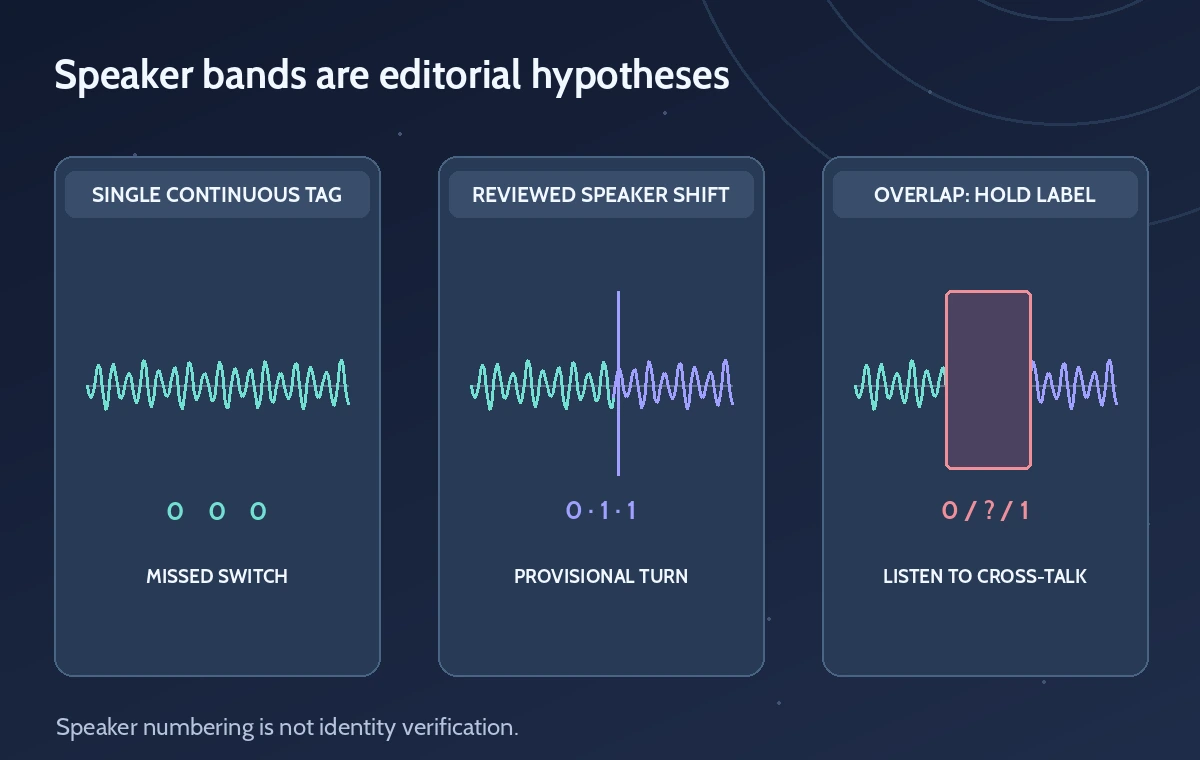
A producer should pay special attention when the host interrupts the guest, two people laugh simultaneously, or a phone voice enters mid-sentence. Automatic diarization may merge short interjections, split one speaker into two labels, or assign words to the wrong person. A waveform with colored speaker bands can reveal suspicious handoffs, but the colored boundary is a visual hypothesis until someone listens to the source. Compare the audio over a few seconds on both sides of every doubtful transition.
The recorded phone caller might sound dramatically different because of compression, yet still be a third real speaker. Conversely a distant microphone can make one person sound like a new speaker. Maintain an ‘unknown speaker’ state when there is insufficient evidence. Do not force all segments into two named identities merely because the program has two advertised guests.
Interpret metadata and absent labels safely
Deepgram documents a `diarize_info` metadata object when a diarizer actually runs, including model architecture information. This matters if a batch system used a moving model alias or a self-hosted environment does not have the requested model. An absent `diarize_info` block when diarization was requested may mean it never ran; it is not proof the audio contained only one voice. Check model support and request diagnostics before treating unlabeled words as a single speaker.
Speaker IDs are not universal across files. Do not assume Speaker 0 in episode 12 is the same person as Speaker 0 in episode 13. Match identities using reviewed recording context, never numeric sequence. Store the request configuration and raw response in a restricted editorial workspace, then expose only the reviewed output publicly.
Create a focused listening and correction pass
Build a review queue for the first voice turn, every model-detected change, low-confidence words, telephone entries, cross-talk, and speaker names spoken aloud. Play each passage with enough lead-in to hear phonetic context. Correct speaker assignment and text independently; a correct transcript word can still have the wrong speaker. Track reviewer decisions by timestamp and revision so a later edit doesn’t silently undo them. Spot-check calm stretches too, rather than sampling only the obvious errors.
Keep corrections as an overlay to the source metadata. A producer may need to re-export captions or quotations; maintaining the relation to original timestamps prevents drift. Avoid publishing speaker confidence as a biometric certainty score. The purpose is editorial traceability, not a diagnostic about an individual voice.
Prepare a release-ready transcript without overclaiming
Generate a transcript with reviewed names or anonymous labels, timestamps as appropriate, and a disclosure of substantial omissions where editorial policy requires it. Get participant permissions and apply any radio archive restrictions. Validate that the captions match the edited audio version rather than the raw recording if segments were removed. A final listening session should include the introduction, each uncertain handoff, and the ending sponsor or attribution material.
Use fictional speaker-turn fixtures to test API integration, including three speakers, interruptions, and missing `diarize_info`. No recognition accuracy or latency numbers are claimed in this article. Recheck product and regional data terms, model selection, and current pricing before introducing real interviews into the processing system.

How We Research
For this November 2026 source review, we consulted the named official references: Deepgram Docs: Speaker Diarization; Deepgram Docs: Utterances. We checked the documented inputs, response structures, eligibility or compatibility details, and explicitly described failure modes for the named feature. The tutorial scenarios and original diagrams are hypothetical editorial examples. We did not log into a vendor account, send private files or real recordings, purchase a subscription, execute a production API request, or measure model output, error rates, price, latency, accuracy, or licensing outcomes. No screenshots or quantitative visual results are represented as real service results. Current plans, model availability, limits, source retention, regional availability, and privacy terms should be rechecked before implementation. Legal permissions, speaker identities, private-data releases, and equipment-safety decisions require separate authoritative records and human approval.
Frequently Asked Questions
No. It is a model-assigned identifier within a result. Map it to a real person only after listening and checking source context.
Deepgram currently describes `diarize=true` as deprecated and recommends the `diarize_model` selector instead.
Not according to the current speaker diarization documentation; v2 is batch-only and streaming requests for v2 are rejected.
It groups speech into segments with transcripts and timing information that support editing; it does not authenticate speaker identity.
No. When diarization was requested, an absent block can mean the diarizer did not run. Check deployment and request configuration.