
A museum repeatedly asks an assistant to draft labels from approved collections notes. The same long editorial style guide is attached to each request, so a cached context could reduce repeated input work. But the museum has just changed its rule for describing uncertain dates. Reusing yesterday’s cached guide might reintroduce wording the editors already rejected. Gemini’s API documents implicit caching and an explicit cache-object workflow; the safest use depends on document revisions, not only speed or token savings.
Decide what belongs in reusable context
Separate stable guidance from exhibit facts that change every day. Candidate cached material includes an approved tone guide, allowed terminology, accessibility rules, and citation style. Keep object-level dates, provenance, disputed attributions, and curator corrections in a separately versioned retrieval source. A model should never treat a broad style guide as permission to invent details about a specific artwork. First record exactly which revision staff approved.
In this illustrative workflow, style-guide revision SG-07 permits approximate dates only when marked ‘circa.’ Revision SG-08 adds a rule to avoid turning catalog uncertainty into a precise year. Those are invented examples, not genuine museum policies. Assign a content digest or revision identifier to the approved guide, and keep the authoritative text accessible for an editor who needs to compare outputs.
Distinguish implicit caching and explicit objects
Google describes implicit caching as an automatic optimization for supported Gemini models, while explicit caching creates a named cache resource that the application can refer to in later calls. A cache hit is not a content-accuracy signal. For this guide’s explicit workflow, use the compatible generateContent API; the current documentation says the Interactions API supports implicit caching but not manually managed explicit cache objects.
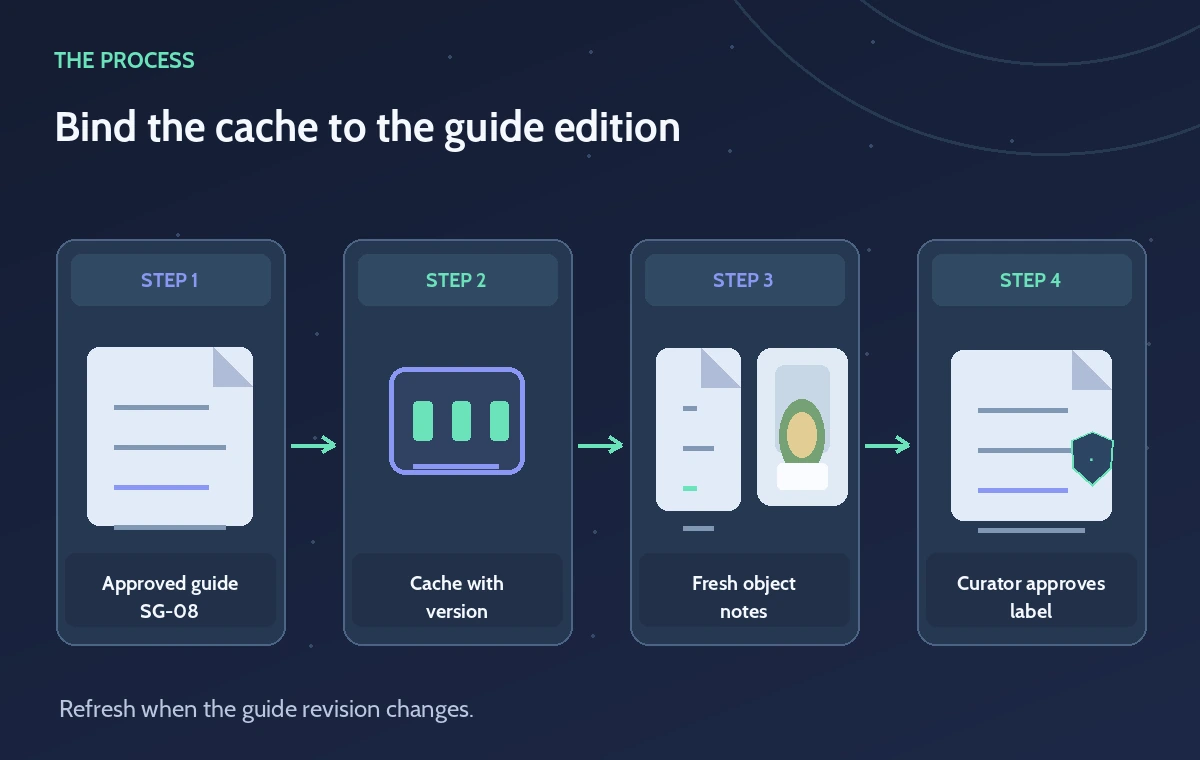
Choose explicit caching only when the fixed material is large and repeated often enough to justify lifecycle management. A short caption request might be cheaper and simpler without a cache. Avoid general promises of savings: model eligibility, minimum token requirements, token pricing, storage duration, and actual reuse volume affect the economics. Check the current model-specific rules rather than assuming every Gemini endpoint shares identical behavior.
Create a revision-bound cache with a clear owner
Create the cached content from the reviewed style-guide edition, using a supported model and the documented cache creation method. Record the cache resource name, model, guide revision, creator, and when the cache expires. Google documents a TTL field and an expiration time on cache resources; the default lifetime described for explicit caching is one hour if not set. Choose a retention period that fits the editorial release window.
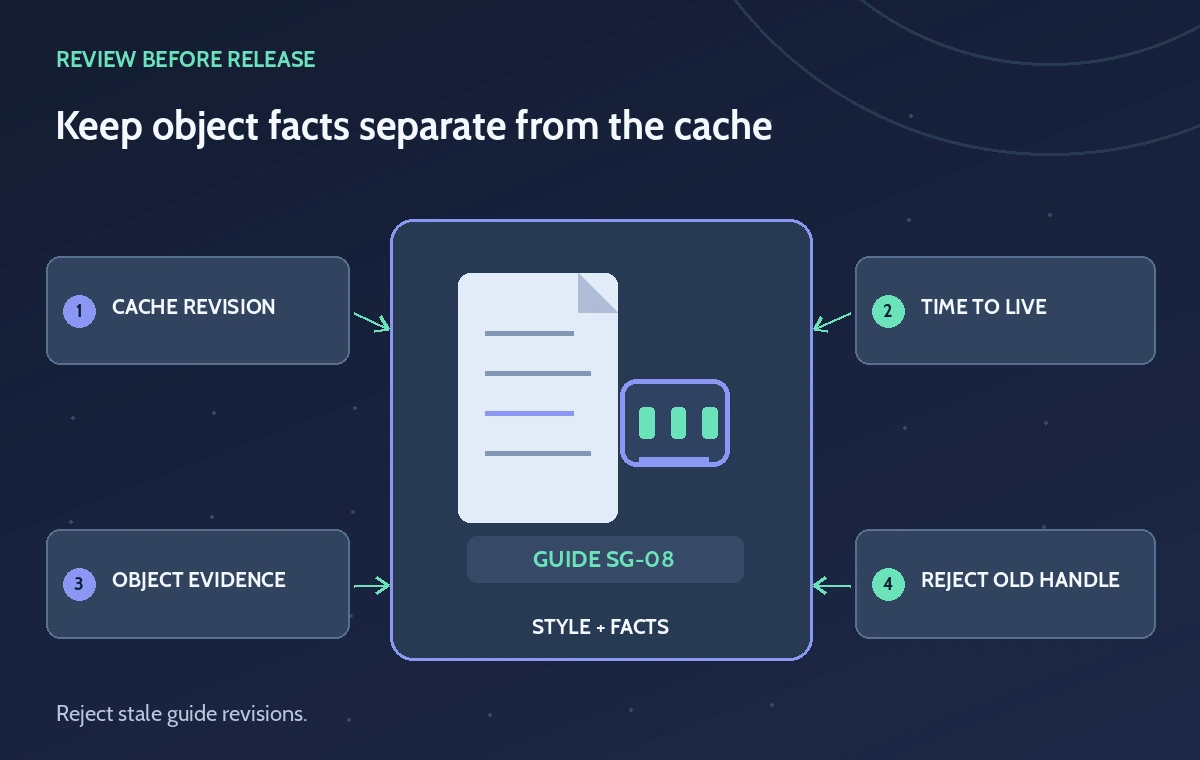
Treat the cache name like an implementation handle, not a publication citation. In an audit record, store the source document’s revision and digest alongside the handle. The displayed museum label still requires a citation or catalog reference to the approved source, even though cached tokens may contain a style guide. If the cache expires, the request should create a new cache from the current approved guide or fall back to a controlled noncached path.
Attach current object facts to each caption request
For a hypothetical painting, pass the approved object ID, curator note, and verified uncertainty statement in the fresh per-request content. Ask the model to write a short caption that preserves that uncertainty and follows the cached style guide. Do not put internal private donor records, unpublished acquisition negotiations, or unlicensed images into a cache simply because they are frequently referenced.
Keep a hard boundary between the style instructions and object-specific evidence. If the object notes say ‘probably 1910s,’ the caption should not assert ‘1912’ just to sound polished. A reviewer should compare each factual assertion with its cited catalog record. Cached tokens save repeated context transfer; they do not validate a date, title, ownership claim, or attribution.

Invalidate the old edition instead of trusting TTL alone
When editors approve SG-08, stop referencing the SG-07 cache immediately. Create a new cache from the current text and update the application’s revision-to-cache mapping in one controlled change. Cache expiration only limits how long a resource exists; it cannot guarantee an old version won’t be called before its deadline. Add a revision check before generation that rejects requests using outdated editorial instructions.
Use a conspicuous test sentence that changes between the guide editions. A review screen can show ‘SG-07: exact year permitted’ versus ‘SG-08: keep circa if uncertain’ and require the current rule to survive in the draft. These labels are schematic examples, not observed Gemini output. Record the correction and invalidate dependent drafts if an old edition was used in public material.
Plan access, billing, and retention separately
Before enabling caches, confirm which staff and service identities can create, list, update, and remove cache resources. Document how temporary material is handled, how long inputs are retained, and which vendor terms govern the selected Gemini API. Do not assume a short TTL is equivalent to immediate deletion of every downstream trace or a guarantee that no personnel can retrieve the underlying source elsewhere.
Google documents that explicit cache usage has token and duration considerations. Estimate reuse using realistic traffic, and compare a reference run without caching to one with the same approved guide; do not invent cost or latency improvements. Keep expiration alerts and cleanup tasks separate from publication status. A draft label is still pending approval even if it was generated from the latest cache.
Run a release test that catches stale instructions
Before publishing, test a currently approved object record, an object with conflicting dates, an absent source, and a stale-cache handle. The expected result for a stale handle is a controlled rejection or regeneration from the current guide, not a silent guess. A curator reviews language, citations, object identity, image description, and accessibility. The production system should log guide revision without storing unnecessary private object notes.
This is a design based on Google’s developer documentation, not a live Gemini cache or benchmark. Verify the API surface, SDK methods, minimum cache token rules, pricing, and data practices before deployment. Treat a cache as an operational optimization whose correctness depends on revision governance and human editorial approval.
How We Research
For this November 2026 guide, we consulted the following official product documentation: Google AI for Developers: Gemini context caching, Google Gemini API: CachedContents reference. We checked the named feature’s documented request patterns, eligibility or platform limitations, and failure modes, then designed an editorially hypothetical workflow that tests the source-to-output handoff. This was a documentation review, not a hands-on evaluation: no paid service was accessed, no account was connected, no live media or source data were uploaded, and no timing, costs, recognition scores, model-generated text, or real screenshot results were measured. The original diagrams illustrate design decisions rather than actual vendor interfaces or product output. Readers must recheck API and plan availability, price, data processing terms, and regional limits before implementation. Source records and authorized human review remain necessary for any release or consequential decision.
Frequently Asked Questions
No. Google currently documents manually managed explicit cache objects with generateContent rather than the Interactions API.
No. A cache reuses context. It does not verify truth, provenance, policy compliance, or current approval.
Google documents configurable TTL and expiration fields, with a one-hour default when no explicit TTL is supplied.
Stop using the prior cache handle, create a cache from the new approved revision, and reject stale requests.
No. Factual object statements still need versioned catalog evidence and curator review.