
OpenAI Realtime Semantic VAD addresses a specific design risk when AI-assisted workflows meet real records and real people. This guide works through a hypothetical community organization example, showing what the documented feature does, what it does not prove, and where human review belongs. The examples use invented names and identifiers; we did not conduct product tests, inspect customer data, or measure results. The four diagrams are schematic teaching images, not vendor screenshots or records of a successful deployment.
Use a pause-sensitive visitor question as the design test
Imagine a museum kiosk serving a visitor who asks, “Where is the accessible entrance … if the main door is closed?” The pause before “if” is normal thinking time, not a finished request. A system that answers immediately may direct the visitor to the wrong entrance.
Write the full approved question and expected safe reply before choosing audio settings. Keep the actual accessible-route information in a maintained museum source; voice turn detection cannot verify route accessibility. This is a fictional kiosk design exercise, not a recorded trial with museum visitors.
Distinguish semantic VAD from silence-based turn detection
The Realtime API documentation describes two turn-detection modes. Server VAD uses acoustic activity and pauses, with configurable threshold and silence duration. Semantic VAD considers whether the utterance appears complete and varies the wait accordingly.
Neither mode reads the visitor’s mind or guarantees that a pause means a sentence has finished. For this kiosk, the goal is to avoid answering a question about an entrance until the qualifying clause is spoken. Compare the two modes using the same scripted examples, while noting that real rooms and microphones will behave differently.
Configure the mode using the documented session field
In a supported Realtime conversation session, the developer can update session.audio.input.turn_detection with type semantic_vad. The optional eagerness setting accepts low, medium, high, or auto; the documentation explains that low generally allows more time for an utterance to continue.
Do not reuse the server_vad-only threshold or silence_duration_ms knobs as if they controlled semantic VAD. Verify the selected model and session type first: some transcription models require turn detection to be null, so blindly copying a speech-to-speech configuration can fail or mislead. Store the selected configuration beside test-case results.

Trace the visitor’s words through the response boundary
Draw a flow with four stages: microphone audio, detected utterance, full question, and kiosk reply. The process diagram shows the hypothetical pause in the middle of the question, not a live waveform measurement.
Record speech-start and speech-stop events when supported and relate each to the transcript or observed phrase. A speech-stop event is a turn-handling signal; it is not proof that a museum policy was checked. When the transcript is incomplete, the appropriate response may be to invite the visitor to finish rather than guessing the route.
Choose interruption behavior deliberately
In Realtime speech conversations, create_response and interrupt_response affect automatic replies and whether incoming speech interrupts ongoing assistant audio. These settings are not equivalent to transcription-only chunking.
In a noisy entrance hall, a nearby conversation may unintentionally start another turn; during a deliberate visitor correction, interruption can be useful. Test an interrupted response with a short phrase such as “Wait, I meant the north door.” Never assume the model’s prior answer continues to be reliable after that correction. A visible replay or restart control gives visitors a nonverbal recovery path.
Compare a false finish with a complete question
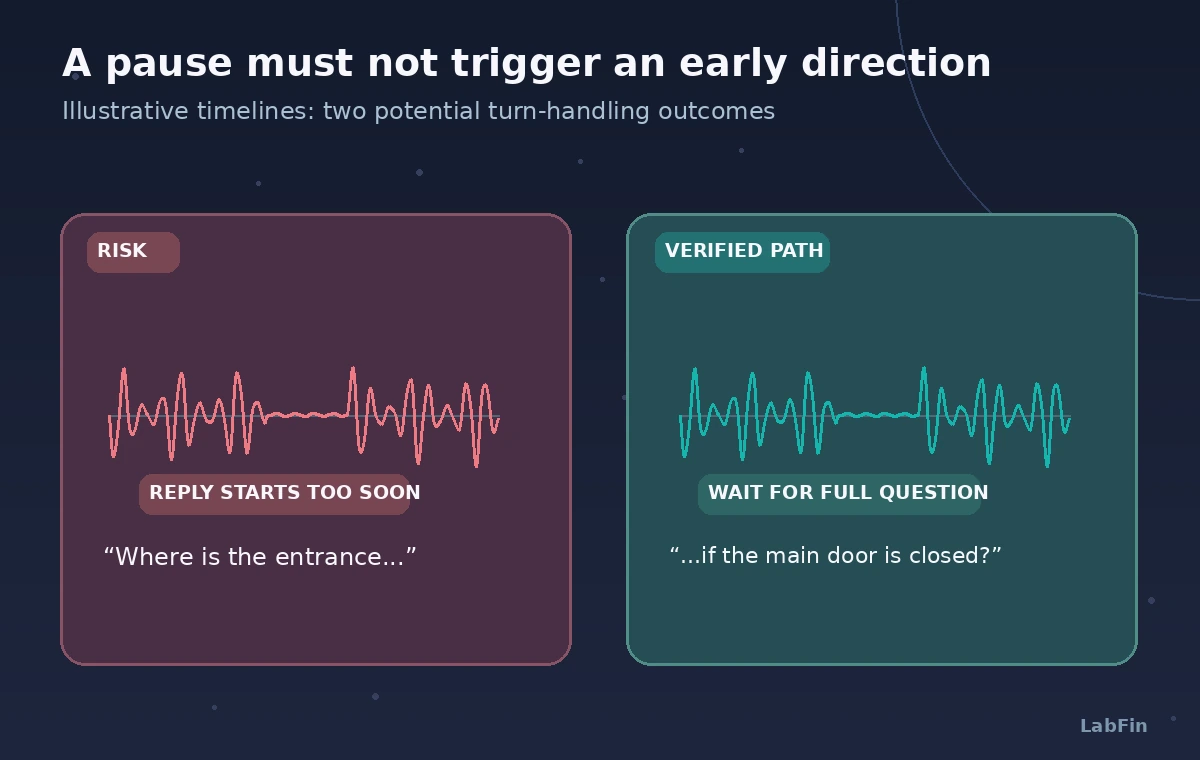
The comparison illustration uses the same fictional sentence in two timelines. On the left, an assistant launches a route answer after the first clause while the visitor is still pausing. On the right, the qualifying phrase is included before any answer begins.
These panels depict potential outcomes, not measured latency or performance evidence. The reviewer should inspect exact words and sequencing rather than score whichever mode feels faster. A pause-aware interaction is still wrong if the final response invents access details or ignores a posted closure notice.
Make the directions source-controlled
Separate turn-taking from factual retrieval. The kiosk should point to a current facilities record with entrance names, opening status, and the source’s update time.
If the approved route is not available or the lookup fails, the kiosk should acknowledge the uncertainty and direct the visitor to on-site staff or a clearly identified official notice. Avoid inventing a ramp, elevator, or emergency access path. Do not treat a conversational confirmation such as “okay” as a booking, accessibility certification, or authorization to share someone else’s location.
Test failures beyond the ideal microphone
Create a scripted matrix covering a hesitation, a long pause, an interrupted answer, a visitor changing direction, background chatter, quiet speech, and an invalid facilities record. Inspect whether the complete utterance is captured and whether the system stops when uncertain.
Because language and audio conditions differ, test with consent from diverse speakers rather than extrapolating one scripted sentence to the public. Do not record identifiable speech without a documented purpose, retention limit, and appropriate notice. A failure log can store synthetic transcripts and event times instead of raw private recordings.
Audit what the visitor actually sees and hears
The review diagram locates four checks around the kiosk: microphone pickup, pause boundary, audio playback, and sourced route notice. Ensure that captions, a text input alternative, volume control, and a route-to-human-assistance option remain available.
Check that a visitor can correct a partial answer and that the kiosk has a graceful offline message. A successful demo of one pause does not establish accessibility for all visitors. Validate usability with the museum’s accessibility lead and relevant visitors before public deployment.

Document launch limits without invented benchmarks
A responsible release note records the chosen Realtime model, session settings, accepted input languages, supported kiosk hours, fallback route, and responsible owner of directions. Revisit the documentation when models or event names change.
Price, regional deployment, audio privacy policy, and operational availability should be verified in the real account immediately before launch. We did not establish an actual Realtime connection, assess latency, or observe visitor behavior. The instructional images should not be mistaken for a vendor interface, measurement plot, or evidence of a completed deployment.
How We Research
For this November 2026 article, we reviewed vendor-maintained documentation: OpenAI: Voice activity detection guide, OpenAI: Realtime client events reference, OpenAI: Realtime conversations guide. We compared documented capabilities, settings, and explicit limitations with the fictional scenario, then checked where source revisions, missing evidence, or human permissions could change the answer. We did not use a paid production account, benchmark models, process real visitor or donor information, or obtain approval from a vendor. Example diagrams and names are educational. Before implementing this workflow, recheck the provider change log, model availability, region, price, privacy controls, and current API reference; obtain independent review for any safety, legal, or accessibility decision.
Frequently Asked Questions
No. It estimates whether an utterance is complete. Noise, speaking style and session settings can still cause mistaken turn boundaries.
That setting belongs to server_vad. Semantic VAD exposes an eagerness setting; verify the current model-specific reference.
No. It only indicates the end of a detected speech turn. Route facts need separate trusted records and review.
No. Turn-detection support varies by session and model; some transcription models require a null turn-detection setting.
Only when a legitimate purpose, notice, permissions and retention safeguards justify that storage. Synthetic test phrases can often suffice.