
A small makerspace has six versions of a laser-cutter safety handbook in its internal archive. A volunteer asks what to do when the exhaust fan stops. An ordinary semantic search might find a convincing answer in an obsolete draft because the wording resembles the question. OpenAI vector store attribute filters help limit retrieval to files with the right metadata, but they do not certify that a document was approved. This is a fictional instructional scenario; no live documents were uploaded or queried.
Separate document authority from semantic relevance
Before indexing, decide which system records approval. The answer cannot be “whichever PDF scores highest.” Maintain a controlled register with document ID, revision, approval state, effective date, document owner, and replacement history. The approved instruction for fan failure may instruct users to stop the machine immediately; an older training draft may have contained tentative advice that was later removed. The retrieval workflow must preserve the distinction even if the older text is easier to find.
Use an access-controlled source repository as the authority for those fields. If staff simply upload mixed PDFs into one search index and tag every file “current,” the search layer cannot correct the mistake. A vector store is a retrieval component, not an approval committee. Keep the approval process separate from the model prompt and publish a documented rule for who can change the source metadata.
Attach explicit attributes to vector store files
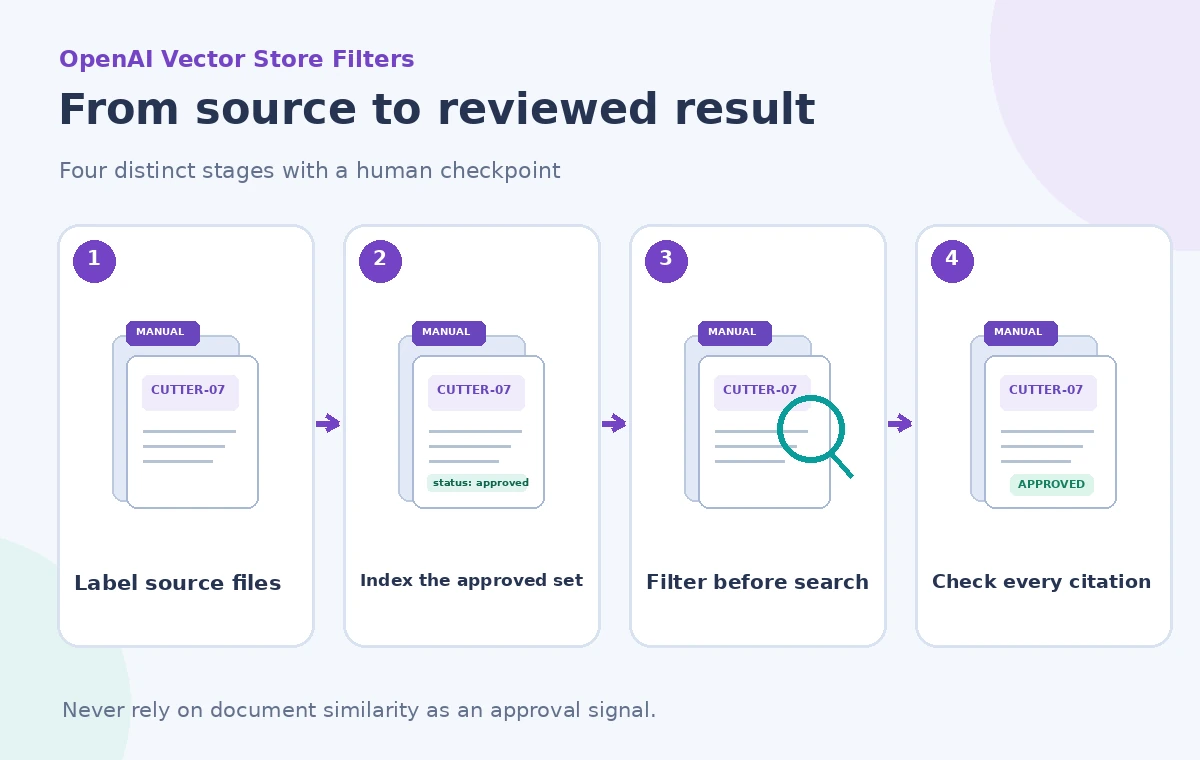
OpenAI’s Retrieval guide describes vector stores as containers that index uploaded files into searchable chunks. The vector store file object supports an attributes map; filters target those attributes. An illustrative record might use `manual_id: cutter-07`, `status: approved`, and `revision: 4`. These values must be attached during ingestion, not inferred afterward from a filename that happens to contain the word FINAL.
Use stable identifiers, not a string like `latest` whose meaning can change silently. For effective dates, agree on a consistent representation that matches the comparison operators available for the relevant attribute values. Keep a small ingestion log that links the uploaded file ID to the approved source record and records when the index was refreshed. A file successfully indexed is not necessarily the newest approved file.
Create a filter before sending a search query
The vector-store search endpoint accepts a `filters` argument. Comparison filters can match a key and value with an operator such as `eq`; compound filters can combine conditions with `and` or `or`. An example concept is “status equals approved AND manual_id equals cutter-07.” For a multi-site archive, add a location or equipment model constraint when that information is independently known. Do not rely on the model to invent the right model number from ambiguous user wording.
A filtering rule is a security and quality aid, not a substitute for data access control. Make sure the calling application restricts who can query which collection and that the correct version of the metadata actually exists. Never claim that semantic matching alone excludes every obsolete document; the filter can only act on values stored with the files.
Design a no-result path rather than weakening the rules
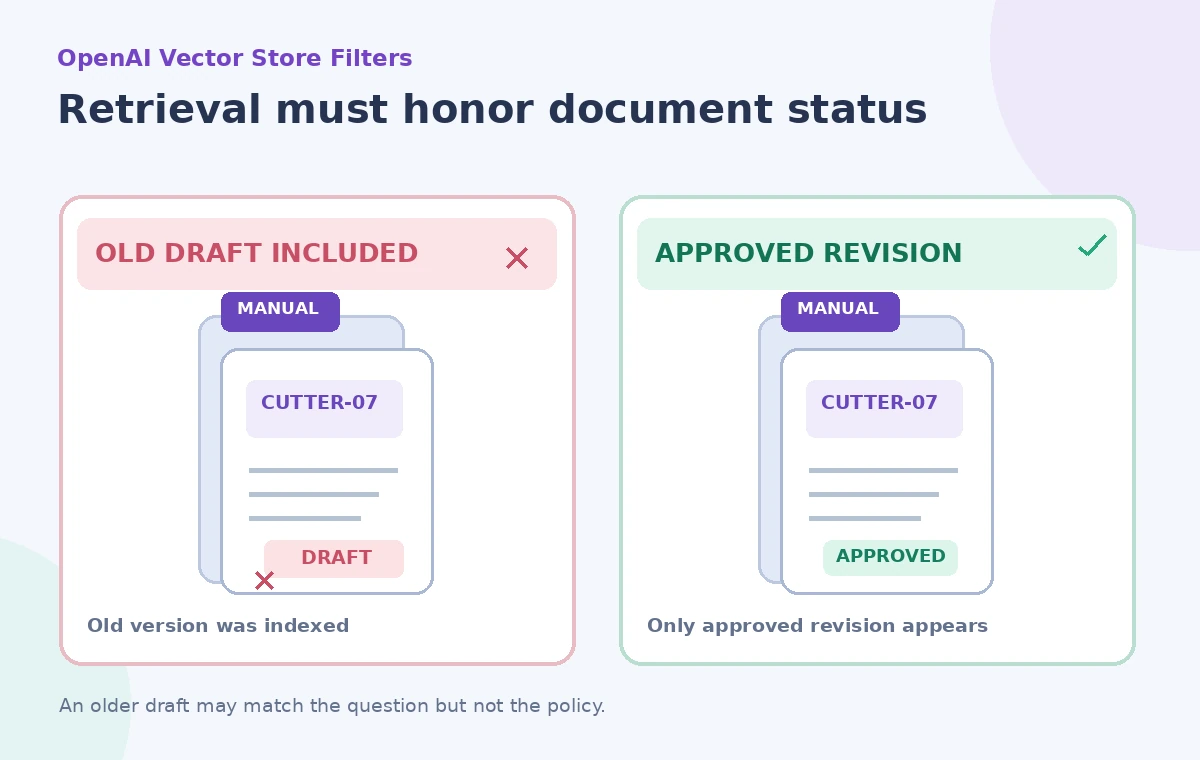
Suppose the approved manual has not finished indexing. The search may return no suitable passage. Resist the temptation to automatically drop the approval filter and show an older draft as if it were the current instruction. Return a visible “no approved manual found” state and direct the volunteer to the designated safety lead or emergency procedure. A missing answer is preferable to a falsely authoritative answer during a hazardous operation.
For a non-urgent editorial question, staff can investigate indexing health, missing attributes, or a mismatched equipment ID. Record why the result set was empty. If an exception is necessary, label the superseded source explicitly and prevent it from becoming an operational recommendation. This distinction should be tested before any public chatbot is connected.
Validate passages rather than only result titles
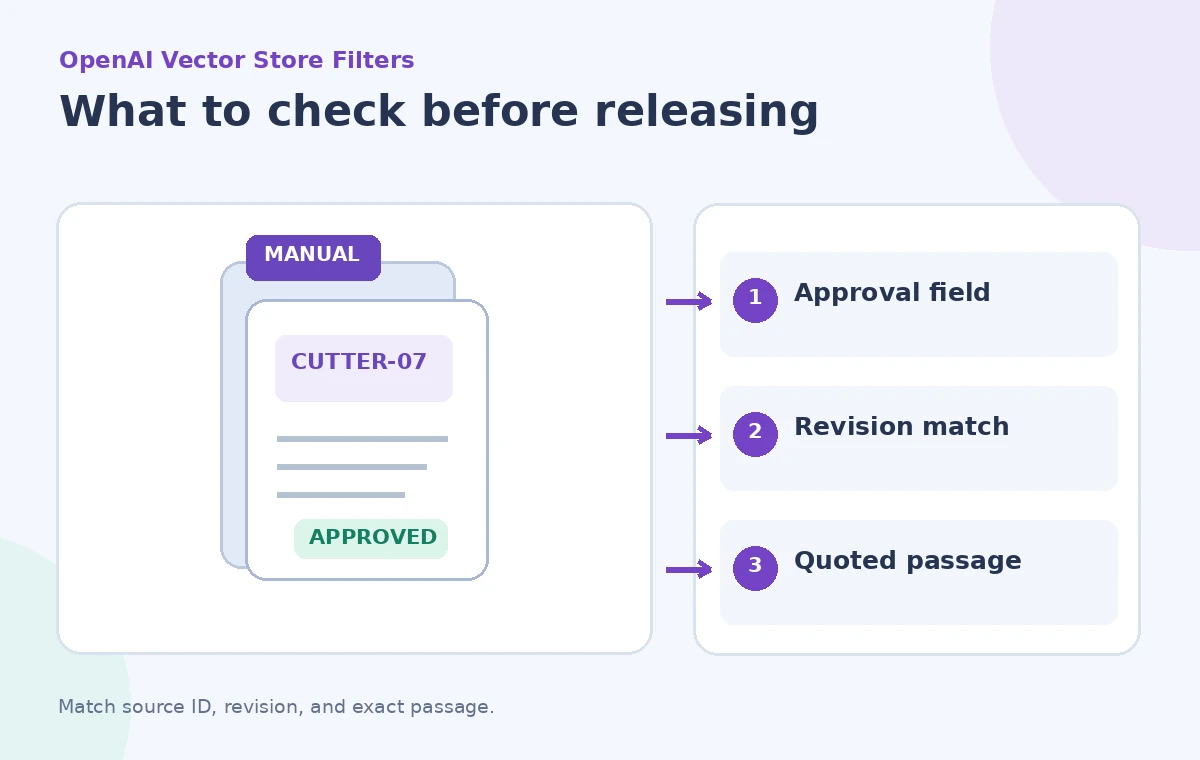
Review the retrieved chunk, its document identifier, and the corresponding approved original. A relevant sentence clipped out of context may omit an exception, prerequisite, or warning located in the next paragraph. Keep a direct way for a reviewer to open the authoritative PDF or manual page. When the source says “stop work and notify the supervisor,” do not paraphrase it into “continue at reduced power.”
Use citations as navigation aids, not as automatic truth badges. Check that the result is from the intended equipment model, that the approval revision has not changed since indexing, and that the surrounding paragraphs support the answer. A generated summary can combine two individually valid passages into an invalid instruction if the contexts differ.
Test conflicts, stale indexes and missing metadata
Build a small hypothetical test set with two conflicting revisions, one approved manual, one draft, an untagged file, and a correct file under a different equipment model. Ask both straightforward and misleading questions. Verify that the restricted search never treats the draft as authoritative, and that a no-result state remains honest. The diagrams compare these intended states; they are not measurements of OpenAI’s real error rate.
Also simulate a document becoming superseded. Confirm that the register, vector store attributes, and application cache are updated together or that the application refuses to answer until the update is reconciled. If staff cannot reproduce which version was searched, the retrieval workflow is not ready for safety-facing use.
Keep costs, access and retention in scope
Vector storage and searches can generate charges under the current API pricing and usage terms. Verify the relevant limits and rates in the provider documentation before a production rollout rather than hard-coding a price into an evergreen guide. Check what documents may legally be uploaded, who can retrieve extracts, and how long copies must be retained. Index only necessary material, particularly if manuals contain employee or vendor contact details.
A production integration should log file IDs and filter criteria without storing unnecessary personal text. Put access control ahead of retrieval, and give administrators a way to remove superseded materials from both the source repository and search index where appropriate.
Require a final approved-answer gate
For the fan-failure example, the response should show the approved document title, revision, and an exact reference the safety lead can verify. When that proof is missing, show a request for human assistance rather than an instruction dressed up with a citation. Write the acceptance criteria before deployment: which statuses count as approved, how conflicts are handled, who may change those statuses, and which questions require immediate escalation.
OpenAI’s filter feature makes a source-aware search design possible, but the organization must establish source authority, access rights, and review. The final decision to expose operational guidance should be made by people responsible for the safety program.
How We Research
For this November 2026 editorial review, we consulted these named primary references: OpenAI Retrieval guide, OpenAI vector store search reference. We checked the described capability, scope, documented limitations and approval boundaries against the hypothetical use case above. We did not use a live account, upload real client files, conduct a vendor benchmark, or measure recognition or retrieval accuracy. The diagrams are original teaching illustrations, not screenshots or measured product outputs. Confirm current feature access, fees, security terms and interface labels in the official sources before deploying this workflow.
Frequently Asked Questions
No. Similarity is not an approval or version rule. Store reliable attributes and filter results by those attributes.
Yes. OpenAI documents comparison filters and compound AND/OR filters for file attributes.
Do not silently remove the filter. Show a no-result state and escalate to a responsible reviewer.
No. They help narrow retrieval results. Enforce user permissions independently in the application and source systems.
No. Compare the quoted passage with the authoritative approved document and its context.