
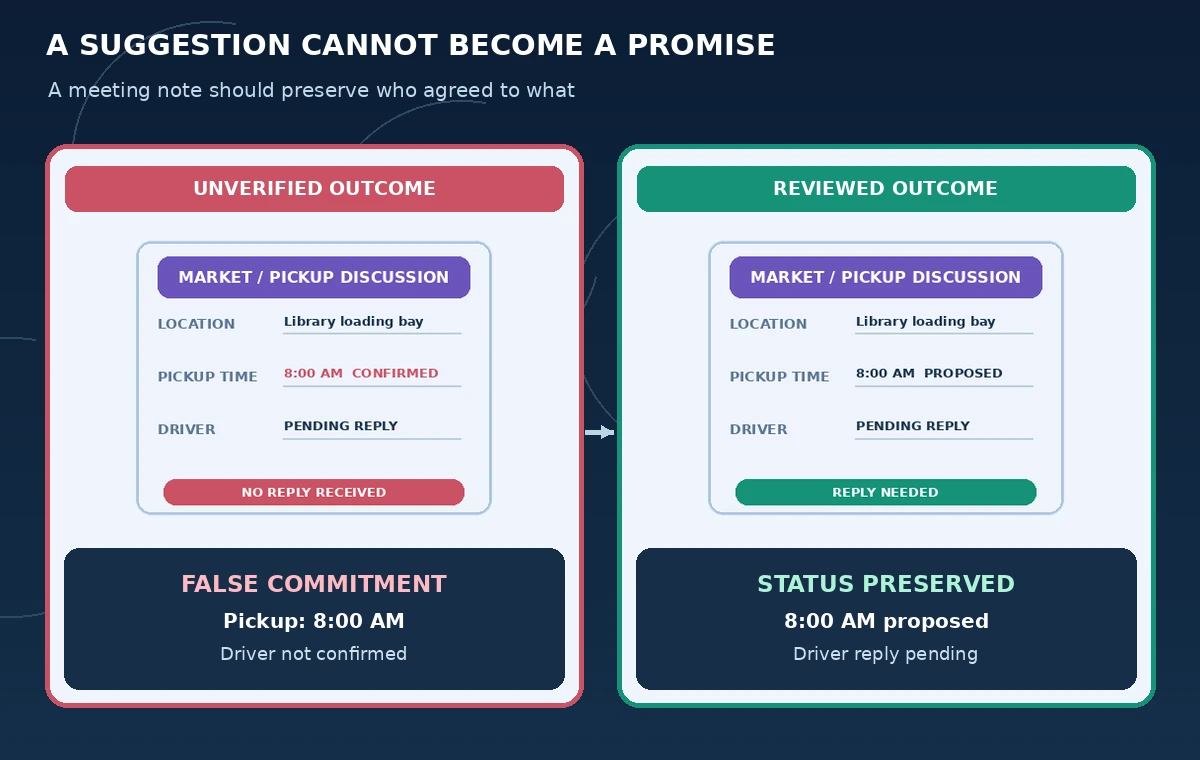
At a neighborhood market planning call, organizers suggest an 8:00 a.m. pickup for donated tables, but the driver says they must check another commitment. One volunteer writes “8?” beside the driver’s name. An AI-enhanced meeting note could polish that into “Pickup confirmed for 8:00 a.m.” and create a false obligation. The quality test is not how neatly the notes read, but whether uncertainty survives.
Granola is a meeting notepad that combines a person’s rough notes and a transcript to generate enhanced notes without adding a meeting bot. Granola documents device-level capture, private-by-default notes, and transcript handling. This article describes a hypothetical planning call; it does not claim to have recorded, transcribed, or tested actual participants.
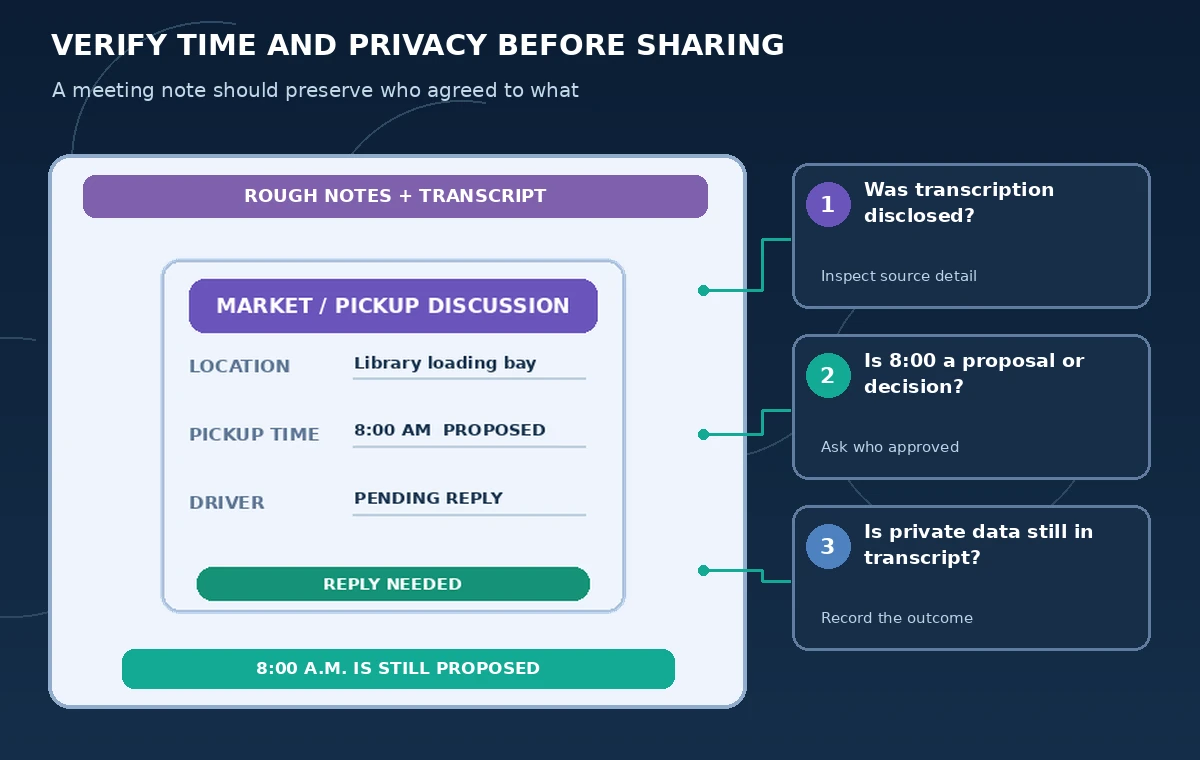
Tell attendees how note capture will work
Before starting, explain that an AI notepad will transcribe the discussion and produce an edited summary. Ask for the consent required by the organization and applicable rules, including any meeting guests who join late. Granola recommends clear verbal notice and offers visibility features, but the fact that a bot does not join the call is not a substitute for informed participation.
Agree which topics should remain off the transcript: private phone numbers, sensitive patron information, or confidential negotiations. Prepare an ordinary manual-notes alternative for anyone who objects. The goal is not maximum capture; it is a useful, permitted record. Record who is authorized to view a shared version separately from who happens to be present in the meeting.
Mark facts and questions while people speak
Start from the calendar event or an ad-hoc note in Granola and take a few short human notes. In the example, write “8:00 proposed,” “driver checking,” and “confirm after vehicle inspection.” That modest wording provides anchors for the enhanced note. An open question needs an explicit question mark or pending status so it is not silently promoted into an assignment.
Track decisions and proposals in separate columns during the call. The meeting may confirm that the library is the pickup location while leaving the time unresolved. Do not group both facts under one polished headline called Final Logistics. If someone mentions two possible trucks or two different days, preserve both options until the responsible person chooses.

Understand what Granola saves after transcription
Granola says its desktop app captures microphone and system audio, transcribes, and does not keep a stored meeting audio recording. The persistent materials include the transcript and notes. Privacy review must therefore cover text, not just whether a recording file is visible in a cloud folder. Confirm the organization’s settings before recording external partners or storing sensitive contacts.
The original audio generally will not be available in the app to replay after the process described by the vendor, so capture essential wording with care. A disputed time should be checked with attendees or an authoritative written follow-up. Never infer that the absence of an audio archive proves a statement in the enhanced note was accurate.
Review the enhanced note against human anchors
After the meeting, compare the enhanced note to the brief bullets taken during the call. Check every noun in the action list: which person volunteered, what task they offered, and whether they accepted a deadline. In this scenario, the driver did not promise to arrive at eight. Replace any definite pickup sentence with “8:00 a.m. proposed; driver confirmation pending.”
Examine the model’s additions especially when rough notes used shorthand. A polished paragraph might combine two speakers or transfer a suggestion to the person being discussed. Separate who raised an option from who has authority to approve it. The conceptual comparison image shows the unsupported confirmed time versus a reviewable pending status.
Protect confidential details in both note layers
Granola describes a visible edited note layer and an underlying transcript that can still inform Chat. Removing a private number from the top note is not always the same as deleting the relevant transcript passage. Review what was captured and use the documented transcript-deletion feature where appropriate, after considering any records obligations and organizational policy.
Keep private coordination numbers in an approved contact system rather than embedding them in a public pickup summary. Confirm that a shared note exposes only the intended information and that folder or workspace membership has not inadvertently expanded the audience. Do not promise zero retention; inspect the vendor’s current privacy documentation and local admin settings.
Do not turn reminders into assignments automatically
Create a list with columns for action, owner, status, and evidence. “Confirm available truck” can be assigned only to someone who accepted it; “driver reply pending” should not become a named assignment to another volunteer. A reminder to ask a question is not proof the answer was received. The note should make follow-up work obvious without claiming it is already finished.
If Granola Chat is used to query notes across meetings, ask for the specific passage supporting a claimed confirmation. A later meeting might supersede an earlier proposal. Compare the dates and participants before deciding which statement is current. Search and generative summaries are navigation aids, not an authorization mechanism for changing an event schedule.
Send the smallest useful recap to attendees
Draft a short recap with the pickup location, the proposed time, the unresolved driver response, and the person responsible for asking. Send it for confirmation before posting volunteer instructions. Include a clear reply request, such as “Please confirm whether 8:00 works by Thursday,” not an invented deadline inferred from conversational urgency.
When someone corrects the recap, update the shared record and mark the revision date. If the driver responds with an alternative time, preserve the earlier proposal as history but show the confirmed plan prominently. Check permission to share AI-assisted notes and avoid automatically inviting external contacts to a workspace.
Maintain a transparent correction and retention process
A useful archive contains the meeting date, attendees, consent process, reviewed note, and later written confirmation. It should not expose personal numbers to everyone who needs a pickup schedule. Follow the team’s deletion and retention rules for transcripts, especially when contacts request that sensitive passages not be kept.
The important outcome is a dependable operational record. AI can help convert scattered conversation into readable notes, but it cannot decide whether a tentative option became a commitment. That determination comes from the participants and their subsequent confirmation. Treat any ambiguity as a question to ask, not a gap for the model to fill.
How We Research
For our November 5, 2026 documentation review we consulted these named official sources: Granola Docs: Granola 101; Granola: Security and privacy; Granola: Transcript segment deletion; Granola: Meeting transparency. We mapped documented access requirements and controls to a narrowly defined hypothetical workflow, then wrote independent checkpoints that an editor or operator could verify. We did not purchase a subscription, use customer records, operate equipment, execute production code, or measure tool accuracy for this article. The diagrams are original instructional artwork, not screenshots or proof of vendor output. Plans, availability, legal rules, and organizational procedures may change; confirm current documentation and authorized source materials before acting.
Frequently Asked Questions
Granola says it captures device audio and does not add a meeting bot; meeting notice and required consent still matter.
Its security page says it does not store meeting audio after transcription; transcripts and notes are retained under relevant settings.
Yes. Review the underlying transcript and use the vendor’s segment-deletion option when appropriate.
No. Compare it with actual speaker commitments and get written follow-up for tentative items.
No. It is a hypothetical example; no real attendees, transcripts, or results were used.