
AI can draft a podcast synopsis quickly, but a useful show-notes page must describe the episode that listeners will actually hear. Chapter markers should land on the right topic; guest names must be correct; recommendations should not appear as sponsorships; and links should lead to real resources. This workflow begins with audio evidence, not a fabricated summary generated from the episode title.
Start with the final edit, not a rough transcript
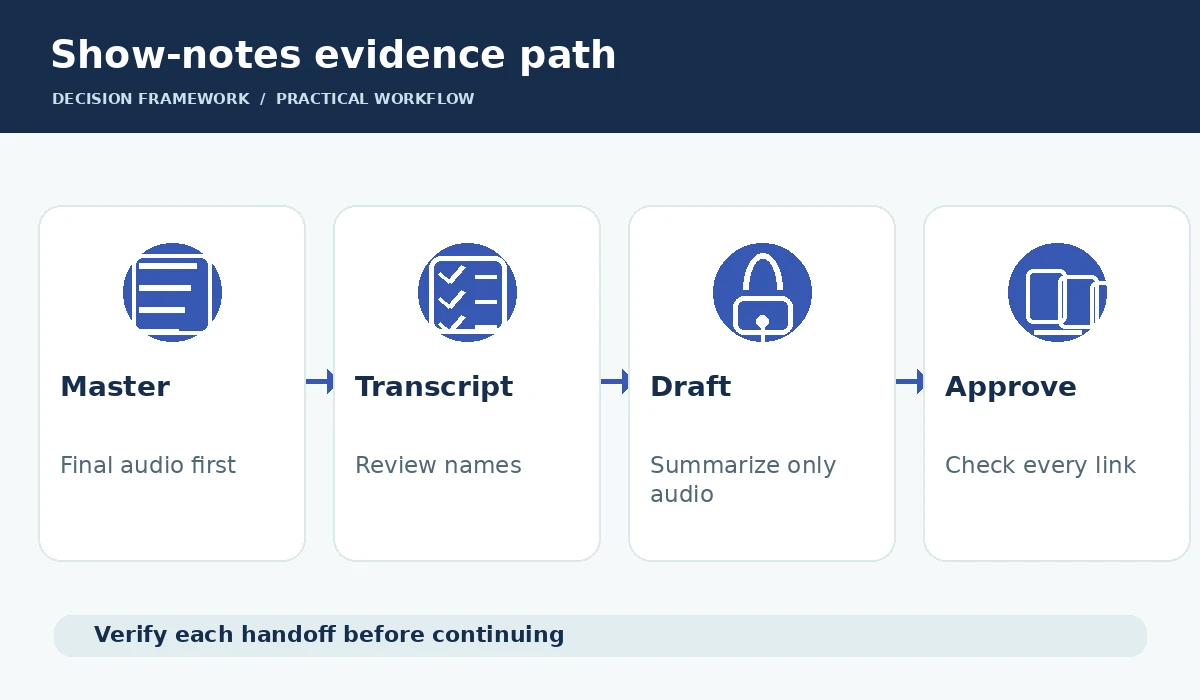
Lock the intended audio version first. If you generate chapters from a draft recording and later remove a five-minute exchange, every downstream timestamp can shift. Export a verified final master, label the file with an episode identifier and produce a transcript of that version. Keep the original raw recording separately for dispute resolution.
Choose a transcript standard before writing the summary. A clean-read transcript can remove filler speech, but it should not silently change figures, names or meaning. Mark unclear phrases instead of guessing. Revisit proper nouns directly in the audio. A concise editorial worksheet listing topic segments and important claims saves more time than re-prompting the model repeatedly.
Prepare a source-grounded show-notes prompt
Provide the finished transcript and a clear instruction: produce a two-sentence teaser, three to five verifiable takeaways, a chapter list with candidate timestamps and a list of resources mentioned by name. Require a quote or transcript location for each important assertion and instruct the model to label missing information rather than invent it. Specify whether the podcast is educational, interview-driven or conversational.
Example editorial direction: “Use only this transcript. Do not infer guest titles, products, URLs or sponsor relationships. Identify claims requiring verification. Suggest chapters at significant topic changes, not every tangent.” That constraint does not eliminate errors, but it makes a draft easier to audit. A model should not be asked to guess precise timestamps from an un-timed transcript.
Build a listener-first summary instead of keyword stuffing
Begin with the listener problem and describe what the episode delivers. Introduce the guest only with a verified role, then identify the main conversation topics in their real sequence. Avoid phrases such as “everything you need to know” when the show covers a narrow angle. Two useful paragraphs are often more valuable than a very long automated wall of notes.
Make the heading informative and use natural search terms only where accurate. Do not repeat the same phrase across every subsection. A summary should let someone decide whether to press play without spoiling every answer or presenting speculative remarks as established facts. If guests disagree, represent the disagreement fairly rather than manufacturing consensus.
Check chapters against playback timecodes
Candidate chapter boundaries often identify a subject correctly while placing the marker on a filler phrase or an advertisement. Open the final recording and play at least the first ten to fifteen seconds after each proposed marker. Shift it to the first substantive sentence of the new segment. Verify that titles describe what follows and that timestamp formats match the publisher’s requirements.
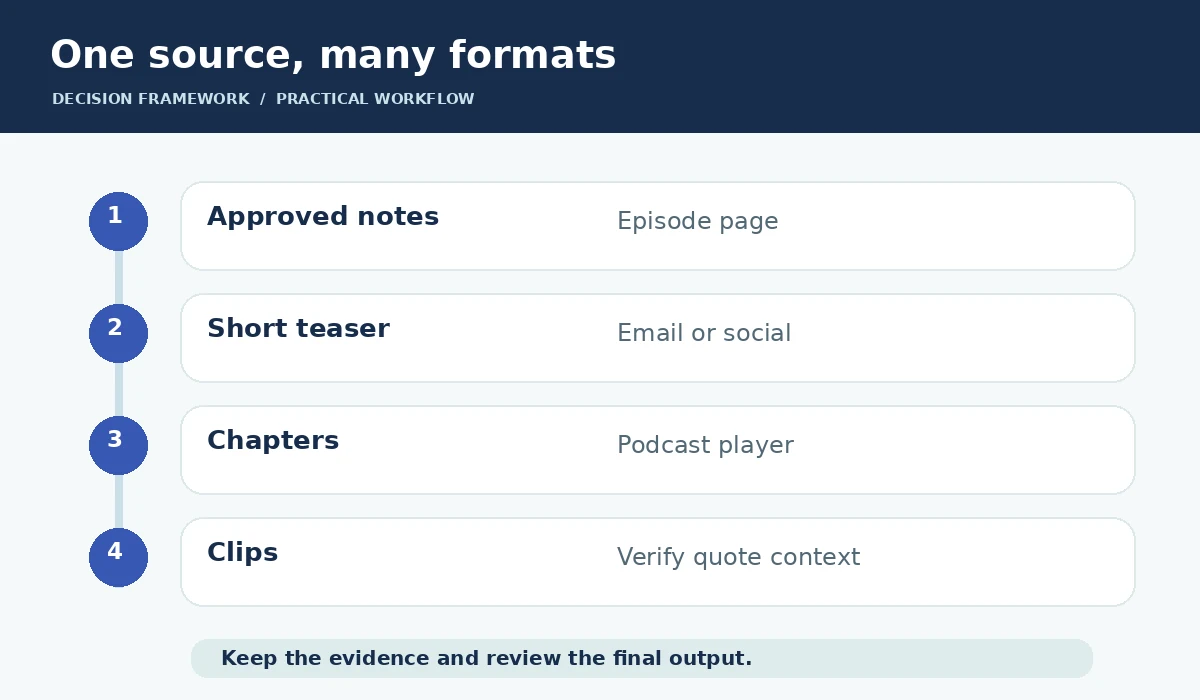
Check that timestamps strictly increase and stay within the published file duration. An edit made after the chapters were drafted should trigger a fresh alignment pass. Store both the human-friendly chapter title and the exact starting time. If your platform provides automatic chapters, review the output rather than assuming it respects editorial boundaries.
Verify names, links and external claims
Listen to the source when the summary mentions a number, product name, website or technical assertion. A speaker may misstate a statistic, and a clean transcript can preserve the mistake; an AI summary must not turn it into an unqualified fact. For consequential external information, check a primary source and identify where your production team verified it.
Only publish links you opened and checked. If a resource cannot be identified confidently, write “resource mentioned during the episode; link not confirmed” in an internal checklist instead of inventing a URL. Separate genuine paid sponsorship wording from organic mentions. Avoid quoting a guest out of context for click-through appeal.

Keep the production assets reusable across channels
Create one approved source of truth with the title, description, chapters, key links and optional transcript. From that document, draft platform-specific blurbs, newsletter summaries and social excerpts. Those derivatives should retain the same facts even when their length and tone differ. If a fact is corrected, update the approved source first, then regenerate dependent copies.
Caption clips need a separate check: speaker attribution, line breaks, punctuation, and any on-screen claims must be verified against the clip as edited. A quote that is accurate in a full interview can become misleading when its condition or counterpoint is removed. Keep a timestamp reference beside the social copy.
Add a human approval loop with visible ownership
Assign a producer to confirm editorial content, an audio editor to approve timecodes, and a publisher to verify URLs and formatting. For a solo podcast, these can be stages of one person’s checklist. Requiring explicit approval is more effective than hoping the final reviewer remembers every earlier correction. Record which file version was reviewed.
A strong release checklist asks whether the title is supported by the episode, whether chapters are correctly aligned, whether all names and numbers are verified, whether links are appropriate and whether a listener can find the promised material. Do a final read in the actual podcast app and on a narrow phone screen: line breaks or special characters can render differently than in the editor.
Know when automation is the wrong next step
Automated notes are less suitable for highly sensitive recordings, poor-quality multilingual audio or discussions with uncertain speaker identity unless the workflow includes careful human review. In such cases, start with permission and accurate transcription rather than generating a public summary. Some platforms allow exporting transcript text while others impose plan-specific limits; confirm your selected path.
Use your own before-and-after time log to decide whether automatic summaries help. Count corrections and mismatched chapters rather than trusting a tool’s promotional speed claim. The purpose is to publish a faithful guide to an episode, not maximize the amount of text generated.
How We Research
We reviewed official and product-maintained documentation including Riverside show notes and chapters, Auphonic shownotes and chapters, Descript review context. We mapped each documented feature to the specific workflow discussed above, separated product claims from editorial recommendations, and documented cases requiring confirmation by a human or a workspace administrator. We did not purchase or operate paid accounts, run independent quality benchmarks, test every platform configuration, or guarantee costs, privacy outcomes or productivity gains. Source checks were performed on October 27, 2026; documentation and feature availability may change.
Frequently Asked Questions
Some tools propose them, but play the final export at each boundary to confirm alignment and topic relevance.
You can draft planning copy, but do not present it as a verified summary of an audio episode that has not been checked.
No. Prioritize the real listener benefit, distinct topics, verified resources and navigable chapter markers.
Fact-check it from the original source and edit the public notes to avoid repeating the claim as established fact.
They can add helpful context and descriptive text, but no tool can guarantee rankings or eliminate editorial review.