
Elicit pricing depends on the research task rather than only how many papers you search. A student exploring a question, an analyst exporting evidence tables and a systematic-review team screening thousands of records need different capabilities. Public plan cards may also present annual-billing equivalents beside monthly offers. Comparing those numbers without the billing term creates a false bargain.
This October 2026 guide separates the free discovery workflow from paid exports, systematic reviews and collaboration. It uses Elicit’s official pricing page and help documentation, but it does not claim that a particular plan will automatically produce a publishable review.
Use Basic when discovery and reading are enough
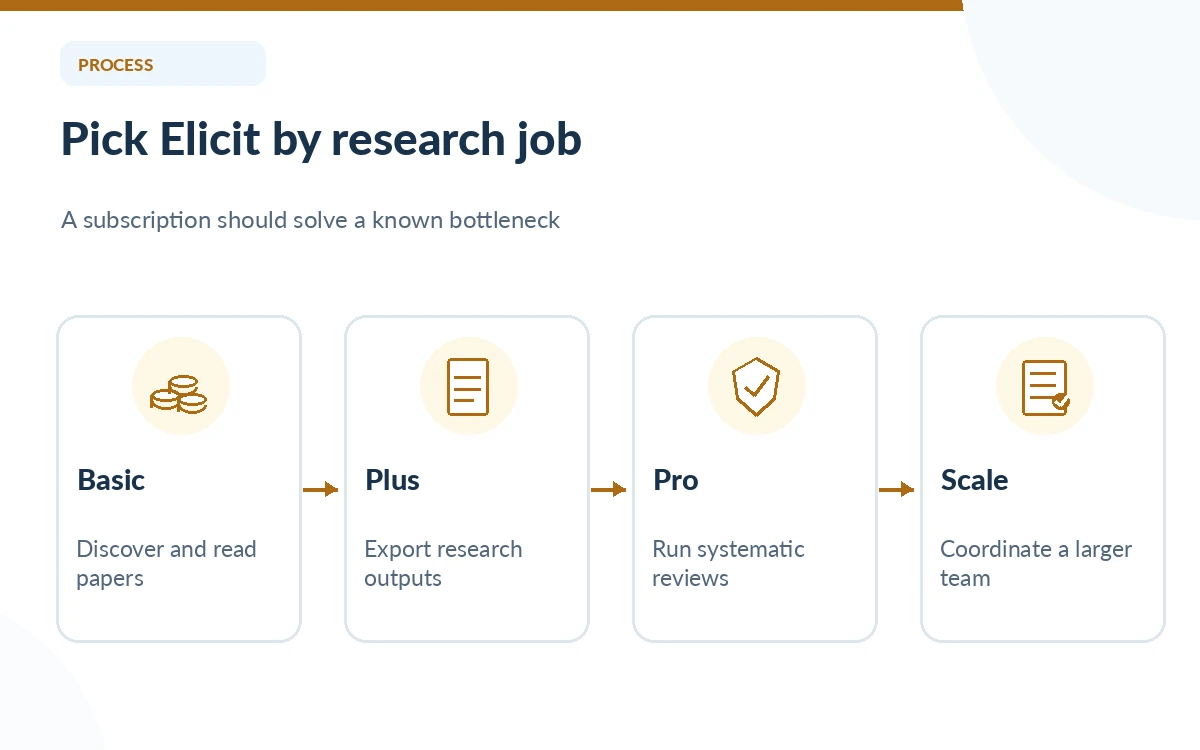
Elicit lists a free Basic option for casual exploration, including paper search, summaries and chat where full text is available. The official page also describes limited usage of Research Agent and Reports. For a student learning a topic or testing the relevance of literature to a class assignment, this can be a useful starting point before paying for more elaborate analysis.
Free does not mean that every automated workflow is unlimited. Check the exact usage meter and export options rather than inferring access from the presence of a feature in a marketing demonstration. When your work is mostly reading the primary papers yourself, adding a subscription may not save meaningful time.
Understand Plus and the billing-term difference
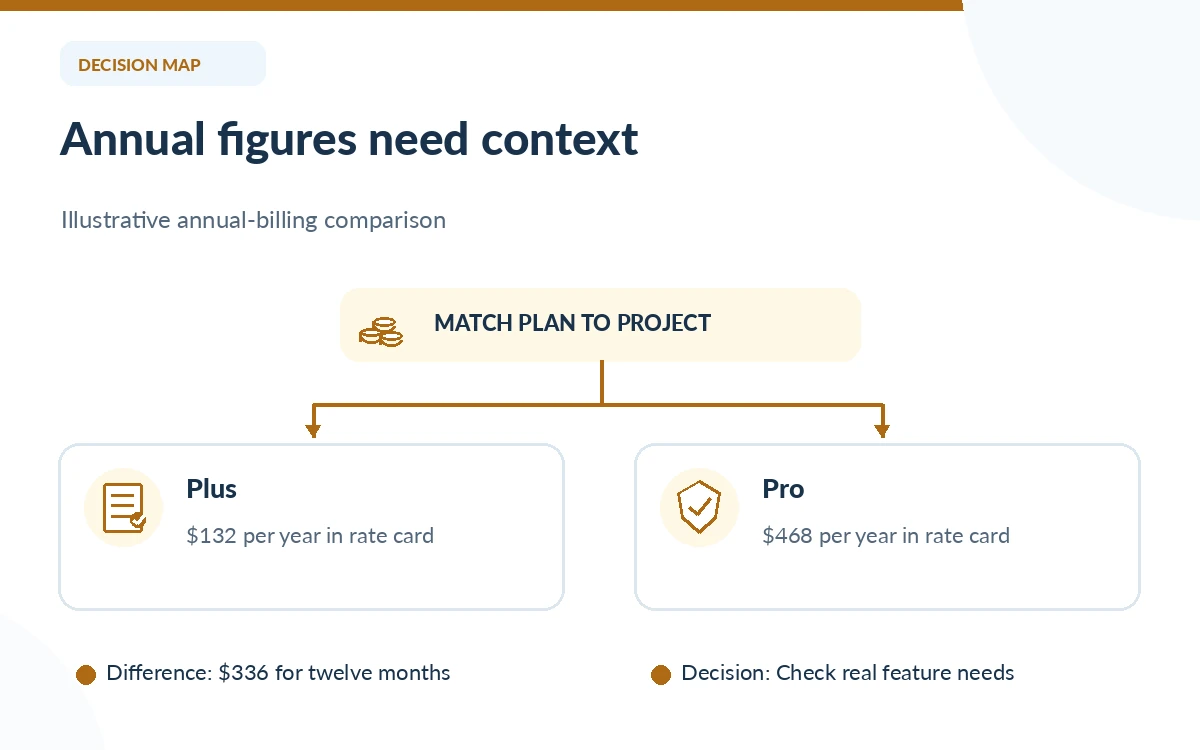
The official price page displayed a Plus plan at $11 per user per month when billed annually, with $132 charged for the year. It adds export formats such as RIS, CSV, BIB, PDF and DOCX and standard access to research workflows. Check the currently selected “Monthly” or “Yearly” tab before quoting a figure, because the page can show different prices for different billing terms.
Export matters when you need to transfer citations into a reference manager or deliver a structured spreadsheet to a collaborator. If you only ask occasional questions and copy individual references manually, the free offering may cover the job. Pay for the workflow you actually run, not because Plus sounds like the sensible middle tier.
Compare Pro against systematic review needs
Elicit presents Pro as the plan for systematic review work, and its public price card showed $39 per user per month with annual billing of $468 when reviewed. Its dedicated review workflow can screen up to 5,000 papers per review, and the page mentions 20-column table additions, research alerts and API access. These are capability limits or descriptions, not guarantees of publication-quality extraction.
For a research team, the practical upgrade question is whether you need a structured protocol, repeatable inclusion decisions and high-volume full-text extraction. Check whether your project needs manual dual screening, institutional audit records or registration. Elicit can support stages of that process, but editorial responsibility and domain expertise remain with the researchers.
Know when Scale and Enterprise become relevant
The Scale plan adds higher usage and collaboration features, including shared editing and administration. The official page displayed $89 per user per month with annual billing of $1,068. Enterprise pricing is by quote and focuses on organizational controls and higher capacities. These values are snapshots of the selected pricing presentation, not universal renewals or negotiated contract offers.
If a team has six occasional readers but only two people actively extracting and screening, assess licenses according to actual participation and current seat rules. Do not simply buy six higher-tier accounts because a group of six appears on the project title. Also consider institutional review policies, data retention, permissions and export needs.
Calculate a real project budget
A solo researcher choosing the published annual Plus option would pay $132 for twelve months under the displayed plan term. Pro at the displayed annual price would total $468, a $336 annual difference. This arithmetic leaves out taxes, separate organizational agreements and any price changes. It does not prove that the larger plan is worthwhile without evaluating the user’s work.
For a multi-person project, multiply the eligible seat count by the verified annual rate, then add researcher review time, data cleaning, quality appraisal and software used to manage references. A cheaper license can still result in greater total cost if the workflow is cumbersome. Record which exports, caps and audit features you need before a subscription is purchased.
Consider scientific limitations alongside features
AI-assisted paper search can miss studies; automated extraction can misread tables and method sections. A systematic review must have an independently documented search strategy, eligibility criteria and error-checking process. The most expensive software tier does not replace protocol design, database coverage or human verification of critical study outcomes.
For regulated or sensitive work, read Elicit’s current privacy and security documentation and discuss institutional requirements before uploading unpublished files. Vendor claims about speed savings should be labeled as vendor statements, not as independently verified productivity gains for your research group.
Use a three-step upgrade decision
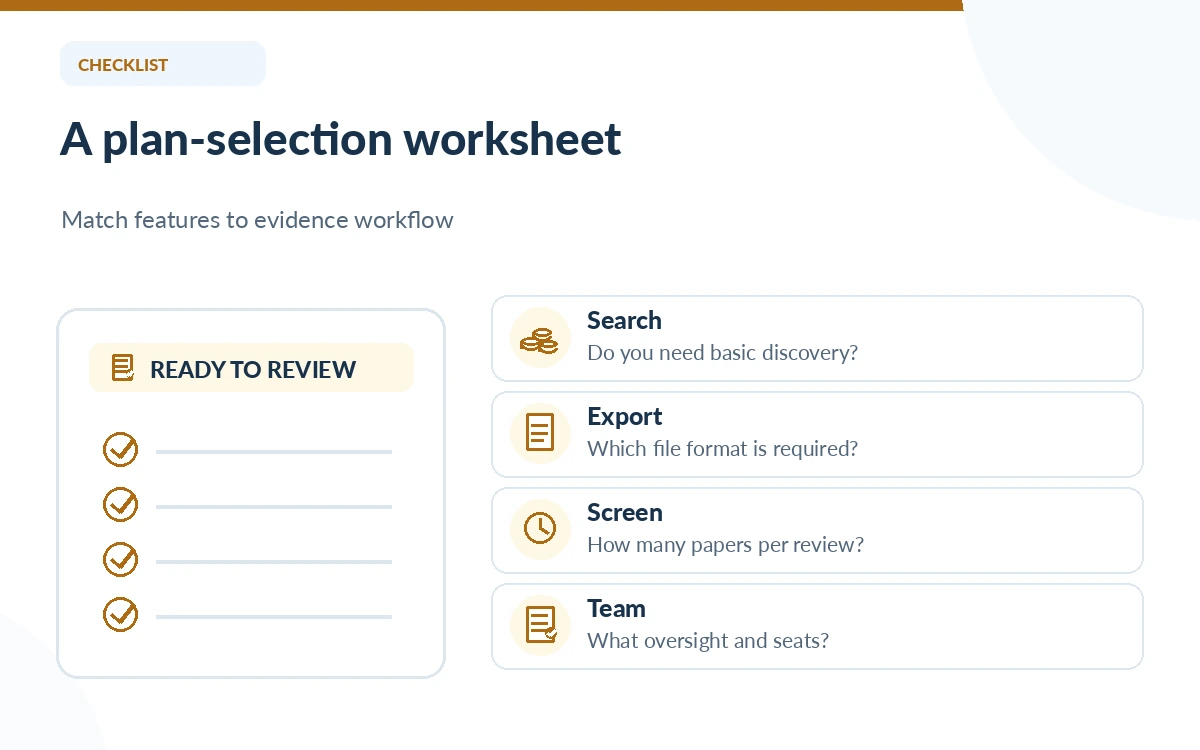
First, run a real research question on Basic and record whether missing features block the next deliverable. Second, check whether the requirement is an export, a larger research workflow, collaboration or institutional administration. Third, read the current pricing and usage table for that exact requirement and confirm the billing cadence at checkout.
If you are preparing a single class bibliography, a paid systematic review license is usually disproportionate. If you are screening thousands of papers against an approved protocol, Pro or a higher tier may be justified. Revisit the decision when the project ends: a recurring subscription should have a recurring use case.
How We Research
We compared Elicit’s public plan and billing cards, September 2026 systematic review guide, and review-workflow update on October 26, 2026. Dollar amounts are the publicly displayed annual-billing choices at review time, not verified checkout quotes for every account. We have not personally purchased a plan or audited its screening accuracy.
Frequently Asked Questions
Yes. The public Basic tier supports paper discovery and limited advanced research activity. Specific export and automated review functions depend on the current plan and usage allowances.
The displayed per-month annual rate is an equivalent for an annual commitment, not necessarily the price of a cancel-anytime month. Check the billing toggle and total before paying.
Elicit documentation states that the dedicated Systematic Review workflow is available on Pro, Scale and Enterprise. Review capacity and monthly usage vary by tier.
No. The provider describes project and usage limits, including a per-review paper limit. Verify the current allowance for your project size.
No. A reproducible review still needs a documented search, eligibility judgments, verification of extracted findings and responsible human oversight.