
Poe pricing is not just a subscription number. On Poe, different bots consume different quantities of compute points, and the same bot may charge according to how much text it reads or produces. A plan that looks generous in points can be exhausted quickly by long-context conversations, while a small allowance can cover plenty of short prompts on inexpensive bots.
As of October 26, 2026, Poe’s own help documentation explains daily free points, higher subscriber allowances and point-based bot costs. This guide builds a repeatable budget method; it does not pretend that one monthly price guarantees an identical number of messages across all models.
Understand the two moving parts of Poe cost
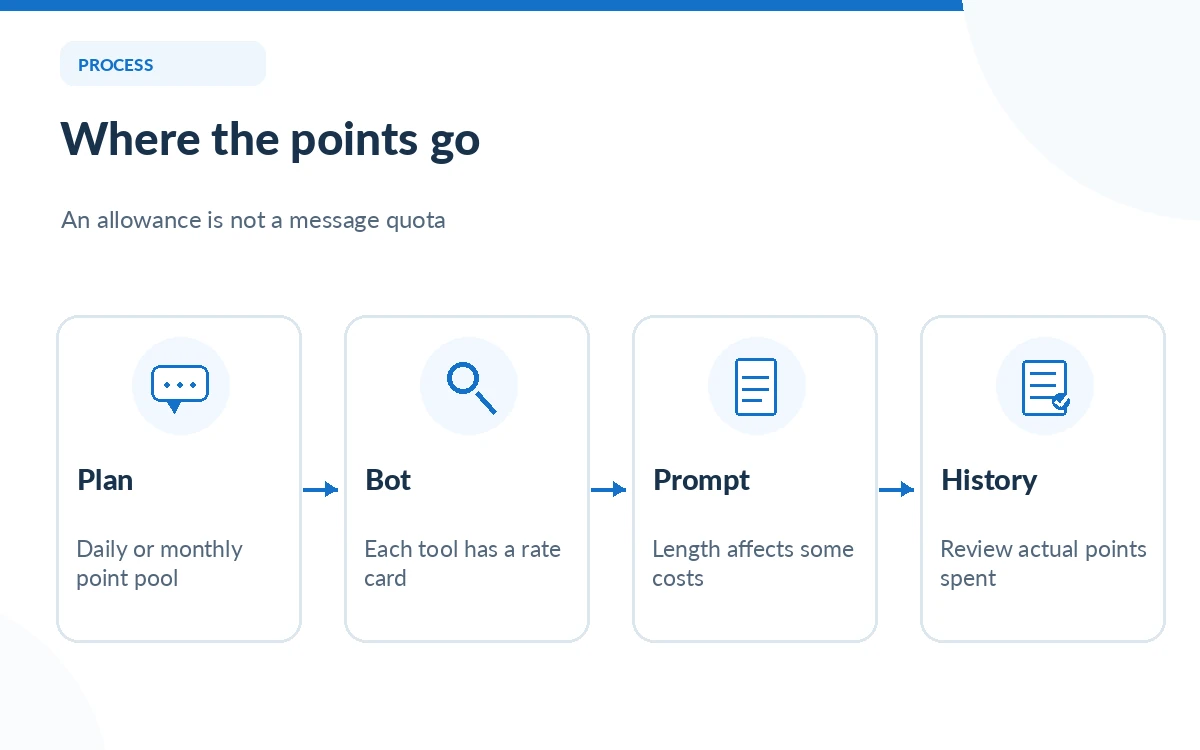
The first number is the allowance granted by your subscription. Poe offers several subscription tiers and shows daily or monthly point allocations. The second number is a rate for the bot you actually use, available through the bot information and the Rates control. Those costs can be fixed for a task or variable with context length and output. You need both figures to estimate how long a plan will last.
The official plan page may show a localized currency even while its fine print mentions US dollars. Poe’s displayed annual page included options such as 10,000 points per day and 660,000 or more points per month when checked. The specific checkout price, taxes and billing term must be confirmed in a US account; we do not convert an automatically localized page into a fabricated universal US quote.
Know which points expire
Poe’s October 12, 2026 FAQ says free users get points that renew daily and do not roll over. Subscribers receive larger allowances; Poe’s purchase help says subscriber points arrive on the plan’s schedule and unused points generally do not roll over unless explicitly specified. The timing matters when you use Poe intensively for one project and very little the rest of the month.
A daily allowance cannot automatically be treated as an interchangeable monthly pool. Someone who uses a tool only on Saturdays may miss most daily resets; someone writing a small amount every day could use the same plan more efficiently. Read whether your selected tier gives daily points, monthly points, or a combination before multiplying any quoted allowance by thirty.
Find the true cost of a particular bot
Open the bot’s details and select Rates before committing to a large task. Poe describes a Rates view that lists how charges are calculated and shows an approximate first-message cost. After sending a small test prompt with non-sensitive material, open the message menu and select Info to inspect what that specific message consumed. For a longer history, Poe provides View Points History in Settings.
Be careful with multi-turn chats: previous messages can increase the context a bot reads. Poe’s purchase help recommends clearing context or beginning a new conversation when changing topics and making prompts specific about output length. That is a budgeting technique, not proof that every bot will become equally cheap. Image and video generation may have entirely different point schedules from text chat.
Use a scenario worksheet, not a message promise
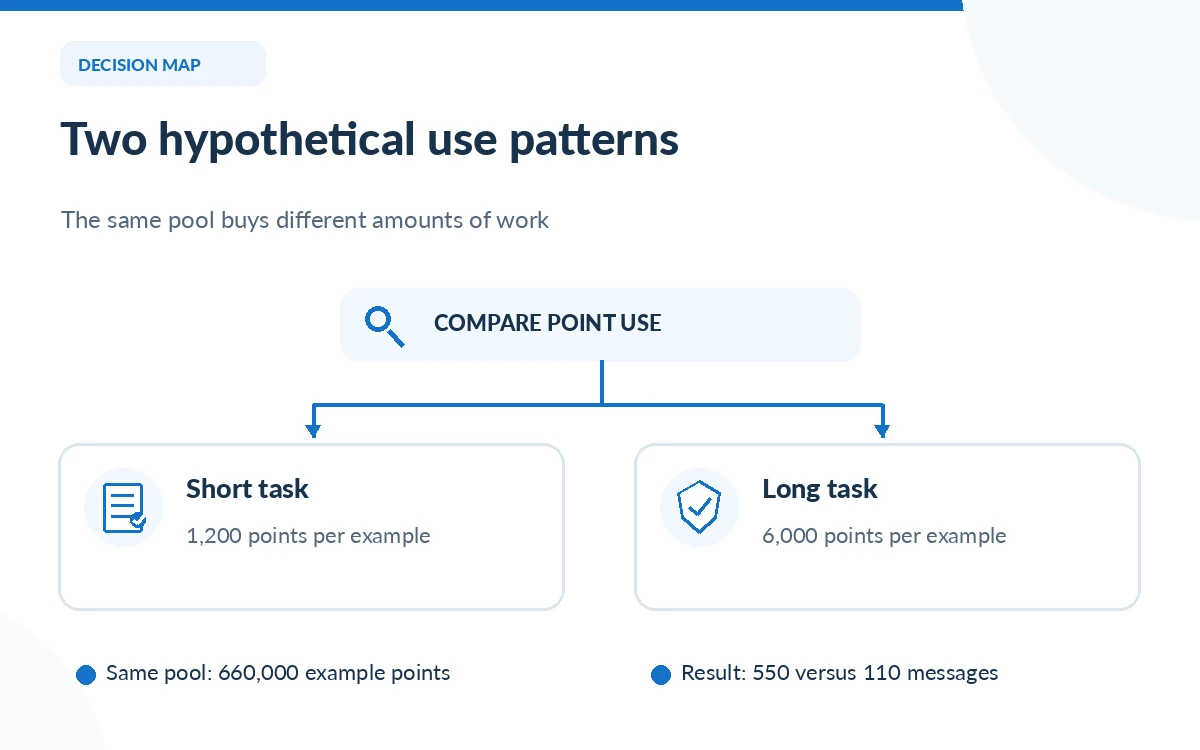
Suppose a bot’s current rate card and your recent history suggest roughly 1,200 points for an ordinary message. An allowance of 660,000 points would support about 550 similar messages by simple division. If a more expensive bot used 6,000 points per message, the same pool would support about 110 comparable messages. These are hypothetical examples; neither figure is an observed Poe rate for a named model.
Add at least three kinds of work to the worksheet: short questions, document analysis and media generation. Take their actual point costs from your own account after representative non-sensitive trials, then multiply by expected monthly volumes. Include a buffer for retries and long conversations. The value of a plan is the work it funds, not the size of its headline point number.
Know when a subscription beats purchased points
Poe says subscribers can purchase additional points and describes an approximate prepaid rate of $30 per one million points in its FAQ. That reference helps estimate marginal cost, but may not describe every account’s checkout options or taxes. A subscriber who occasionally exceeds a monthly allowance should compare add-on availability with moving to a larger tier.
The decision can be modeled as total subscription charge plus expected top-ups. If you regularly buy more points, reassess your bot mix and whether long context is driving the spending before upgrading. Conversely, if allowances regularly expire unused, downgrading may be appropriate. Read the renewal rules and point expiry conditions rather than assuming unused credits are a cash balance.
Compare Poe with a direct model subscription fairly
Poe offers access to many model families behind one interface, which can be convenient for occasional comparison. A direct subscription to one provider might give you different usage limits, native tools, account controls or privacy settings. It would be misleading to declare Poe automatically cheaper by comparing its cheapest point tier with another product’s highest tier.
Write down the tasks and features you actually use: advanced reasoning, image creation, long documents or mobile convenience. Check the privacy terms for both the platform and the chosen bot. Especially for community-created bots, do not presume that data handling is identical to a first-party model account. Plan cost is only one dimension of a responsible selection.
Run a seven-day point audit
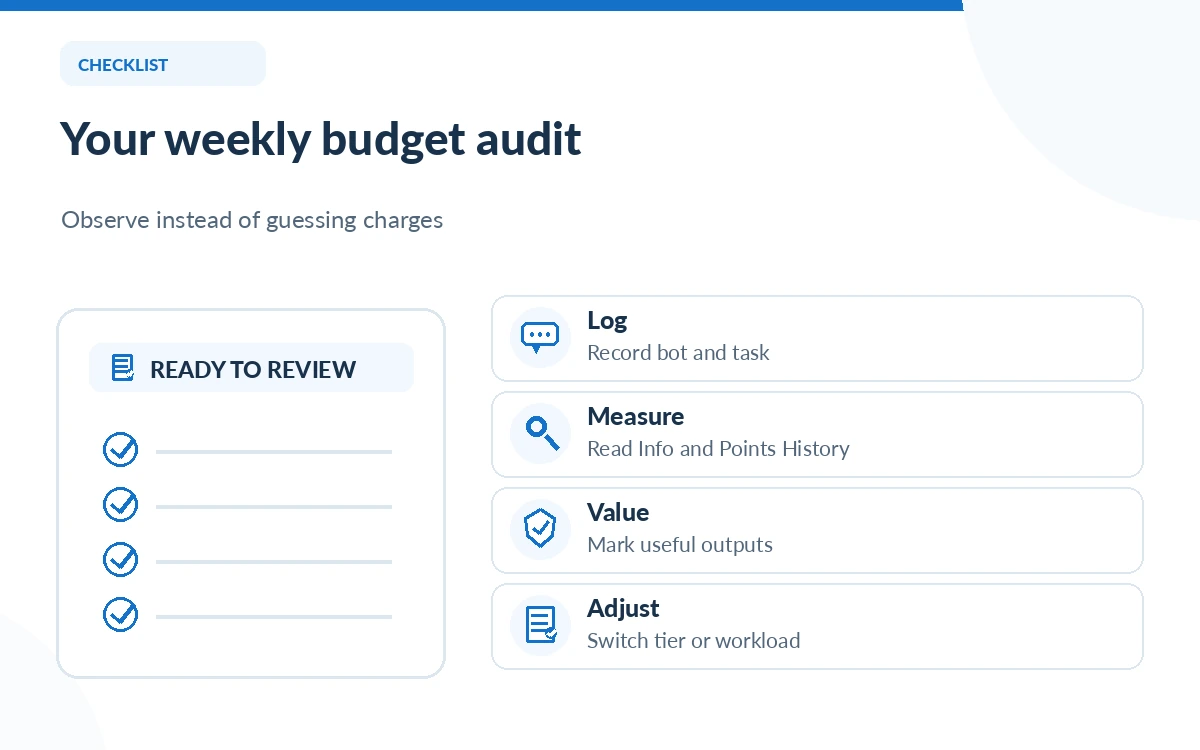
For one week, record the bot name, purpose, points consumed, whether the output was useful and whether you retried it. Poe’s Rates and Points History controls provide an account-based starting point. Group charges by task rather than by model popularity; expensive experiments may be perfectly worthwhile if they replace a difficult paid service, but casual comparisons can also consume a subscription unexpectedly.
At the end, estimate a typical month using the days you actually work, not an invented 30-day full-utilization pattern. Save the dated rate cards and revisit the budget when Poe adds or changes bots. This guide intentionally does not reproduce stale model-by-model prices: the live bot rate card is the authority for the next message you plan to send.
How We Research
We checked Poe’s official subscription page, FAQ updated October 12, 2026, and purchase and points instructions on October 26, 2026. Message counts and point quantities in the scenario are clearly labeled hypothetical. We have not billed a Poe account, purchased points or independently tested every bot.
Frequently Asked Questions
No. Bot rates vary and some are affected by input and output length. Inspect each bot’s Rates view for current information.
Poe’s official FAQ says free daily points reset every 24 hours and do not roll over.
Open the message menu and choose Info. The current Poe FAQ also describes account-level Points History in Settings.
Poe says subscribers can purchase additional points, subject to the available billing and account options.
There is no reliable universal count: divide your own allowance by the current cost of your actual bot and prompt pattern, allowing for variable context and retries.