
Why two delivery counters tell different stories
An online museum ticketing service might ask a queue to send a receipt after a successful booking. When delivery fails, operators often look for one number that tells them how many times a handler ran. Google Cloud Tasks exposes two diagnostic request headers that do not mean the same thing: X-CloudTasks-TaskRetryCount counts retries, while X-CloudTasks-TaskExecutionCount counts attempts that received a handler response. Neither is an authoritative record of receipts actually sent.
The first attempt has retry count zero. According to Google’s HTTP task documentation, the retry count can include failures that never reached the execution phase, while execution count excludes failures caused by 5XX conditions described in the service documentation. Their disagreement is therefore informative. Treat them as diagnostic hints attached to an authenticated task delivery, not as an accounting ledger or a security token.
Authenticate the task before interpreting headers
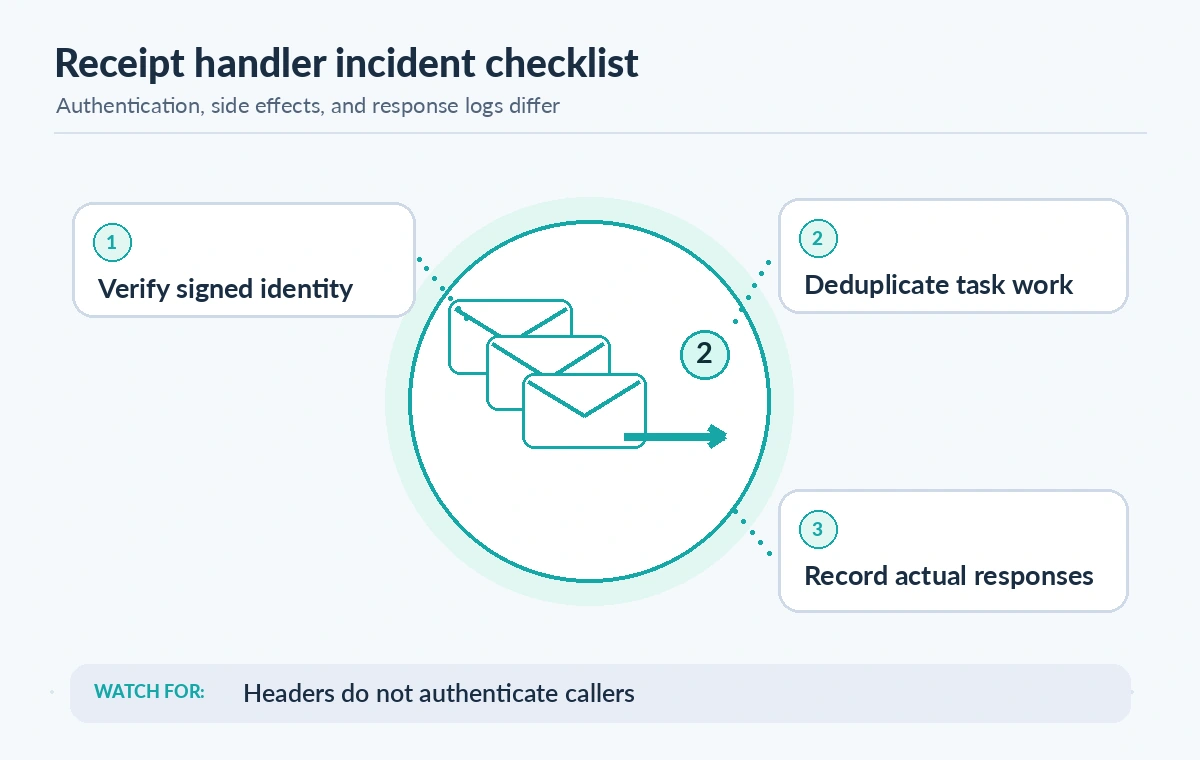
An HTTP client can forge an X-CloudTasks-* header when it calls a public endpoint. Verify the caller through the configured OIDC or other appropriate service-to-service authentication before assigning any operational meaning to the counter values. A handler that authorizes requests solely because a header exists can be tricked into processing fake booking events. Authenticate the expected audience, service account identity, and application payload according to your infrastructure design.
Do not assume a queue name or task name in a request proves authorization. Keep authenticated transport identity, task identity, and the business booking reference as separate fields. The booking reference is used for business deduplication; the task reference helps operators locate queue activity. If a delivery carries an unfamiliar booking ID, it should not create a real receipt just because a retry counter looks plausible.
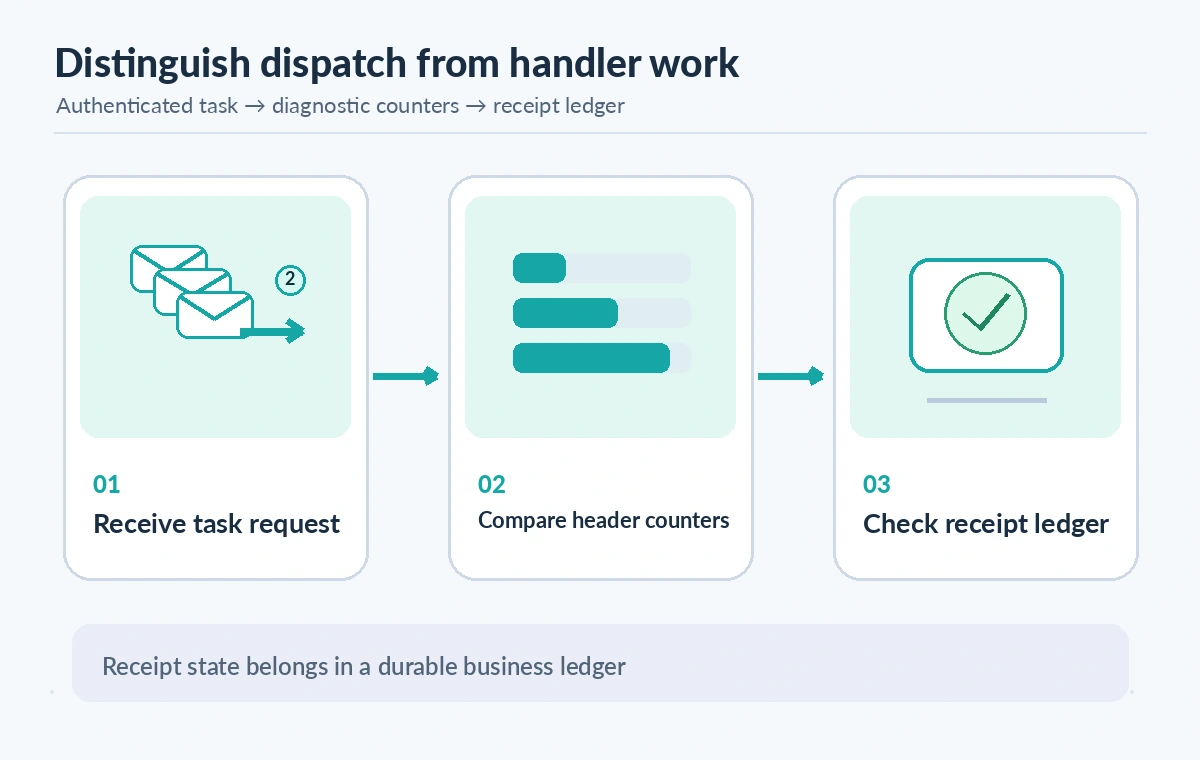
Read RetryCount in the context of the first attempt
X-CloudTasks-TaskRetryCount starts at 0 on the first delivery attempt. It advances with retries, including some failed dispatches that do not produce a normal handler execution. A high value can indicate a transport problem, unavailable service, repeated application errors, or deliberate retry policy behavior; it does not tell you which explanation is true. Combine the value with Cloud Tasks logs, target service logs, and the current configured retry settings.
A hypothetical task may report a retry count of three after two connection failures and one application error. That does not prove that a downstream email provider was called three times. An application might never have received the first two requests. Do not use the number to calculate a billing quantity, notification count, or customer-facing incident statistic without independent evidence.
Use ExecutionCount to distinguish handler responses
Google documents X-CloudTasks-TaskExecutionCount as the count of times a task has received a response from its handler, with specified dispatch failures excluded. This helps separate failures before useful application handling from attempts that ended with a response. However, receiving an HTTP response is not evidence that an email was accepted, delivered, or read. A handler may acknowledge a task while its own work is still pending.
For example, a receipt handler might write a durable outbox entry and respond successfully, leaving a separate sender to deliver the message. That is a legitimate processing pattern, but the queue counter would describe task interaction, not the email lifecycle. Track outbox status and message-provider IDs separately to establish what happened after the handler returned.
Build a real deduplication boundary around the booking
Use a stable business key such as a booking ID plus notification type to prevent duplicate receipt creation. Store completion or an outbox request transactionally, using a uniqueness constraint where possible. When a retry arrives, look up that same business key and return an appropriate success response if the intended work is already committed. Do not deduplicate solely on task retry count, because a duplicate business event can also appear in a completely new task.
For downstream APIs that lack safe idempotency keys, design an explicit reconciliation state before retrying an uncertain send. A network timeout after the provider accepted an email creates ambiguity. Sending again unconditionally may duplicate the receipt; dropping the request may lose it. A persistent outbox, provider reference, and supervised recovery procedure are more dependable than interpreting counter values as business truth.
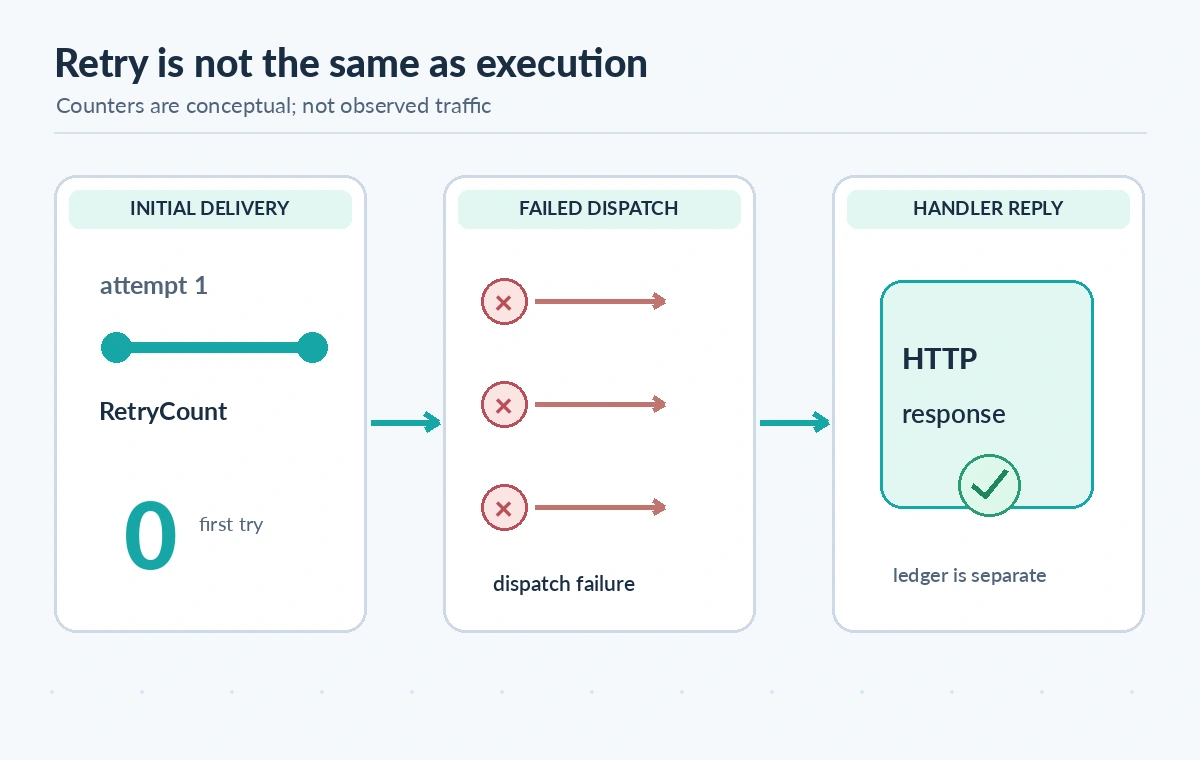
Capture a minimally useful incident timeline
A useful log entry includes an authenticated service identity, task name, business key hash, request timestamp, retry count, execution count, handler response status, and the associated outbox record identifier. Keep personal details and ticket payloads out of broad observability streams. Do not log bearer tokens or full private request bodies. Correlate with queue and target logs using server-side timestamps, which can differ from a client clock.
A three-column incident view can separate the dispatch attempt, handler response, and durable receipt state. These are not interchangeable quantities. If retry count rises while execution count stays flat, investigate delivery-level failures before blaming application logic. If both rise and the ledger shows no completion, inspect transaction failures and whether the handler returns an appropriate status.
Model safe and unsafe outcomes with test fixtures
Construct a local test double that feeds synthetic authenticated events and counter values into the business logic. Test an initial delivery, a simulated failed dispatch followed by success, and a handler timeout after committing a receipt. The counter examples are illustrative rather than measured Cloud Tasks behavior. The acceptance criterion should be exactly one durable receipt intent per business key, not a particular counter trajectory.
Also test mismatched identities, malformed headers, missing booking references, provider errors, and repeated tasks with a different task name but the same booking ID. A queue-level retry configuration affects when another attempt may occur; it cannot replace atomic business state. Keep the tests isolated from actual customer email endpoints to avoid sending accidental notifications.
Decide when to retry, reconcile, or stop
Transient resource pressure and timeouts can merit retry, subject to queue retry limits and backoff. Bad payloads, revoked consent, or invalid booking references need a controlled failure path rather than unbounded resending. If the handler completed the operation but the response was lost, use the ledger to acknowledge subsequent attempts without repeating the side effect. Escalate uncertain external sends for reconciliation.
Treat the previous-response and retry-reason headers as additional clues when present, never as the entire explanation. The service and the application can disagree about the stage of failure. Document the distinct states so an on-call operator can avoid resetting a queue or purging tasks solely because a counter appears larger than expected.
Audit before shipping a receipt handler
Before enabling a production campaign, verify the current Cloud Tasks documentation, the chosen queue type, target authentication, retry policy, and privacy rules. Confirm that duplicate messages are prevented by durable business state, that logs do not expose attendee details, and that operators can reconcile an ambiguous provider timeout. Record evidence from the queue, handler, and provider without claiming one log source covers everything.
No queue, live webhook, or email provider was exercised for this guide. Sample counters and timelines are conceptual. Treat current API semantics, authentication support, and operational limits as properties to check in your own project before relying on them during an incident.
How We Research
Official primary documentation consulted November 11, 2026: Google Cloud Tasks HTTP task creation guide; Cloud Tasks retry configuration guide; Cloud Tasks task routing and authentication. We compared the named API or runner setting with the provider documentation and designed a hypothetical museum workflow to expose failure states, permissions, data provenance, and release checks. We did not call a production API, query a customer account, execute a live workflow, or measure performance. The accompanying illustrations are editorial diagrams, not screenshots or experimentally observed outcomes. Confirm current versions, supported features, charges, privacy rules, and organizational authorization in the real deployment before relying on this guide.
Frequently Asked Questions
Yes. Google documents an initial value of zero, with later retries increasing the retry counter.
Some dispatch failures count as retries without becoming a response-bearing handler execution, so the counters track different events.
No. Verify the configured service-to-service authentication before trusting operational headers or processing a request.
Neither counter. Use a durable, unique business key and an idempotent receipt or outbox transaction.
No. A successful HTTP response describes the task exchange; provider acceptance and message delivery need their own records.