
Why a green check needs a workflow identity
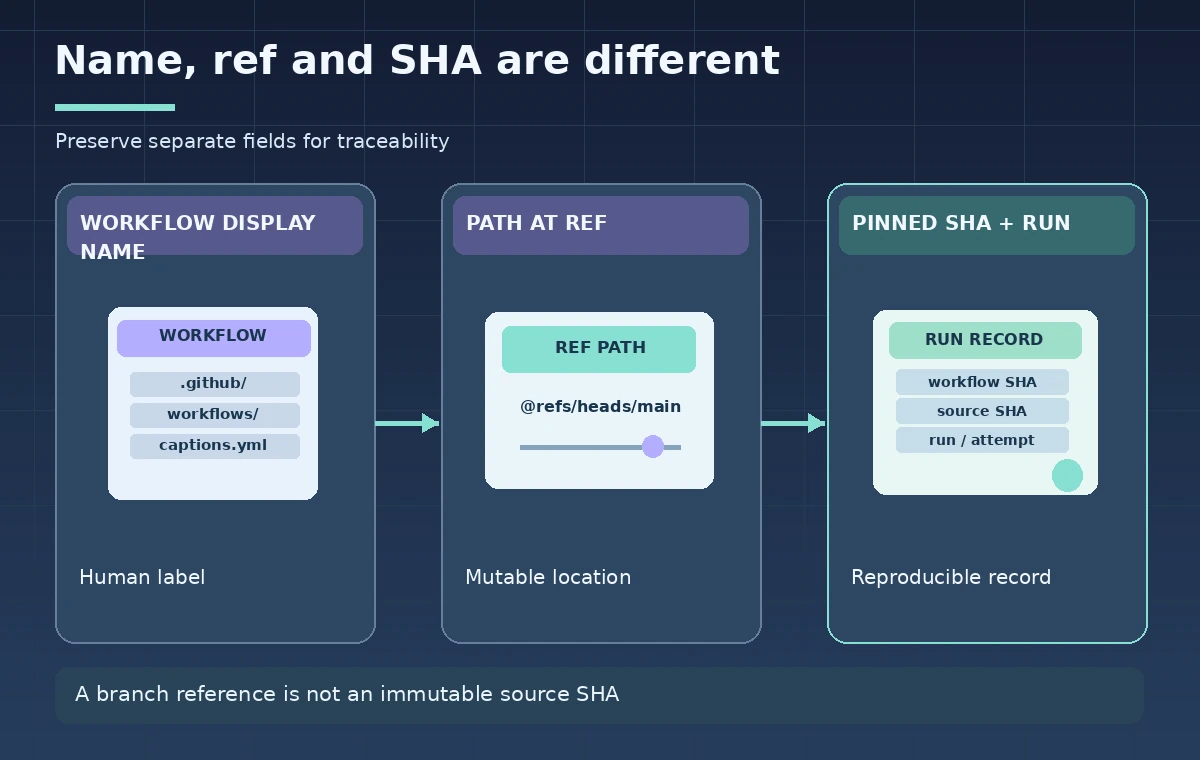
A museum caption review might pass on a pull request, then fail after a workflow file is edited. A green status alone does not tell editors which configuration executed the test. GitHub Actions exposes `GITHUB_WORKFLOW_REF`, a default variable describing the ref path to the workflow file, including repository, workflow path, and ref. This is useful context for a review log. It is not the same as the display name of a workflow and is not an immutable cryptographic identifier. A complete release record should also capture `GITHUB_WORKFLOW_SHA`, run identity, attempt number, the tested source commit, and the tool versions used.
Read the ref path exactly as provided
GitHub documents a value shaped like `owner/repository/.github/workflows/check.yml@refs/heads/main`. The `.github/workflows/` segment identifies the workflow file, while the ref segment tells you which named reference the workflow points to. The name can change as branches or tags move; an administrative renaming can also make historical context harder to compare. Preserve the exact string in a structured record rather than stripping prefixes or attempting to infer a full commit hash from it. Escape it before displaying it in HTML or shell commands because branch and repository names are external strings and should be treated as data.
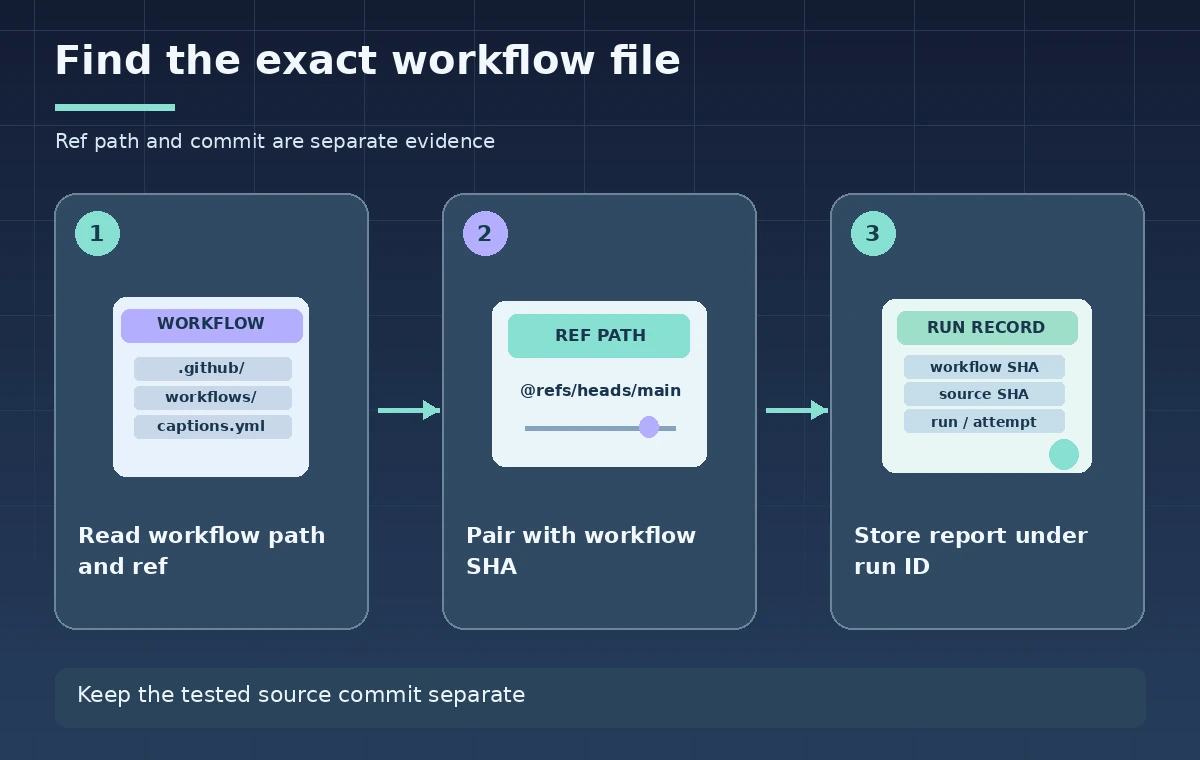
Pair workflow ref with the SHA of the workflow
`GITHUB_WORKFLOW_SHA` identifies the commit SHA for the workflow file. Store it adjacent to the ref value, not in place of it. The ref gives humans a readable workflow location, while the SHA supports a more stable comparison of which workflow revision applied. Neither field by itself proves that every action dependency was pinned or that every intended check ran. For provenance, include the event type, job name, workflow run ID, attempt number, and checkout commit under test. Document any reusable workflow relationships separately; the file that initiated the run might not contain every command executed by downstream jobs.
Distinguish tested code from workflow definition
In a pull request workflow, the checkout may use a merge commit or a different ref from the workflow definition, depending on event and configuration. Do not report `GITHUB_WORKFLOW_REF` as the SHA of the code under test. Keep two distinct columns in the review ledger: workflow identity and source revision tested. If a release reviewer needs evidence that a caption file at a particular commit was checked, collect the actual checkout SHA and the report’s content digest as well. This distinction prevents auditors from assuming that an unchanged workflow ref guarantees unchanged caption content or the same dependency versions.
Protect logs from untrusted values
Default variables supplied by GitHub are useful metadata, but anything derived from branch names, PR titles, or repository content can become dangerous if interpolated directly into shell scripts. Write values to a structured file with proper quoting, and avoid executing them as commands. Do not print tokens, signed URLs, secrets, or full private contributor profiles in a public report. A workflow ref also is not a trust decision: a malicious change to a workflow file may run before the provenance logger executes. Use branch protection, code review, least-privilege permissions, and trusted actions to protect the release process.
Make a structured caption-check record
A useful record has fields for run ID, run attempt, workflow ref, workflow SHA, tested commit SHA, validation tool digest, caption file identifiers, result summary, and approval status. Store the report as an artifact with a retention policy consistent with the institution’s obligations. Human reviewers should be able to compare a report with the source repository without rerunning the entire system. Avoid using a display label like “Caption QA” as the unique identifier: several different workflow files can share that name. The ref path helps distinguish them, and the SHA clarifies their exact workflow-file revisions.
Handle renamed files and moved workflows
If a project reorganizes its `.github/workflows` directory, a report generated before the move should retain the old path rather than retroactively rewriting history. Record the new workflow ref on new runs and link the change to a reviewed pull request. If a branch is deleted later, the historic ref string remains useful as a breadcrumb but may no longer resolve directly. An immutable commit SHA and saved repository metadata make the evidence easier to reconstruct. A release gate should not rely on resolving a mutable branch name months after the report was generated.
Review a hypothetical release sequence
Imagine a caption-fix pull request that runs an accessibility validator. Attempt one fails; a maintainer edits the workflow on a protected branch and re-runs the checks. The two reports may show different workflow SHAs or different tested commits, depending on the event and rerun circumstances. An auditor records the actual variables per run instead of asserting what GitHub must have used. This scenario is hypothetical; no repository, runner, or artifact was accessed. It illustrates why separate fields for workflow ref, workflow SHA, source SHA, and run attempt are needed to explain the evidence accurately.
Approve only the check actually performed
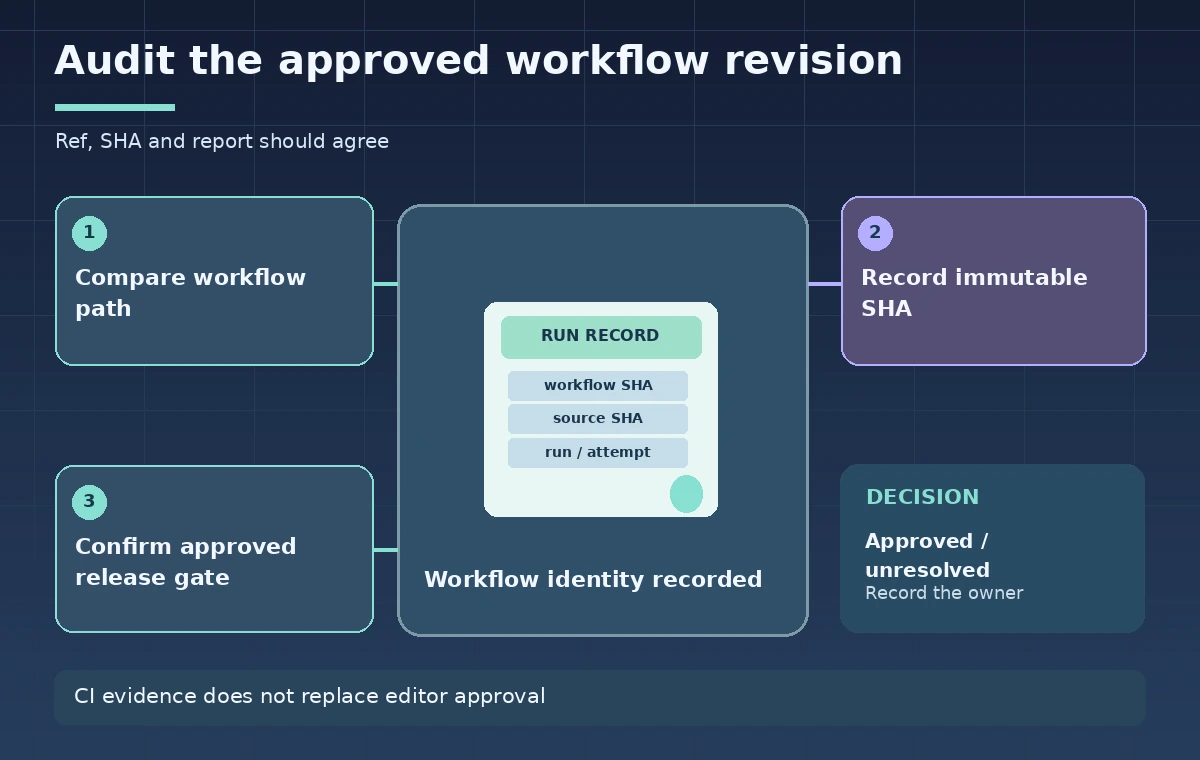
Before publication, verify that the expected caption validator executed with the reviewed rules, that failures are not suppressed, and that the tested commit matches the planned release. Compare the recorded workflow SHA against the reviewed workflow source and the action dependency lockfile or pinned SHAs where relevant. A green job status generated by an unrelated workflow is not proof of caption quality. Keep human editorial approval, accessibility review, and any legal clearance as separate gates. `GITHUB_WORKFLOW_REF` strengthens traceability, but it cannot replace those release decisions or the underlying test output.
How We Research
Primary official sources reviewed November 11, 2026: GitHub Actions variables reference; GitHub workflow syntax; GitHub workflow run context. We compared GitHub’s official default-variable reference with its workflow syntax and context documentation. The workflow-file path and run examples are hypothetical; no repository, branch, CI runner, or release was inspected. All sample identifiers, interface states, examples, images, and comparisons in this article are editorial teaching materials, not test results, measured figures, actual API calls, or vendor screenshots. Product parameters, model support, region availability, quotas, access requirements, and prices may change. Confirm current vendor documentation and institutional permission before using any workflow with real data.
Frequently Asked Questions
It identifies the repository, workflow file path, and ref used for the workflow, such as a branch reference.
No. Named refs may move. Pair it with GITHUB_WORKFLOW_SHA to capture the workflow-file commit identity.
Not necessarily. Record the actual checked-out source SHA separately, especially for pull request events.
No. Names can be duplicated or changed. Retain the workflow path, SHA, run ID, and attempt.
No. Inspect the actual test report, tool version and permissions, and maintain independent editorial approval.