
An archive filename is part of its identity
An image collection may contain accented titles, spaces, parentheses, and characters inherited from older catalog systems. During inventory, the filename is often more than decoration: it may link an object to an accession ledger or preservation report. Amazon S3 object keys support UTF-8 names, but an XML listing can struggle with certain character values. ListObjectsV2 provides the encoding-type parameter, with url as the documented value, so a listing can represent keys safely. The editorial mistake to avoid is treating a percent-encoded listing representation as a new canonical object key or renaming files during an audit.
Understand what EncodingType=url changes
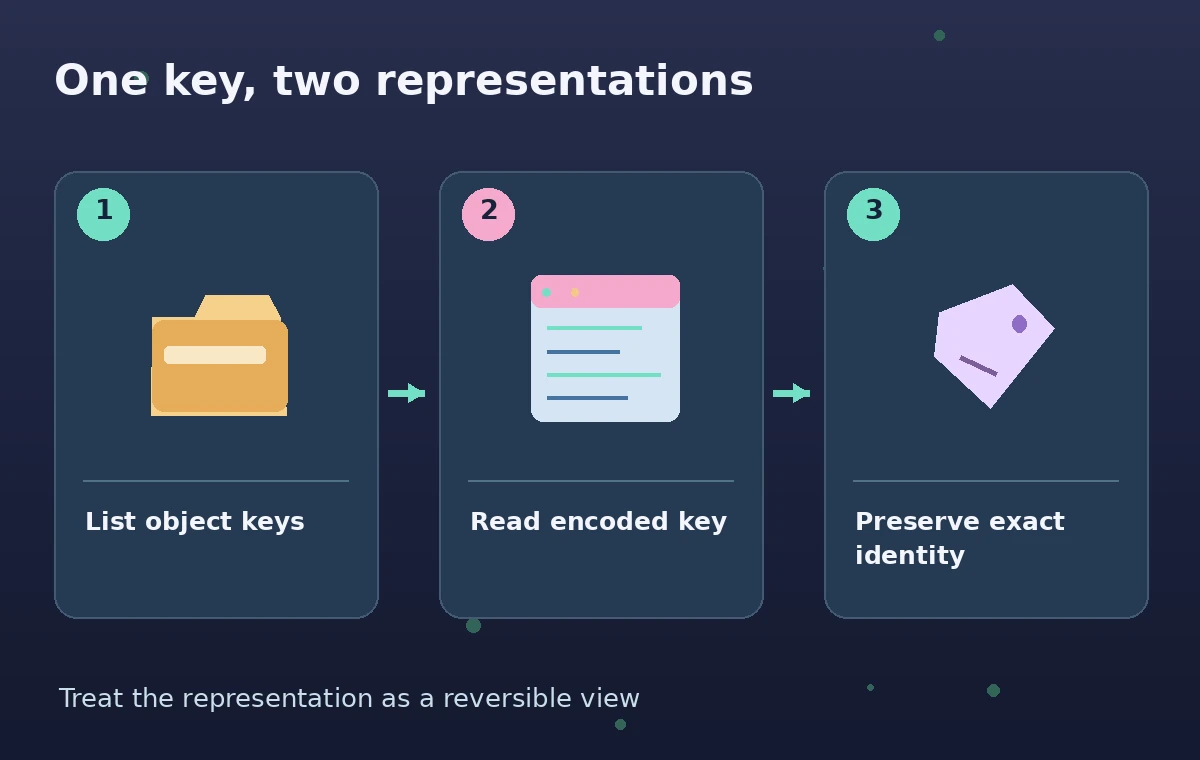
A ListObjectsV2 request can specify encoding-type=url. AWS documents that S3 then percent-encodes key names in the XML response using UTF-8. For example, punctuation such as parentheses can appear as percent-encoded sequences in the returned Key element. This changes how the listing represents the key, not the name of the stored object. Design the inventory reader to parse the service response, decode the represented key according to the documented encoding, and store a stable unambiguous form for future operations. The request parameter is a response-format control, not a file repair operation.
Keep raw and interpreted values separate
For a hypothetical conservation scan named with accents and parentheses, record both the exact listing representation received and the interpreted logical key used by the client. An SDK may already handle decoding, so do not blindly apply URL decoding a second time. Double decoding can turn a literal percent sequence in a key into an unintended character, potentially breaking lookups. Record the client library and decoding convention in your ingestion notes. When comparing inventory exports from different systems, normalize only after verifying they refer to the same key; never alter the original key merely because the export looks unfamiliar.
Use pagination without changing the key identity
ListObjectsV2 can return a truncated list with a continuation token. A reliable inventory follows NextContinuationToken when IsTruncated indicates more results, while preserving the same bucket, prefix, delimiter, and encoding choice across pages. Do not replace a continuation token with an arbitrary decoded filename or assume the first thousand entries represent the whole collection. The complete response may also group CommonPrefixes when a delimiter is set; these prefixes are not necessarily object files. Record the inventory scope and the page count, and detect any repeated or missing key entries before calling an audit complete.
Do not confuse visible text with file bytes
An encoded Key value tells you how a name was represented in a list response. It says nothing about the checksum, content, retention policy, or file format stored under that key. When preservation staff need to prove that a digitized master is intact, use a separate checksum and version-aware verification process. A successfully decoded filename can still refer to the wrong revision or an incomplete ingest. Keep display labels, object keys, version identifiers, and cryptographic integrity results in distinct columns so that an inventory spreadsheet does not turn a readable name into a false assurance of preservation.
Handle unusual characters in downstream exports
CSV, spreadsheets, URLs, and HTML can each interpret punctuation differently. Export logical keys as correctly escaped text for the destination format. For spreadsheets, guard against formula interpretation when a filename starts with an expression-like character. For HTTP requests, let a trusted SDK construct the necessary request encoding rather than concatenating raw key text into a URL by hand. Avoid logging secret-bearing presigned URLs in the audit. The schema should keep an opaque object identifier or exact key alongside a human display name, because visual similarity is not a safe identity check.

Test edge cases with a synthetic key set
Create a permission-cleared test list containing names with accented characters, spaces, parentheses, literal percent signs, and an awkward XML-sensitive character where your tooling supports it. Run the listing reader and verify a round trip from the represented key to an exact key lookup. Also check a prefix that returns multiple pages. Use made-up archive names; no real accession details are needed. Capture which library performed decoding and whether your output preserved byte-level identity. This is a proposed test protocol, not a claim that those operations were performed against a production bucket for this guide.
Validate the expected records, not just the syntax
After decoding, reconcile expected accession identifiers against the inventory. Detect duplicate logical keys, missing files, unexpected prefixes, and filename changes between inventory revisions. Beware of systems that case-fold or Unicode-normalize display text without maintaining a separate exact object key; two labels that look the same can still differ as keys. If a record fails to resolve, investigate the representation and query construction before concluding the file is missing. A reproducible mismatch report is more useful than silently replacing special characters or trimming punctuation.
Protect visibility during catalog publication
S3 listing permission and public display rights are different. A staff inventory may reveal names of restricted oral histories or donor submissions even when file content is protected. Publish only the approved subset of descriptions, after collection-policy review. Do not expose raw bucket listings or object keys to a public visitor-facing page by default. The encoding parameter is not an authorization setting; it neither grants nor restricts access. Use least-privilege credentials for the inventory job and keep its logs under the same confidentiality rules as the archived material.

Document the listing semantics in the final report
The archive inventory should state that ListObjectsV2 was used, whether url encoding was requested, how keys were decoded, what prefix was covered, and whether all continuation pages were reviewed. Retain the original key and any version data needed to reconcile later changes. Label conceptual diagrams as examples in alt text or methodology rather than presenting them as AWS console screenshots. Correct handling of EncodingType=url solves a representation problem; it does not replace integrity checks, access reviews, or version reconciliation in a preservation workflow.
How We Research
This November 11, 2026 article is a documentation-based instructional analysis, not a hands-on test or production benchmark. We compared AWS, Amazon S3 ListObjectsV2 API and AWS, Naming Amazon S3 objects, identified the precise parameter or behavior that the documentation supports, and organized the guidance around an illustrative museum workflow. We did not run a live service request, inspect real WordPress content, measure accuracy, or verify delivery against a working customer account. Each pictured scenario is an original conceptual illustration; current settings, permissions, supported API versions, and organization-specific governance must be confirmed before use. The release checks deliberately distinguish technical output from authorization, evidence quality, and actual user outcomes.
Frequently Asked Questions
No. It changes how object keys are represented in the listing response, not the stored key itself.
Some object-key characters cannot be represented safely by XML 1.0 parsers. URL encoding provides a supported response representation.
Not automatically. Some SDKs already interpret the response. Check the returned representation to avoid double decoding.
No. Filename handling and object integrity are separate checks.
Follow ListObjectsV2 continuation tokens and reconcile the full scoped listing, not only the first response page.