
Why a blank queue policy is not proof of isolation
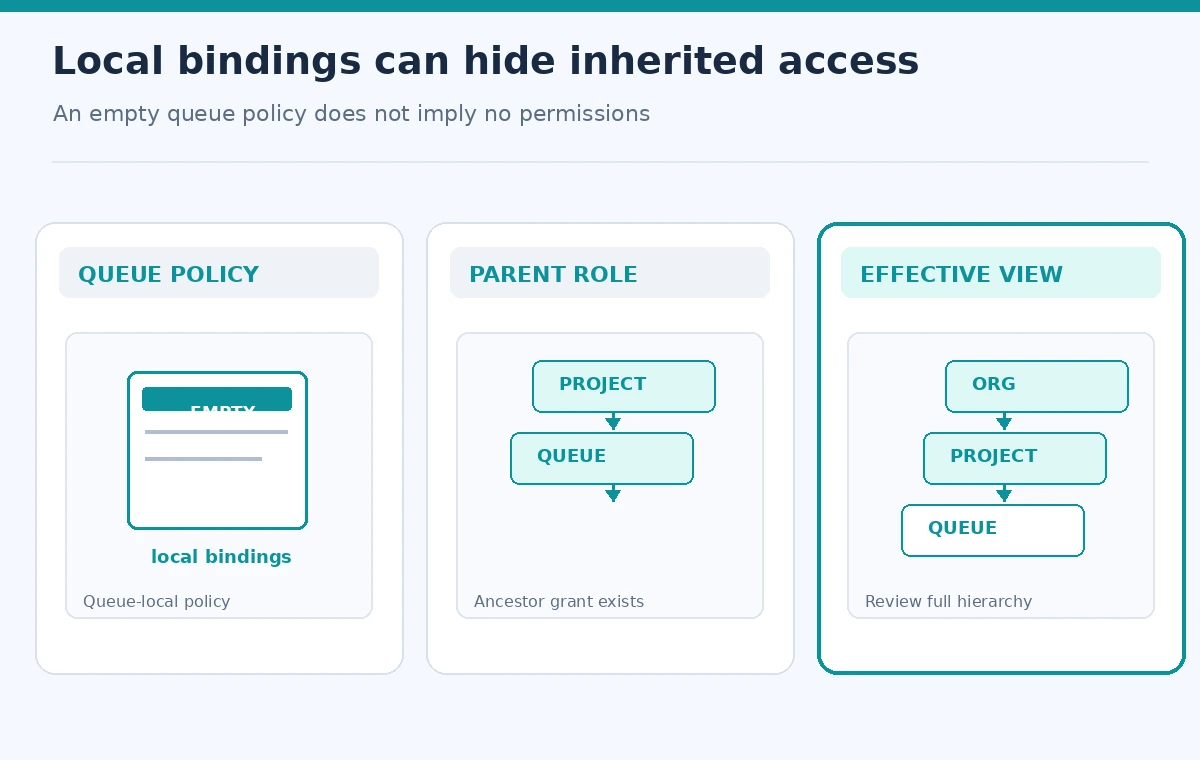
A museum operates a Cloud Tasks queue that sends membership reminder webhooks. A staff member reads the IAM policy attached directly to the queue, finds no bindings, and declares that only administrators can dispatch tasks. That conclusion may be false because IAM roles granted at the project or other ancestor levels can apply to the queue. Google Cloud documents policy inheritance, and GetIamPolicy returns the policy of the selected resource rather than an automatically flattened inventory of every applicable ancestor grant. Treat a blank local result as the start of an access audit, not a security certification.
Identify the exact queue and principal
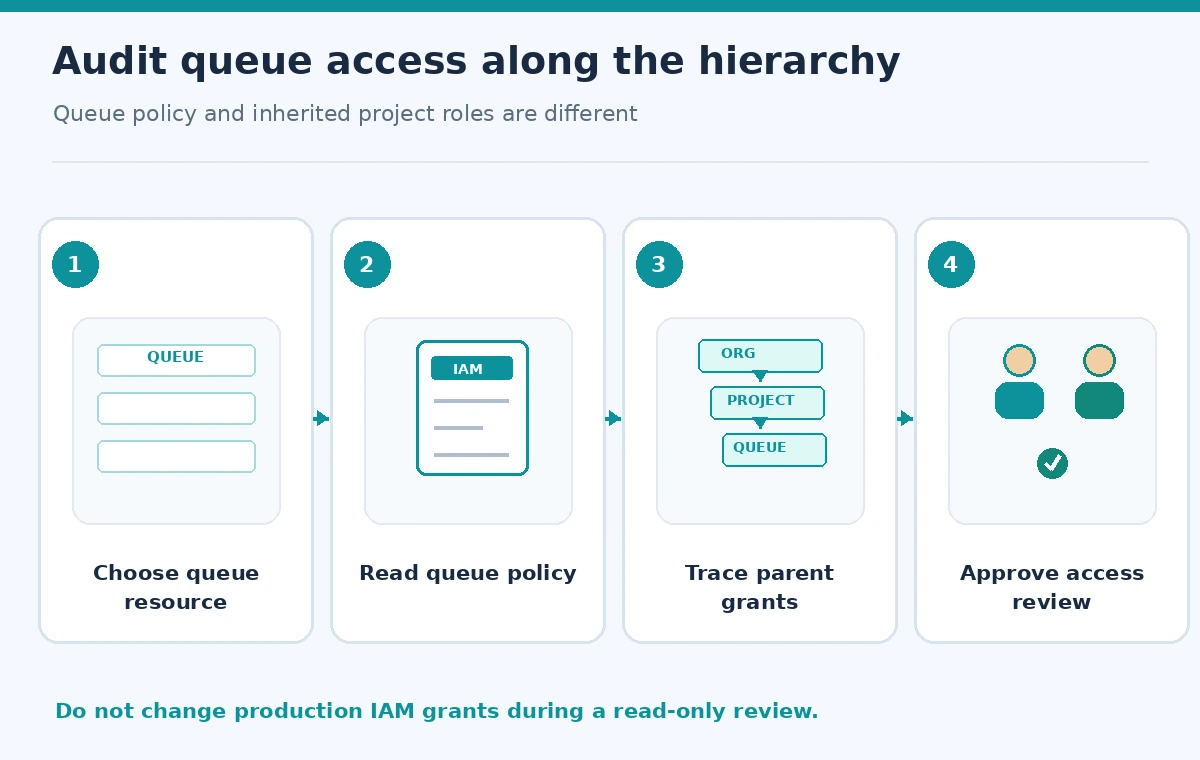
Begin with the complete queue resource name in the form `projects/PROJECT_ID/locations/LOCATION/queues/QUEUE_ID`. Confirm that the intended account and region are correct before examining access. Record whether the audit is about staff who create tasks, a service account that dispatches them, or operators who can modify the queue. These are different capabilities. Assign an audit identifier and use a read-only review role where possible. Avoid using a broad project owner credential solely for convenience; the ability to inspect policy is itself a separate permission that should be granted deliberately.
Use the documented GetIamPolicy method
The Cloud Tasks v2 REST API documents `projects.locations.queues.getIamPolicy` as a POST to the queue resource with the `:getIamPolicy` suffix, returning an IAM Policy object. The caller needs `cloudtasks.queues.getIamPolicy` permission on the relevant resource parent. For example, target the full resource URL under `https://cloudtasks.googleapis.com/v2/` and authenticate through supported Google OAuth credentials. The API returns an empty policy if an existing queue has no policy set, which does not account for inherited grants. Do not confuse this read request with the `setIamPolicy` method, which changes who can access the queue.
Read bindings and policy metadata carefully
Inspect each returned binding by role and member, including service accounts and groups. If conditions are present, preserve the condition expression and title instead of treating the binding as unconditional. IAM policy metadata such as etag helps track changes, but the value by itself does not prove that a policy is safe. For an operational workbook, note the binding source, review date, purpose, and nominated owner. Resolve group membership through authorized identity administration rather than guessing who sits behind a team name. Do not publish usernames or service account identities from a live customer environment in the article.
Trace inherited grants at the project boundary
Review the effective policy path through the relevant project, folder, and organization hierarchy with the IAM team. Google Cloud allows policies attached to ancestors to grant access to descendants; a queue-local policy read cannot list all of them. For each potentially applicable ancestor grant, compare the identity and permissions with the webhook queue’s actual needs. Record whether an inherited role makes a queue-local binding redundant, and distinguish that finding from an instruction to remove the inherited role. Removing a project-level grant could interrupt many other services. Escalate changes through the organization’s change-control process.
Understand why testIamPermissions is not a security gate
Cloud Tasks also exposes `testIamPermissions`, which reports requested permissions held by the calling identity. Google explicitly says this API is intended for permission-aware interfaces and command-line tools, not authorization enforcement, and may fail open. Use it only as supplementary diagnostic context. Do not use a green result to authorize a sensitive operation, and do not infer that a missing permission means the resource does not exist. Real requests must still be authorized by Google Cloud. A read-only audit should not dispatch a task merely to see whether credentials work.
Compare local, inherited, and effective exposure
Build a conceptual access matrix that separates queue-local bindings, project or folder grants, and permissions relevant to the specific service identity. An operator might see no local roles but still have queue access inherited from a project. Another role might include visibility without management rights. Each row should include the resource boundary and evidence source, not a fabricated count of allowed principals. If inherited permissions cannot be assessed by the reviewing team, label the audit incomplete. Avoid creating new IAM roles as a test: read operations and a controlled identity review are safer.
Preserve credentials and audit logs
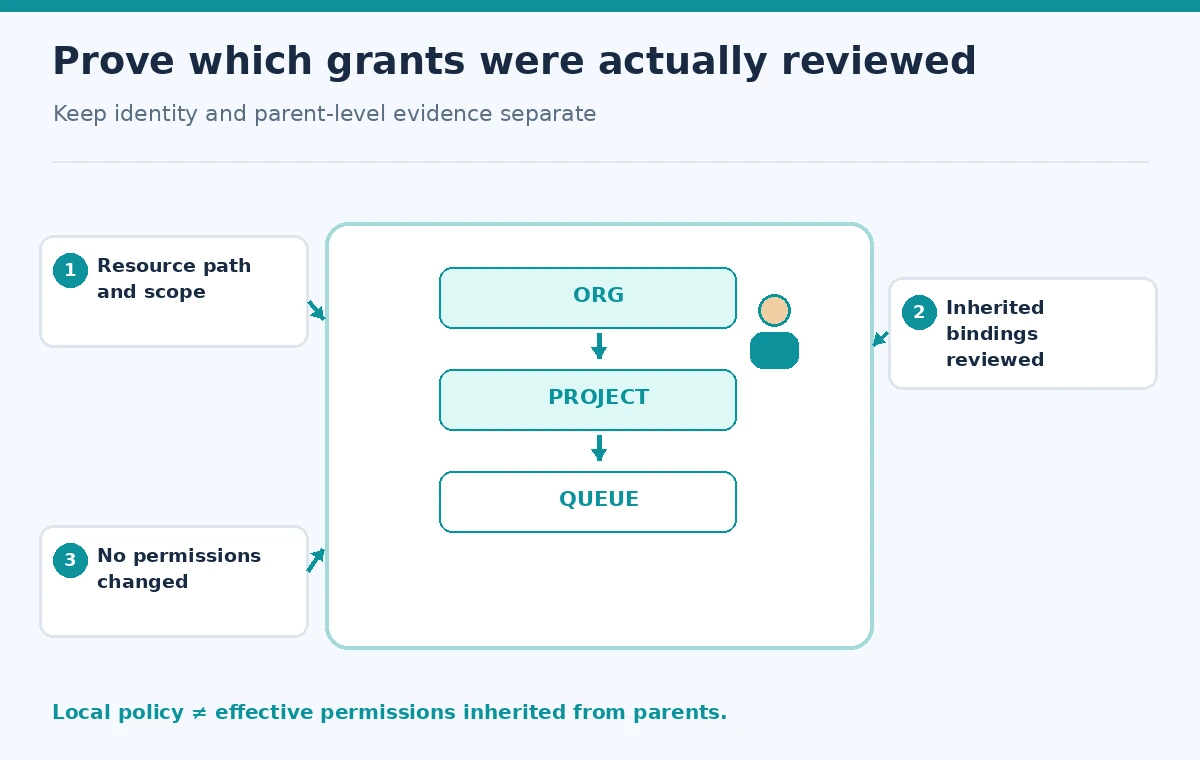
Policy documents can reveal account identifiers, internal group names, and operational structure. Share redacted summaries rather than raw policy JSON outside the organization. Record the authenticated identity used for the read, timestamp, queue path, and the applicable ticket number in a protected audit log. Review any recent policy change through official Cloud Audit Logs or organization governance tooling. Do not insert service-account keys or OAuth tokens into article drafts, CI logs, or ticket screenshots. Short-lived identity-based authentication is generally preferable to exporting long-lived secrets for a one-time audit.
Decide whether remediation is required
An access finding should describe the specific unintended capability, the principal affected, and which inherited or local grant causes it. Ask the owner to validate the business requirement before scheduling a policy change. Prepare a rollback and coordinate with the webhook owner if a grant removal may interrupt reminders. A complete approval checklist separates evidence collection, independent review, and the actual change window. This article intentionally performs no write operation; GetIamPolicy helps investigate access but cannot certify the absence of every risk or substitute for a full IAM analysis.
How We Research
We consulted Google Cloud’s Cloud Tasks getIamPolicy reference, testIamPermissions reference, and IAM allow-policy and inheritance guide. The museum reminder queue is hypothetical; no production policies, principal memberships, or operational access rights were observed or tested.
Frequently Asked Questions
No. Project, folder, or organization policies can grant inherited permissions.
No. It reads the policy; setIamPolicy is the separate write operation.
The documented permission is cloudtasks.queues.getIamPolicy on the relevant resource parent.
No. Google explicitly warns it is intended for permission-aware tooling, not authorization gates.
Not without a change review. A parent grant can support many resources outside this queue.