
A queue dashboard should not guess who can press Run
A museum uses Cloud Tasks to deliver RSVP reminders and build notices. Staff want a small operations console that shows an enabled “inspect queue” control only when the signed-in operator appears to have the relevant Google Cloud permissions. Cloud Tasks has a testIamPermissions method for this type of permission-aware user interface. The tempting mistake is to treat the returned list as an authorization token. Google explicitly warns that the operation is not designed for authorization checking and may fail open without warning. This article describes a hypothetical console design, not a penetration test, a real IAM audit, or an authorization scheme for a production museum account.
Know the exact method and target resource
The documented v2 endpoint is a POST to projects.locations.queues.testIamPermissions on a queue resource, shaped like projects/PROJECT_ID/locations/REGION/queues/QUEUE_ID. Its request body contains an array of permission names, not wildcard patterns. The response is a list of permissions reported for the caller. Call it with only the actions the interface needs to explain, such as the relevant queue-reading or task-viewing permissions from the current IAM reference. Before coding, confirm that the queue name, project, region, and identity are the ones the operator expects. A response for one queue cannot be assumed to describe another queue or project.
Treat an empty response as ambiguous
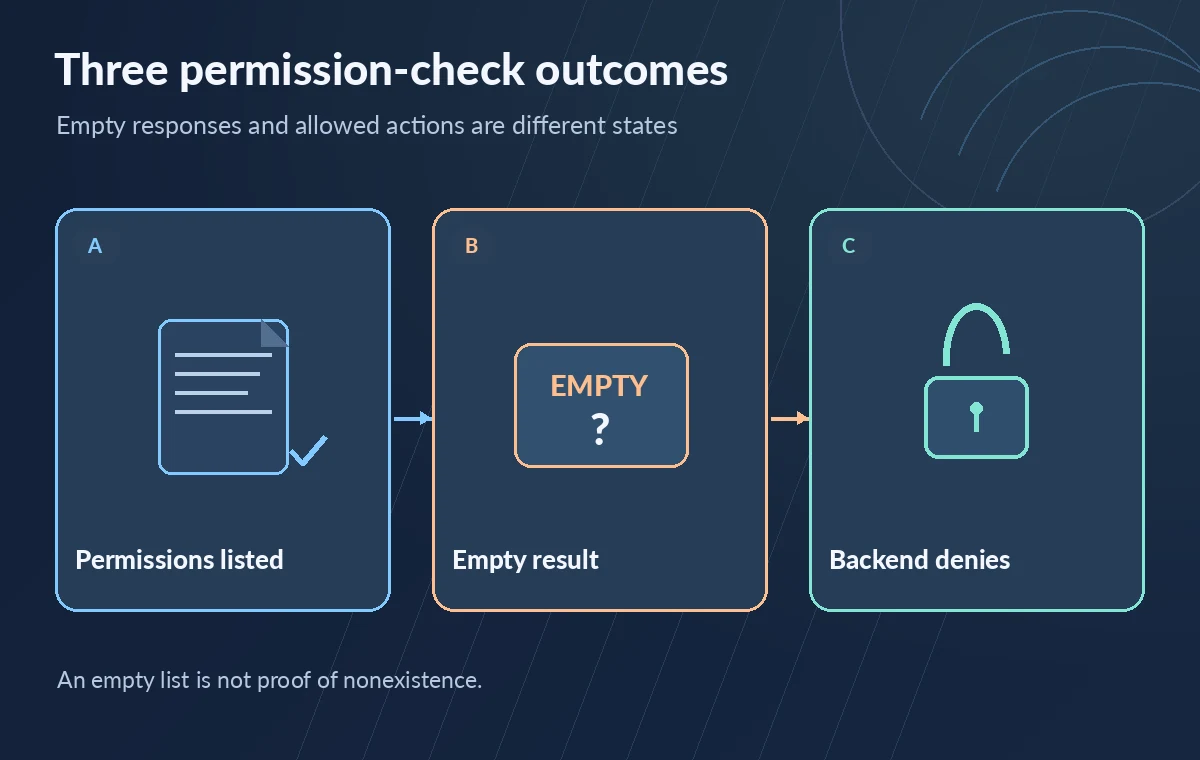
One especially important documented edge case is that a nonexistent queue can return an empty permission set instead of NOT_FOUND. An empty result therefore does not by itself establish whether the queue exists, whether the operator lacks permissions, or whether another policy path affected the answer. Do not generate a banner that asserts “access denied” as a definitive forensic conclusion. Present the result as an unavailable capability hint and provide a separate, appropriately authorized resource lookup if the operator needs a more precise diagnosis. The service also warns about fail-open behavior, making the method unsuitable as the sole guard on any real action.

Design the user interface as a suggestion layer
The console can dim a destructive action, hide an advanced menu, or display a note about permissions based on returned hints. Those choices make the experience easier to navigate but cannot protect the queue. Every actual API operation must still use authenticated identity and receive permission checks from the service. For example, a client might show a “delete task” button based on a previously cached hint even after an IAM role changes. The deletion must still be refused if the caller is not currently authorized. Maintain the least-privilege separation between viewing task metadata, adding work, pausing a queue, and editing IAM policy.
Never pass a visual hint as a bearer of trust
A JavaScript client or command-line tool can be modified by its user. If a backend accepts a value such as hasQueueAdmin=true and skips IAM verification, the UI has accidentally become the security boundary. Instead, forward a request under an appropriate authenticated identity and rely on the service authorization for the target API. Log the actual operation outcome with a correlation ID, not merely the earlier testIamPermissions output. If your design uses a service account, be clear that a check made as that account reflects its permissions rather than the human operator’s permissions. The two principals must not be confused in an audit.
Distinguish queue policy from inherited access
An IAM permission outcome depends on more than a single policy document attached to a queue. Project-level grants, organizational conditions, and relevant policy enforcement can affect what an identity can do. A prior article about GetIamPolicy concerns retrieving queue-level policy bindings; testIamPermissions answers a different, caller-centered UI question. Neither method on its own is a complete administrative access certification. In a security review, document the caller principal, resource, permission string, time, and operation actually exercised. For a high-risk permission change, use established IAM tools, organizational review, and a separate approval path rather than a green icon in a custom dashboard.
Prepare safe, read-only test cases
Before a limited pilot, create synthetic queues and operator accounts in an approved test project. Compare an operator that can inspect tasks, another that can manage tasks, and an identity with no relevant grants. Include a deliberately mistyped queue resource to observe how the UI handles an empty result without inventing a cause. Do not run a real deletion simply to confirm which button should appear. A test matrix should record expected hints and independent backend authorization, with explicit failures for mismatches. This is a suggested test approach; we did not execute those test calls or inspect real museum identities.
Plan for stale hints and operational changes
Permissions can change while the operator is looking at a screen. Refresh the UI hint when it is useful to reduce confusion, but do not claim that polling makes the result an authoritative permission state. Handle 403, timeout, and unavailable API responses distinctly from an empty permission array. Use accessible text that describes what the console knows and does not know. Keep destructive operations behind separate confirmation and auditing. If the queue is paused or deleted, the interface must not equate the existence of an old permission hint with the continued existence of the resource.

Release only after the real boundary is reviewed
For production readiness, an engineer should verify which principal calls the endpoint, who invokes real queue operations, how IAM is enforced, what response is shown when a resource is missing, and what evidence is recorded. A button can help operators avoid unproductive clicks; it never grants or revokes roles. Confirm OAuth scopes and the current Cloud Tasks reference before deployment. Protect visitor contact information and avoid logging raw task bodies in a shared dashboard. The accompanying images are explanatory workflow sketches, not authentic Cloud Console screenshots or proof that any real IAM policy was tested.
How We Research
We reviewed Cloud Tasks testIamPermissions REST method and Cloud Tasks queue REST resource and Google Cloud IAM overview, focusing on supported parameters, model or API versions, response shapes, service limitations, and operational consequences. The example museum or grant workflows are hypothetical, designed from official reference material rather than client testing. The illustrations are original conceptual drawings, not service screenshots, measurements, security tests, or actual audit evidence. We did not access customer data or perform live API calls. Features, pricing, preview terms, IAM settings, and provider behavior can change; validate current documentation against your selected deployment before making production or editorial decisions.
Frequently Asked Questions
No. Google explicitly warns it is for permission-aware interfaces rather than security authorization, and real operations must enforce IAM.
No. The method can return an empty set for a nonexistent resource and cannot independently resolve every reason for an empty result.
It reports permission hints for the authenticated caller, which might be a service account rather than the human using the UI.
No. The API documentation specifies an explicit permissions array and disallows wildcard entries.
No. IAM policies and queue resources can change; treat the result as a temporary interface hint and enforce permissions independently.