
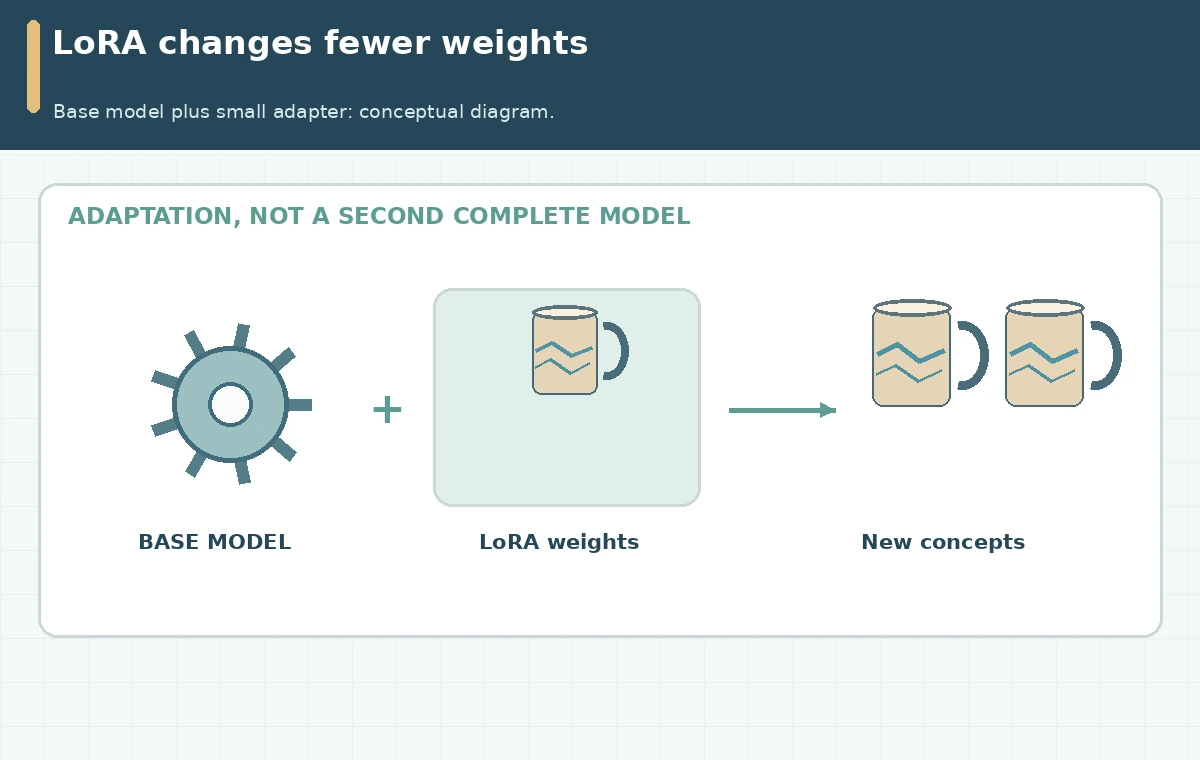
A LoRA can adapt a compatible image-generation model to a subject or visual style without updating every weight in the base model. That does not mean a tiny folder of images will produce a reliable, licensed asset. This guide uses an invented series of illustrated ceramic mugs—not real people—to describe the dataset decisions, evaluation splits, and rights controls that should come before training. It is a preparation and review checklist, not a completed model-training experiment or a hardware benchmark.
Decide whether you need training at all
For a one-off illustration, prompting or a reference-image adapter may be sufficient. LoRA is more appropriate when the same visual language or approved subject must recur across many prompts and you have permission to use a coherent dataset. Define the acceptance criteria first: a recognizable mug silhouette, consistent painted wave motif, intact handle, and useful variations in camera angle and setting. Avoid vague goals such as “train beautiful images.” Training is not inherently preferable to an existing style reference, and it adds responsibilities for dataset maintenance, compatibility, model storage, and license compliance. Write down who will consume the results and what failures would make the project unusable.
Build a rights ledger before collecting images
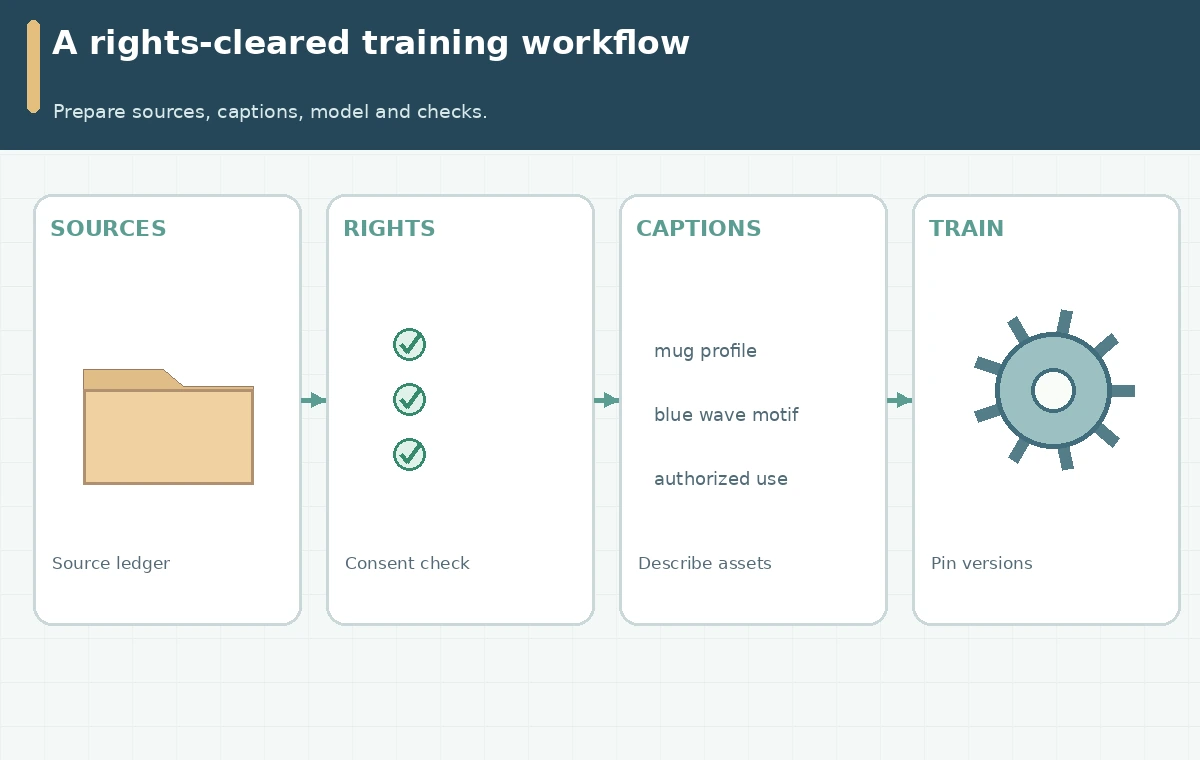
List every source image, creator, acquisition method, permitted training use, subject permission where necessary, and approved output use. A public image on the web is not automatically training data you may use. If a commissioned photographer provided the mug images, review the contract rather than assuming the commission transfers all machine-learning rights. Exclude personal data, private material, and pictures of recognizable people without appropriate consent. A rights ledger should contain the evidence itself or a durable reference to it; “found online” is not a license. Keep the training dataset under controlled access and avoid publishing a checkpoint that could reveal sensitive or licensed content without authorization.
Curate variety without contradicting the subject
For the fictional mug set, include authorized photographs or illustrations from different angles, lighting setups, and backgrounds while keeping the actual wave motif and handle geometry consistent. Remove near duplicates that would dominate the training signal, and flag blurry or heavily compressed files. Do not let every example use the same tabletop, or the model may memorize a background rather than learning the intended mug identity. Document crops, resizing, caption choices, and excluded outliers. If you are training a style rather than a product subject, select images that consistently demonstrate the desired brushwork or color language across several objects, not simply repeated copies of one picture.
Select a supported LoRA script and base checkpoint
Hugging Face’s Diffusers LoRA guide explains that LoRA trains a smaller number of added weights and documents scripts such as `train_text_to_image_lora.py`. Its DreamBooth documentation describes subject-focused training and the `train_dreambooth_lora.py` option. Choose a base model whose license, architecture, and training instructions match the task. Pin library versions and record hardware requirements from the specific example; do not assume one memory figure applies to every model. Keep the output directory separate from the licensed training files. Never describe this guide as evidence that a particular GPU completed a run.
Use a validation split and record overfitting signals
Reserve images or review prompts that were not used as nearly identical training examples. Test whether the mug remains recognizable from a new camera angle and against a background absent from the training set. Look for repeated camera framing, copied background texture, malformed handles, and the wrong motif on the mug. Hugging Face cautions that text-to-image training is experimental and can overfit, including catastrophic forgetting in broader training contexts. Evaluate generations at several checkpoints rather than choosing the last file automatically. These are proposed review criteria, not scores from a LabFin experiment. Document a pass, revise, or stop decision with specific examples.
Treat checkpoint sharing as a separate approval
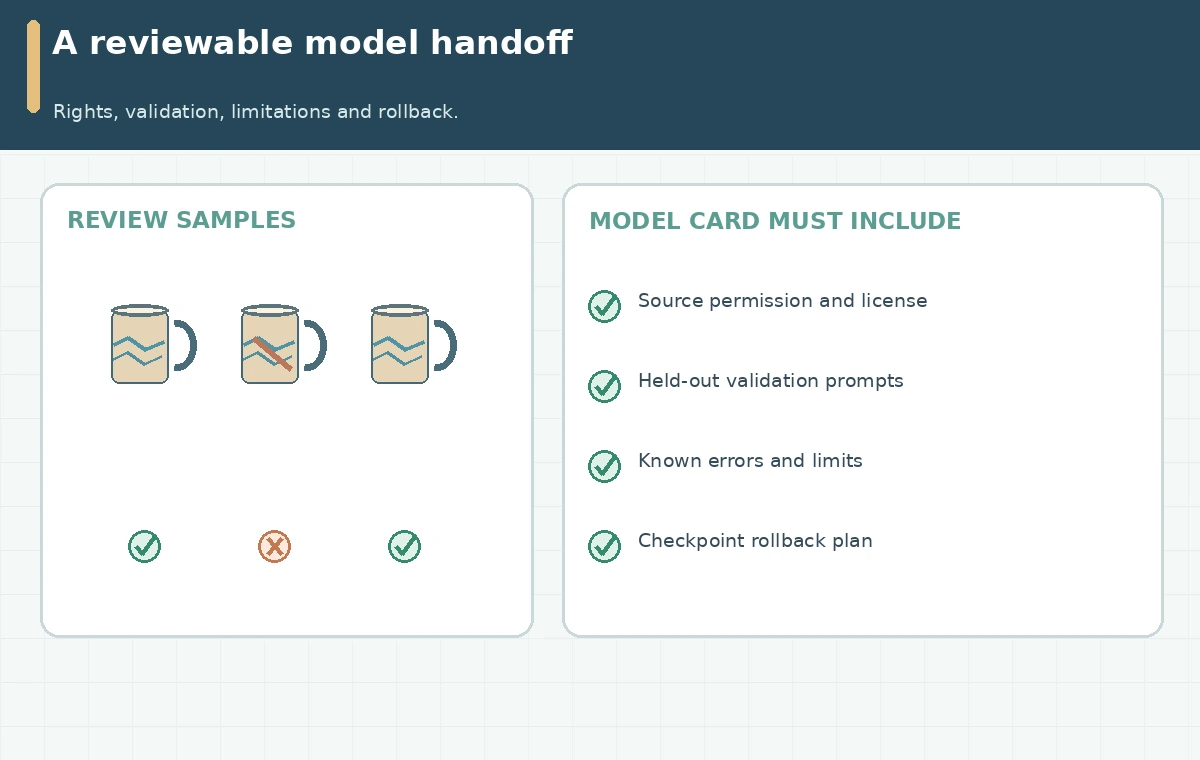
A lightweight adapter can still inherit use restrictions from its base model and reflect characteristics of the supplied training data. Save the exact base model identifier, license terms, training script version, captioning procedure, configuration, and source rights record. Decide whether the LoRA is for internal use, a client handoff, or public distribution, because those permissions may differ. If releasing it publicly, review potential memorization, ownership, disclosure, and checkpoint metadata. Small weight size does not equal low privacy risk. Restrict accidental uploads to model hubs until a responsible reviewer authorizes both the weights and their accompanying samples.
Make a model card and a rollback plan
Write a brief model card describing intended use, out-of-scope uses, known failure modes, training data provenance category, license dependencies, evaluation protocol, and version. Attach a small gallery of rights-cleared validation examples and the reasons each passed or failed; do not describe hypothetical examples as verified outputs. Keep original base and earlier checkpoints so a new training run can be compared and rolled back. Include a procedure for excluding a dataset item if permission is later withdrawn. A trustworthy adaptation project is one that a second reviewer can understand and discontinue safely, not merely a download with an appealing thumbnail.
How We Research
We consulted the Diffusers LoRA training guide, DreamBooth training reference, and text-to-image training cautions on October 28, 2026. We made no training runs, claims of model accuracy, compute-cost estimates, or claims that a particular license grants rights beyond its published terms. The visuals are original conceptual explanations, not screenshots or measured experiments.
Frequently Asked Questions
LoRA trains a smaller set of adaptation weights, while full fine-tuning updates far more of the base model.
Do not assume public visibility grants training permission; review source rights and consent before using each image.
No fixed small sample count guarantees quality. Diversity, relevance, model fit, and evaluation matter.
Typically it contains adaptation weights, so a compatible licensed base model is still required for inference.
No. Review licensing, privacy, memorization, samples, metadata, and approved distribution purpose first.