
A chart can look finished before its evidence is ready
A curator preparing a hypothetical monthly attendance report might ask an assistant to turn an approved CSV into a chart. The polished image is tempting to paste into a board packet immediately. Yet an attractive axis and a plausible trend do not prove that the correct dates, categories, or source revisions were used. Code Interpreter is a tool for running code in an isolated container; it does not independently certify the business meaning of the input. The useful editorial task is to connect each visual statement to an authorized dataset, a specific transformation, and a human review decision.
Request execution output deliberately
The Responses API documents an optional include array. Setting include to code_interpreter_call.outputs requests the outputs of Python execution in Code Interpreter call items. First enable the code_interpreter tool with its required container configuration, then inspect the response output items for the relevant code_interpreter_call and its available outputs. Do not assume every response necessarily uses the tool or produces a chart. Tool availability, the chosen model, errors, and the request itself affect what appears. A text-only assistant answer is not a substitute for inspecting the requested tool-call record.

Treat the tool output as a trace rather than a verdict
The execution record can help an editor see what the sandbox emitted, but it is a partial trace of a computation, not a certification that the data were legitimate. Preserve a mapping between the input file revision and the executed chart. If a notebook groups attendance by month, review the grouping rule and check whether late corrections were included. A graph that was successfully drawn can still mislabel a category, omit null values, or average figures that should have been added. Explain in the publication which source and transformation were reviewed rather than simply saying the AI verified the chart.
Define a compact provenance ledger before asking for a plot
Assign an internal identifier to the approved source file, record its version and a checksum in a private editorial ledger, and note the date range and unit of measurement. Do not insert donor names or individual visitor details solely to make a demonstration look realistic. Use an aggregated or synthetic practice dataset when possible. In the prompt, specify the exact column names and the requested chart type, and tell the assistant to flag missing or ambiguous fields instead of inventing values. A reviewer should be able to reproduce the intended data mapping without relying on the assistant conversation as the only record.
Examine the calculation and visual axes together
A meaningful check includes the code path, its numerical summary, and the final visual. If the chart counts visitors, compare the total against a separately computed source total. Read all axis labels, category names, time zones, and sorting rules at full resolution. Zero-filled months must be distinguished from months for which no data were received. A stacked bar can also double-count a person if several categories overlap. The diagram illustrates a plausible discrepancy, not an observed Code Interpreter failure. Reviewers should annotate the precise reason for accepting or revising each chart, rather than relying on a generic pass label.
Separate sandbox files from durable publication artifacts
OpenAI describes Code Interpreter containers as ephemeral, with documented expiration behavior. Generated files can be returned through file citations or other supported container-file mechanisms, but a sandbox working copy is not a long-term archive. Download or export an approved image and any necessary source-side methodology to the organization’s controlled storage while access is available. Preserve a versioned chart alongside the editorial approval record. Never promise that an expired container can be reconstructed from an assistant answer; retaining an output image is not the same as retaining every calculation needed to reproduce it.
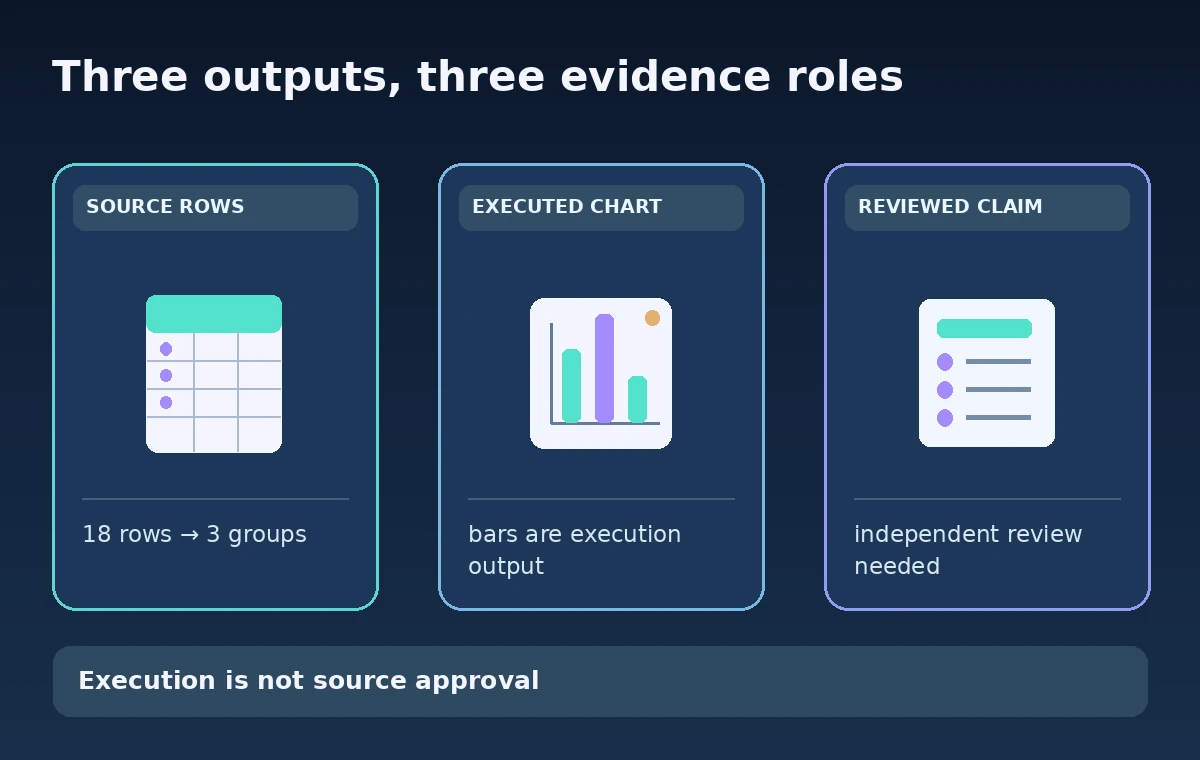
Review failure states before sharing a board report
An absent tool output, an execution error, a mismatched source identifier, or a chart with unreadable labels should stop publication. The editor can ask for a rerun with corrected inputs, but should then recheck the revised output rather than carrying forward an earlier approval. Avoid presenting a narrative summary if only part of a requested analysis completed. If the assistant reports a change in attendance without showing the calculation basis, label that statement as unverified. Document both the successful path and the stop conditions in a short release checklist.
Keep sensitive archive material outside public demonstrations
Code Interpreter can process uploaded files, which makes access governance important before an analyst starts. Apply collection permissions to the source dataset and minimize personal fields. A screenshot of a tool result might inadvertently expose filenames, group labels, or file contents. Review every chart and caption as a separate publication artifact. For material involving minors, donors, or restricted collections, obtain the appropriate organizational approval before sending data to any external service. A technical sandbox should not be described as an automatic permission boundary for all downstream screenshots and exports.
Compare the chart with an independently chosen check
Choose a small set of source records whose expected totals can be calculated manually, such as two known months and a category with no entries. Ask an editor who did not prepare the prompt to reconcile those values with the plotted bars. Check that a revised record changes the corresponding chart element as expected. Do not fabricate a measured accuracy rate or claim the platform produced a particular result in this guide: the figures in the illustrations are conceptual. The objective is a repeatable review routine that would expose errors even if the chart appears professionally designed.
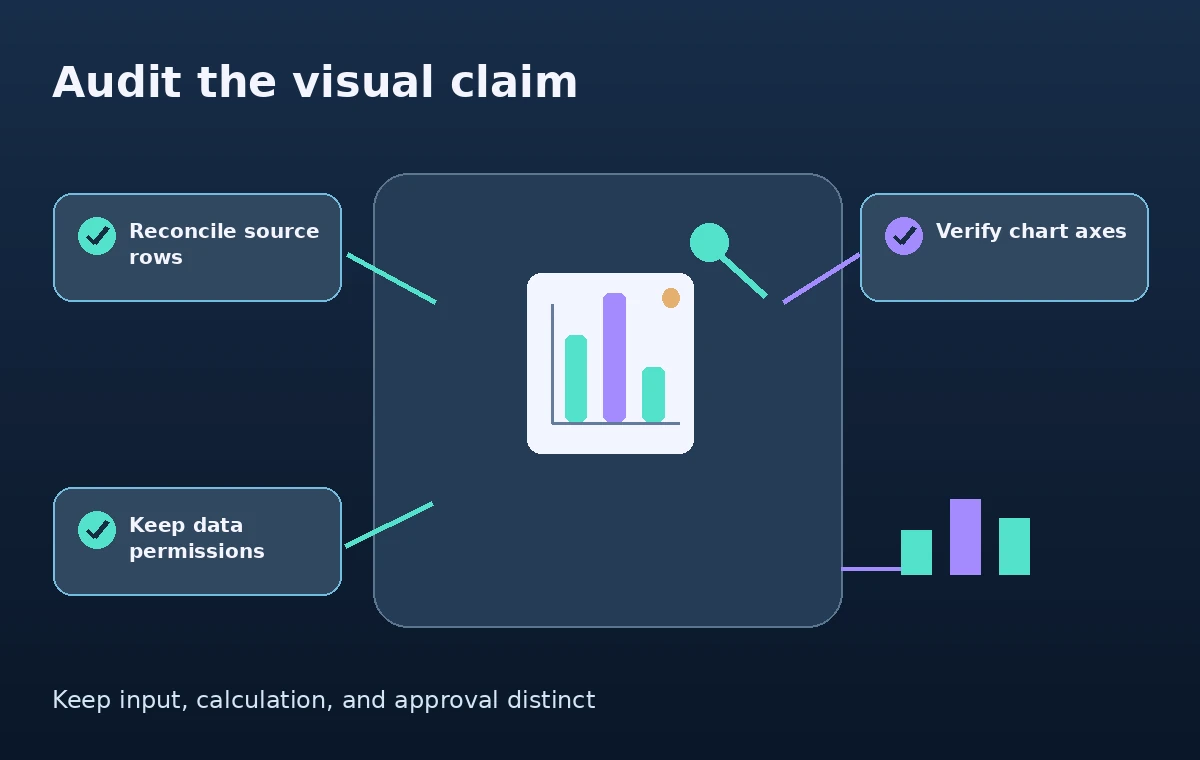
Publish a method note alongside the finished picture
The final chart caption should name the approved dataset class, relevant date range, unit, and review limits without revealing private records. The editorial ledger should link to the reviewed input version, output file, and reviewer decision. Keep the computation trace internal when it contains private information, but give readers enough context to distinguish facts from assumptions. A visible Code Interpreter output can support this workflow; it cannot replace source governance, checking arithmetic, or judging whether a conclusion is warranted. Revisit the analysis when the archive releases a corrected source revision.
How We Research
This November 11, 2026 article is a documentation-based instructional analysis, not a hands-on test or production benchmark. We compared OpenAI, Responses API reference — include parameter and OpenAI, Code Interpreter guide, identified the precise parameter or behavior that the documentation supports, and organized the guidance around an illustrative museum workflow. We did not run a live service request, inspect real WordPress content, measure accuracy, or verify delivery against a working customer account. Each pictured scenario is an original conceptual illustration; current settings, permissions, supported API versions, and organization-specific governance must be confirmed before use. The release checks deliberately distinguish technical output from authorization, evidence quality, and actual user outcomes.
Frequently Asked Questions
No. The include option requests additional details for matching output items. Configure the tool and inspect whether a code_interpreter_call actually occurred.
Yes. Wrong groupings, missing records, axes and labels can make a successfully rendered graph inaccurate or incomplete.
No. It helps document what code produced, while input provenance and factual conclusions require separate review.
Retain approved outputs and a controlled provenance ledger or reproducible calculation record, subject to the organization’s data policy.
Use synthetic or approved aggregate examples. Production data and generated outputs should pass the same privacy and publication review as any other artifact.