
A neighborhood association opens comments on a proposed redesign of the community garden. Most messages discuss paths, opening hours, or maintenance. Some are angry because a proposed ramp looks too steep. Automatically hiding every emotionally worded criticism could silence the people whose access concerns most need attention. A moderation classifier can identify potential safety issues, but it cannot decide whether the association has handled a complaint fairly.
OpenAI’s Moderation API supplies content-category signals for text and images. This article uses invented comments, policies, and workflow diagrams rather than actual API calls or measured model performance. Its aim is a practical separation between automated risk screening and an accountable human decision to keep, escalate, restrict, or remove content.
Write the community policy before choosing a threshold
Start with a short, public rule set: no threats, targeted harassment, exposure of private contact details, or instructions for harmful activity. Separately state that critical opinions about accessibility, local spending, and decisions are allowed even when the speaker is frustrated. This prevents a generic classifier from becoming an undeclared civility rule that favors polite praise over urgent complaints.
Give moderators a decision worksheet with the exact rule, relevant context, and possible responses. Label a comment “needs review” without telling the author that it broke a rule. The association should also decide what to do with a user report, a time-sensitive threat, and an ordinary disputed factual claim; these need different operational responses.
Understand what omni-moderation-latest actually returns
The official API guide describes `omni-moderation-latest` for standalone moderation of text and image inputs. A result includes an overall `flagged` value, category booleans, category scores, and applicable input types. Those outputs are risk indicators, not an explanation of intent, verified facts, or compliance with every locally written community policy.
Not every category applies to every input type. The documentation lists some categories, including harassment, as text-only. It also states that the moderation endpoint does not classify audio. Do not tell staff that a photo-only submission has been checked for every text-based abuse category or that an attached voice memo was screened by the same endpoint.
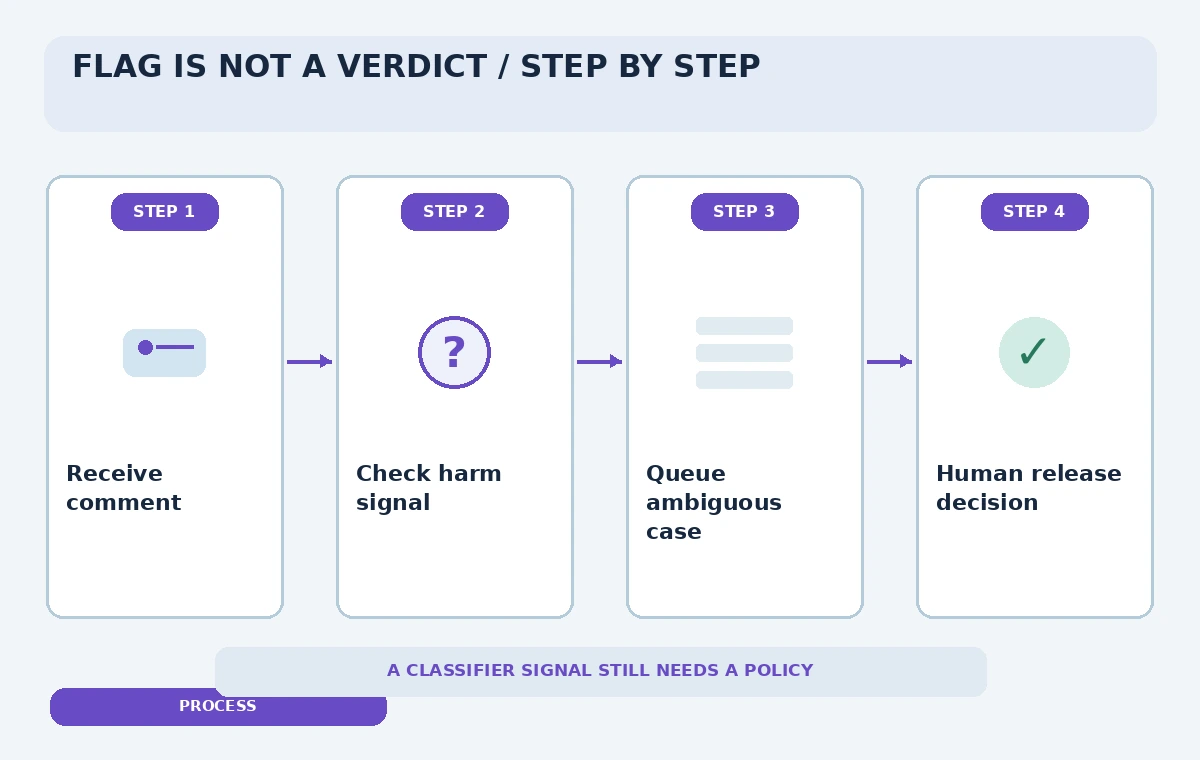
Build an intake route with explicit states
Keep four states separate: received, automated screening complete, human review pending, and final decision. Store a comment identifier, timestamps, language, the model-version label returned, and the current policy revision. Use the smallest necessary excerpt when asking a reviewer to inspect a borderline comment; do not post users’ private details to an open team channel.
An engineering implementation can submit a text string to `/v1/moderations` and inspect `results[0]`, following the current API reference. In the fictional garden example, the automatic result may trigger a review queue for a heated comment, but the public visibility setting should not change solely because one numeric score crossed an arbitrary threshold.
Separate real threats from heated civic language
Consider two invented messages: “The step at the side gate is dangerous; this plan ignores wheelchair users,” and “I will hurt the volunteer who approved this gate.” A human policy reviewer should treat criticism of infrastructure differently from a specific threat. The API may help prioritize examination, but a category match does not contain all the context of a neighborhood dispute.
If a comment references another post, read the relevant thread before deciding. If a safety risk is credible, follow established escalation procedures rather than relying on a generated reply to settle it. The system should preserve evidence needed for authorized review while avoiding unnecessary redistribution of sensitive or graphic content.
Compare the false-positive route with a defensible review
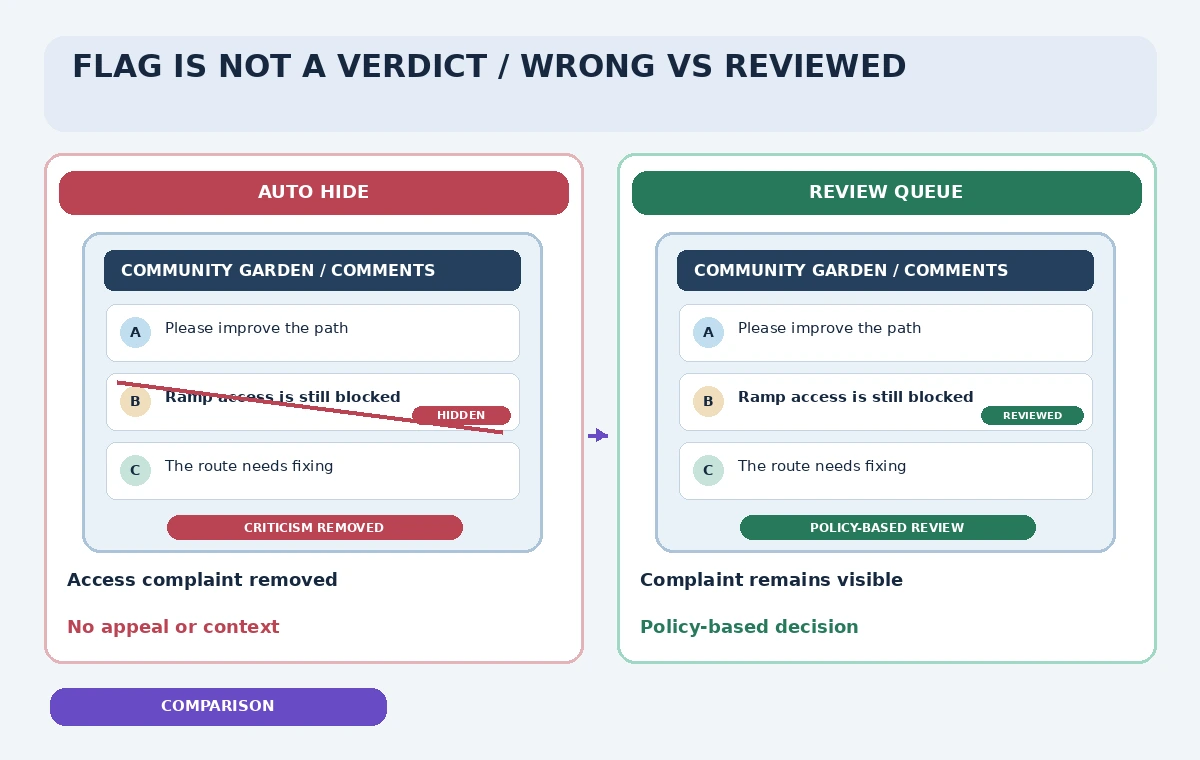
The illustration contrasts two hypothetical states. The bad path automatically removes a sharp complaint about a blocked accessible entrance. The good path sends the same message to a reviewer, who distinguishes criticism from personal abuse and leaves the complaint visible under the stated policy. It is an instructional contrast, not a result observed from an OpenAI classifier.
Write a reviewer decision such as “Allowed: criticism of a design, no targeted threat” and let the author contest a mistaken outcome. If staff later change the community rules, retain which policy was in force for each decision. Otherwise a moderation audit could blame an earlier decision for violating a rule that was not yet published.
Tune the queue without inventing accuracy rates
Test the process on a consented or synthetic set of example messages covering calm criticism, sarcasm, quoted threats, genuine threats, multilingual posts, and neutral reports of injuries. Have human reviewers label the intended treatment without looking at the model score first. Then compare queue routing, missed serious cases, and over-escalation using an explicit evaluation method.
OpenAI notes that underlying moderation models may be upgraded and custom score-based policies may need recalibration. Do not copy threshold values from another organization or claim a particular false-positive rate without a measured local dataset. Begin with review queues and monitor disagreement patterns before considering any narrowly defined automatic action.
Keep privacy and escalation responsibilities clear
Comments may contain phone numbers, home addresses, or information about vulnerable people. Restrict logging to what moderation and appeals genuinely need, define retention, and limit reviewer access. The moderation endpoint is not a substitute for child-safety processes; OpenAI explicitly warns not to submit known or suspected CSAM to this API and directs developers toward dedicated safeguards.
If the classification request fails or times out, use a documented fallback: hold for manual screening or apply a narrow existing policy. Avoid silently treating a failed API call as “safe.” Separately provide a fast route for urgent threats and an ordinary appeal route for disagreements about acceptable criticism.
Audit every decision before changing public visibility
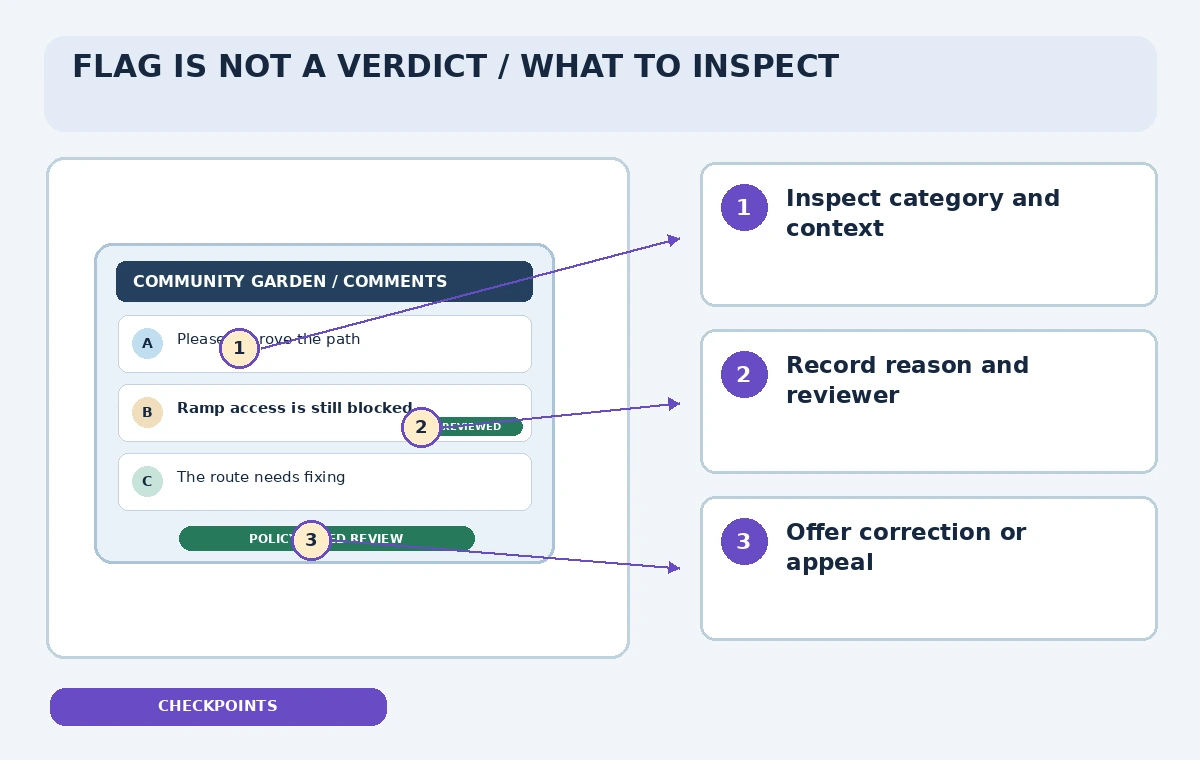
The final schematic calls out the input context, category signal, human policy judgment, and appeal pathway. Run a review of a few fabricated examples in staff training: could someone explain why a strong criticism stayed online while a direct threat was removed? If the answer depends only on a score, the governance design is incomplete.
Check model documentation after changes, version-control your local policy and thresholds, and keep regular summaries of overturned decisions. Success is not “fewest negative comments”; it is a defensible, reviewable process that protects participants from harm while preserving legitimate disagreement about the garden.
How We Research
For this November 5, 2026 documentation review, we consulted the following named official references: OpenAI API Moderation Guide; OpenAI Moderations Create API Reference; Omni Moderation Model Overview. We compared currently documented capabilities and access limits with the safeguards required by a narrow fictional work scenario. We did not use a paid account, run the API, inspect live code, process a real inventory, repair a product photo, or generate footage. Every illustration is an original conceptual drawing rather than a vendor screenshot or measured output. Features, plan eligibility, generative credit terms, policies, and interface labels may change; recheck the vendor sources and obtain human approval before applying the workflow to real records.
Frequently Asked Questions
No. It returns category and score signals. Your own policy and authorization rules must determine actions.
Not with the documented omni-moderation-latest endpoint. The listed input types are text and images.
No. Review context and policy; reports, quoted language, and legitimate criticism can be misinterpreted.
No. OpenAI notes underlying model updates can require recalibration of custom score-based routing.
No. All comments and outcomes are fictional examples illustrating a proposed review process.