
OpenAI Embeddings Dimensions can support a practical workflow, but only when the source records and release decisions remain independently checkable. This guide uses a hypothetical community organization scenario to show where automated suggestions end and human verification begins. The diagrams explain the intended process; they are not screenshots of an actual account, benchmark results, or proof that any customer data was processed. Start with a small authorized dataset and keep the original evidence accessible throughout the review.
Define the museum search problem before changing vector size
Imagine a small museum searching approved object labels and curatorial notes. A visitor asks about a brass compass, but the archive also contains a donated map with a similar story.
The objective is to return relevant records and expose their source identifiers, not to let a similarity score certify ownership or a historical date. Write three example searches, including an ambiguous one, and specify which original records should be reviewed. The decision to shorten embeddings should follow this retrieval task and the index’s storage constraints; a shorter vector is not a content-cleaning or fact-checking feature.
Understand what the dimensions parameter changes
The OpenAI Embeddings API converts text into numeric vectors representing semantic relationships. Current third-generation embedding models include text-embedding-3-small and text-embedding-3-large. Their default output lengths are 1,536 and 3,072 respectively, and the dimensions parameter can request shorter vectors for these models.
It changes the numeric representation and its storage footprint, not the words in the original label. Different models and requested sizes should be treated as separate index configurations. Use the provider’s documentation for the supported request shape rather than assuming a database will adapt automatically.
Preserve a clean, source-linked input catalog
Before producing vectors, export only approved catalog entries, retaining accession ID, approved title, source filename, version timestamp, visibility label, and the body of text permitted for search. Exclude unreviewed donor claims from the approved record field or mark them explicitly as unverified notes.
Keep the original text outside the embedding index so reviewers can open the source. If an entry is withdrawn or access-restricted, its vector must follow the same policy. An embedding is not a replacement for record provenance or the access control that protects a restricted collection.

Create one explicit index schema and migration plan
Pick one model and requested dimensions setting for a candidate index. Record that pair in an index configuration and verify the vector field’s dimension matches the actual output length.
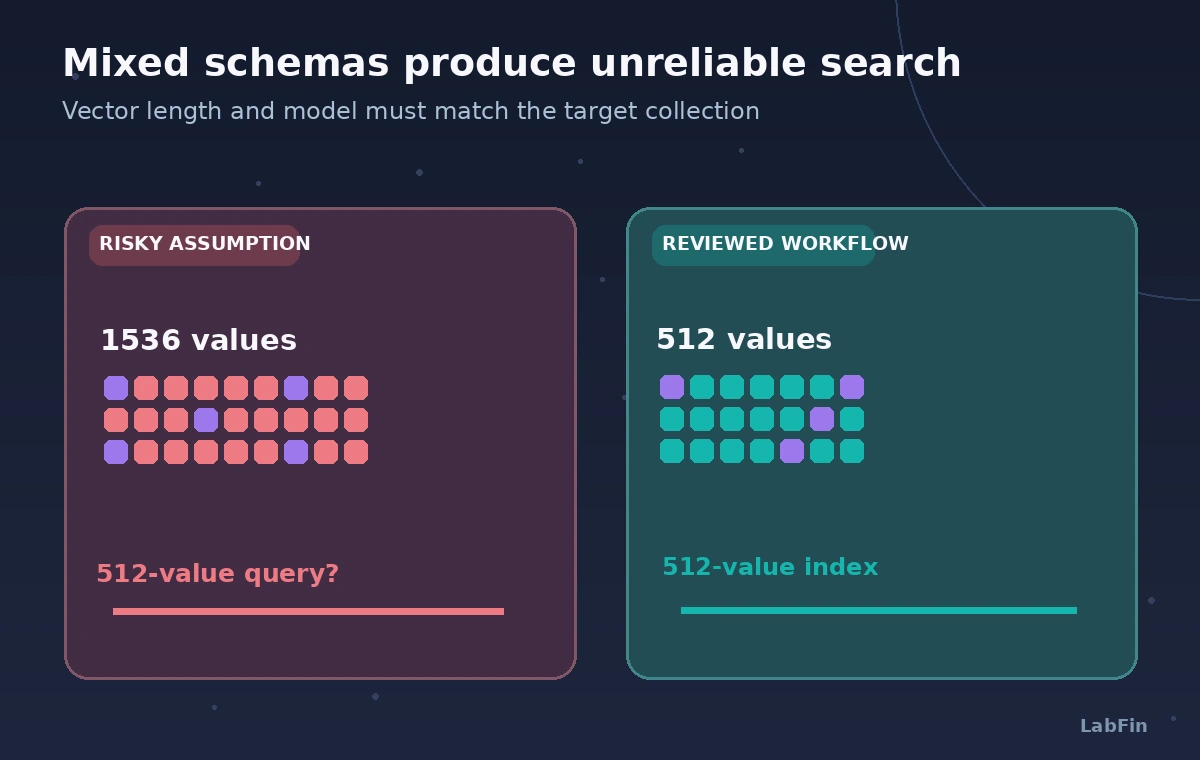
Do not append a new 512-element vector to a field intended for 1,536 elements, and do not silently combine model versions even when lengths happen to match. Build a parallel candidate index, migrate records in a controlled pass, and preserve the current index until reviewers compare the new results. Store model, dimension, encoding, and input-normalization rules as a reproducible manifest.
Generate embeddings without claiming the model checked facts
For each approved text field, call the embeddings endpoint with the chosen model and, where supported, an explicit dimensions value. Tie the returned vector to the source record ID rather than its position in a response list.
If a batch partially fails, retry only missing record IDs, not an entire import without checking for duplicates. A numeric vector can make two descriptions look similar even if one names the wrong maker. Neither a high match score nor a precise-looking database key proves the metadata is true; the source record remains authoritative.
Compare retrieval before and after shortening
Create a small evaluation set with plain-language questions, exact accession-code queries, and cases where two objects share keywords. Compare which source records appear in the first few results in the existing and candidate indexes.
A conceptual diagram can show a misleading mixed-size path beside the stable schema, but it must not imply measured accuracy. Review false matches, missing records, and the treatment of unknown provenance. If the shorter index misses a protected distinction, revise the text fields or configuration before adoption rather than decorating the result with a stronger confidence claim.
Separate semantic similarity from authorization
A staff-only acquisition note can be semantically relevant to a public visitor question; that does not make it suitable to disclose. Apply visibility and access filters in the application or search system before showing source text.
When excerpts are displayed, include the approved title and a link to the permission-appropriate record. Avoid logging raw visitor queries longer than necessary, especially when a user might type a personal name. The model’s dimension count says nothing about retention, copyright rights, user permissions, or whether a link is allowed on a public site.
Check costs and operational limits without invented savings
Smaller vectors may reduce storage and some downstream compute, but a bill also depends on token volume, the chosen model, vector database, indexing operations, and query patterns. OpenAI’s documentation describes token-based embedding usage and per-model constraints; check the live price and your database plan before forecasting savings. Treat any before/after cost bar in a diagram as a teaching analogy, not a measured budget. Keep a rollback snapshot and test ordinary catalog updates, deleted entries, and a failed migration so an economical optimization does not create stale public search results.
Audit the release with source-level questions
Run a release checklist on at least three classes of query: an unambiguous object title, a misleading near-duplicate, and a restricted or withdrawn record. Confirm the expected object ID, source title, version and access status.
Confirm the vector length in the collection schema and that all records were generated using the selected model configuration. For a wrong result, keep the query and record IDs in an internal issue log without copying confidential notes into the report. The review illustration marks these checkpoints on a search pipeline rather than pretending to show real OpenAI output.

Publish a search interface that says what it knows
Present retrieved matches as leads to inspect, with plain-language labels such as “matching catalog records” rather than “verified history.” Expose the source record and, where allowed, the date of the approved update. If there are no trustworthy hits, say the archive did not find a suitable approved record instead of manufacturing a citation. Keep the old index available for rollback until editors confirm the new one is dependable. This example is hypothetical: no API calls, vendor performance tests, or museum collection measurements were conducted for this article.
How We Research
For this November 2026 article, we reviewed these named vendor-maintained sources: OpenAI API: Vector embeddings, OpenAI API reference: Create embeddings, OpenAI Help: Embeddings FAQ. We used their documented API operations, configuration guidance, and stated limitations to design a fictional teaching workflow, then cross-checked the scenario for confused approvals, unsupported results, and missing source identity. We did not call any paid API, train models, process private records, conduct user interviews, inspect a real vendor account, or measure precision, speed, or savings. Illustrations are educational and use invented example records, not live screenshots. Before using production data, check current pricing, regional availability, access controls, retention rules, and the relevant service change log.
Frequently Asked Questions
Not automatically. Shortening is supported by the third-generation models, but relevance changes must be evaluated on your own queries and index. Do not infer accuracy from vector length alone.
Not in a normal fixed-dimension vector field. Maintain compatible index schemas and verify actual returned lengths before importing records.
No. They encode semantic relationships in text. Check authoritative catalog fields and source documents for factual claims.
No. The API reference limits the dimensions option to text-embedding-3 and later models. Check the current reference for the model you use.
Keep the original text, record IDs, model and dimensions manifest, existing index snapshot, permissions, and a small reviewed query set.