
An evidence-based Mem AI review of proactive note capture, task tracking, Voice Mode, monthly limits and security trade-offs. This guide distinguishes documented product capabilities from editorial decision criteria; any purchase or automation still needs confirmation in the active workspace.
What Mem is trying to change about notes
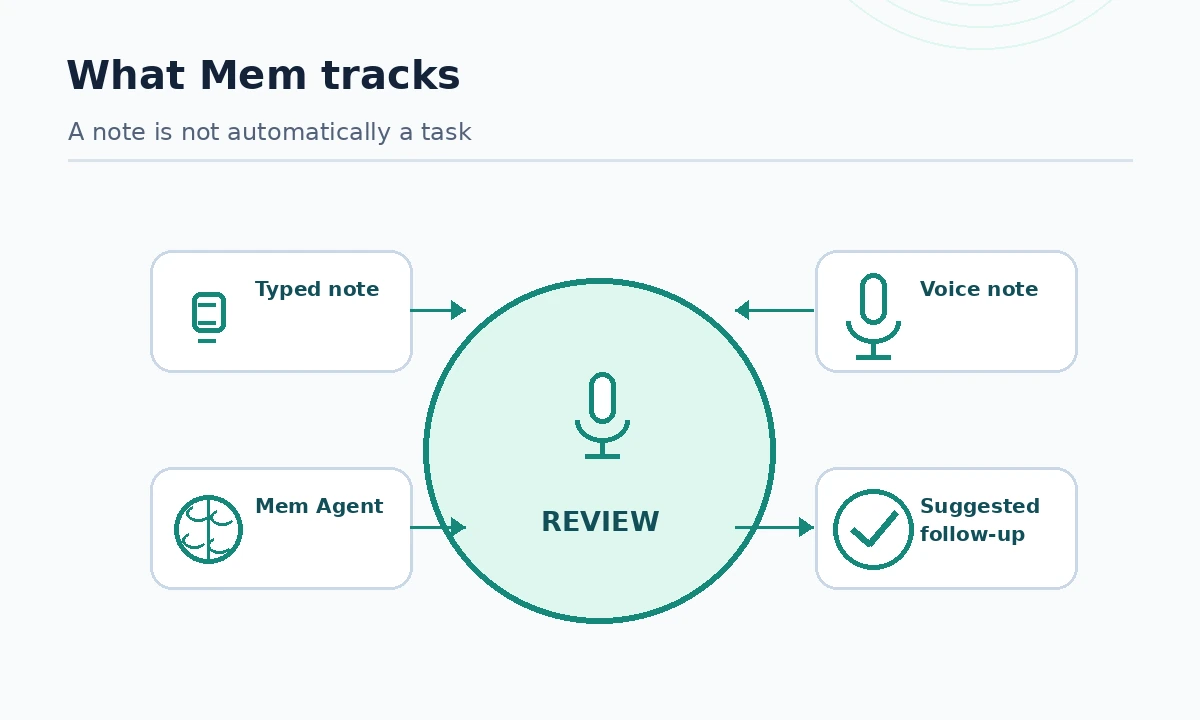
A useful Mem AI review must begin with its actual job. Mem markets itself less as a traditional nested notebook and more as a memory and follow-through assistant. You capture ideas through notes and voice, and Mem Agent can identify tasks and projects, answer questions and use connected context. That promise is different from storing meeting transcripts or offering folders with AI search. Its value depends on whether you want a system that actively reminds you what was left unresolved.
The trade-off is that automatic task detection can misread exploratory sentences as commitments. For a solo consultant this is manageable when every suggestion is reviewed. For a team that needs definitive task assignments, a project manager with explicit owners and status changes may be the safer system of record. This is a review of published capabilities and limitations, not a claim that we tested live recognition accuracy.
Capture, recall and follow-up are separate jobs
The current Mem pricing and feature page lists messages to Mem Agent, notes created per month, task and project tracking capacity, open tasks and projects, and Voice Mode capture. Think of these as separate meters. A voice recording can become text and structured notes; a note might suggest an action; a task may remain open across weeks. None of those transitions eliminates a need to confirm names, deadlines and whether an apparent promise was really approved.
For a pilot, collect five mundane examples: a call recap, a customer request, a personal reminder, a research note and an intentionally ambiguous idea. Mark which contain genuine commitments. After capture, review what Mem identifies as actions and compare with your original notes. Keep the review manual until false positives and omissions are understood.
Mem plans and limits as advertised
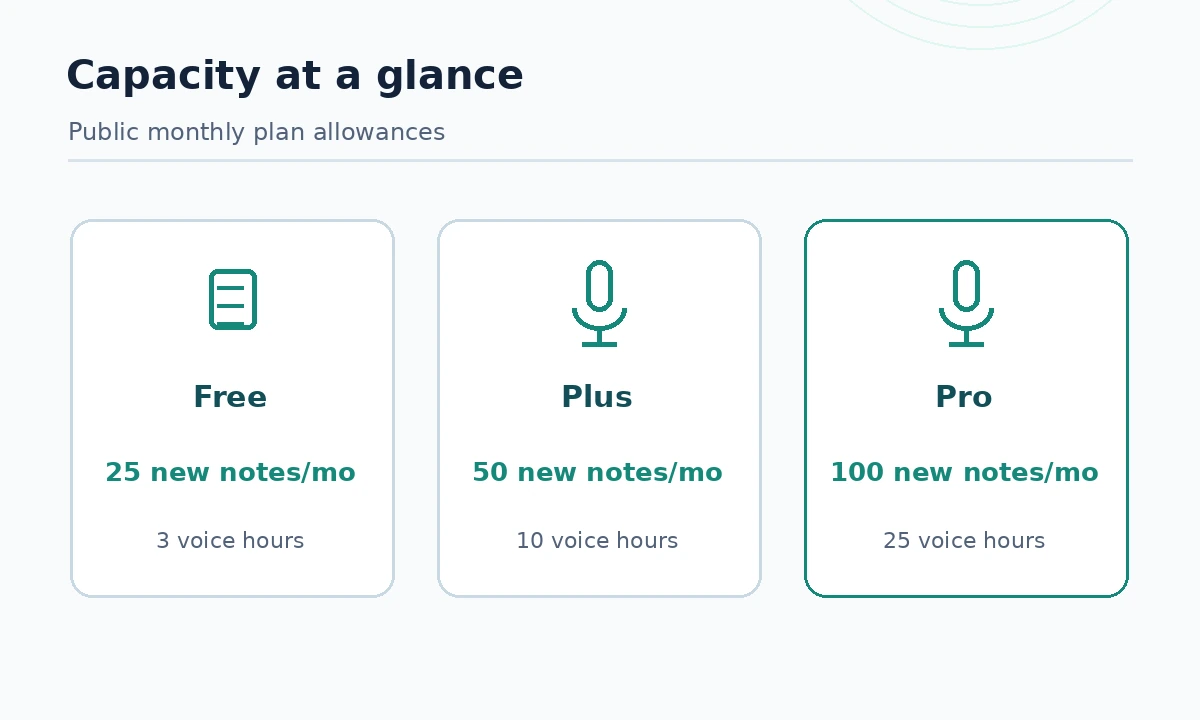
As of October 27, 2026, Mem’s public pricing page shows Free, Plus at $9 per month and Pro at $29 per month, along with higher-capacity Pro multiples. The displayed Free limits are 25 messages to Mem and 25 new notes per month, 15 open tasks and projects, and three hours of Voice Mode. Plus lists 50 messages, 50 new notes, 25 open tasks/projects and 10 voice hours. Pro lists 100 messages, 100 new notes, 50 open tasks/projects and 25 voice hours.
These are distinct allowances. Fifty new notes does not mean fifty messages or fifty hours of transcription. The page also describes task tracking being performed for a limited number of notes created or edited during the month: 25 on Free, 50 on Plus, 100 on Pro. Before subscribing, estimate your weekly capture rate and read the limits column rather than comparing only the monthly price. Higher plans and overages need a fresh checkout review.
What Pro adds beyond bigger quotas
Mem Pro’s published package includes one Custom Routine and one Connection along with its larger basic capacities. Custom Routines can prepare a scheduled briefing or other recurring output, while Connections can bring context from supported outside systems. The higher Pro 2× and Pro 5× tiers expand the quantities, but that does not prove they improve reasoning accuracy or eliminate human review.
Pro is a better fit when one repeated information task justifies a connection and enough usage to test it. If you mainly need search through old notes, start by seeing whether the lower tiers fit; pay for capacity only after hitting a genuine bottleneck. For small teams, confirm how shared or personal use works before treating a personal subscription as a collaborative task management platform.
A practical note-to-action pilot
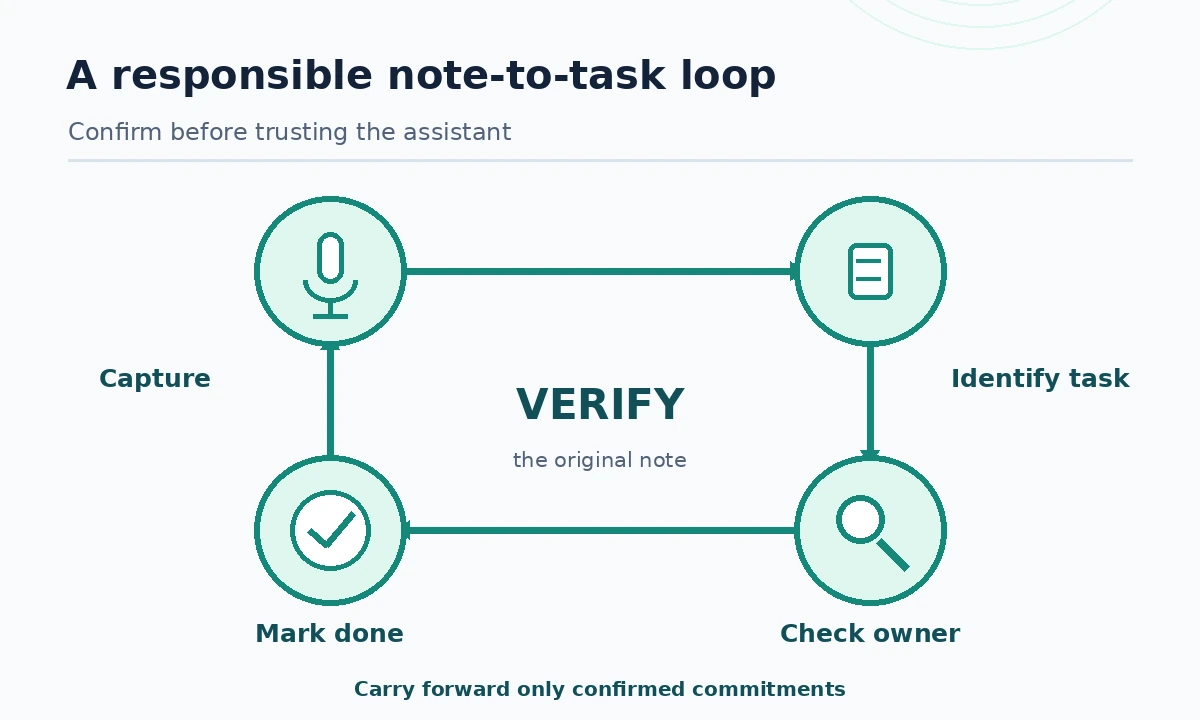
Create a controlled notebook of ten low-sensitivity entries from one workweek. Record each source, capture method, expected follow-up and whether it is genuinely a task. Ask Mem to identify open items, then verify each against the original note. Mark “correct,” “wrong owner,” “missing due date” and “not actually a task.” The aim is not to produce a public benchmark but to learn whether this tool improves your workflow.
Next, request a weekly check-in. Review every proposed action before sharing it or copying it into a project tracker. If work belongs to colleagues, avoid silently assigning obligations based on your private transcription. Where a note contains customer information, redact sensitive identifiers before testing an unfamiliar integration.
Searchable memory is useful only with provenance
The product’s premise is that conversational queries can bring information back without rigid manual filing. The highest-value test is asking for something you can independently identify in an older note: a decision, a reason or an open question. Require the exact source note or sufficient context to verify the answer. If you cannot trace a recalled statement to a record, do not treat it as a certified decision.
You can reduce ambiguity by writing simple notes with one meeting or topic per entry, dates near the top and action lines phrased clearly. “Maybe ask the designer” is different from “Taylor will send a draft by Friday.” An AI assistant may not reliably preserve that distinction unless your notes do. Better source habits can matter more than upgrading plans.
Privacy and data handling require a real check
Mem’s security statement, revised January 15, 2026, says content is encrypted in transit and at rest and that content may be decrypted for AI processing by trusted third-party vendors. It also states that Mem has SOC 2 Type II compliance. These are vendor statements, not a substitute for assessing your own data retention, contractual obligations or whether particular sensitive data should be processed by an outside provider.
Before connecting mail or recording meetings, inspect consent requirements, access settings, provider data handling and deletion options. Avoid putting client contracts, medical details or confidential personnel reviews into a trial solely for convenience. Even a system with encryption cannot correct a user sharing information with the wrong integration.
Who should use Mem—and who should skip it
Mem is a reasonable shortlist item for an individual who wants lightweight capture, voice notes and proactive reminders across loosely structured thoughts. It is less obviously suited to heavily regulated records, shared project governance or teams that need detailed permissioned workflows. Traditional notes apps may be sufficient if your main need is structured writing rather than detected tasks. A conventional task tracker may be better if every commitment already has a known owner.
Our verdict is conditional: use the free tier to confirm capture and retrieval quality for your own material. Upgrade to Plus if the volume limits block a demonstrated use case; evaluate Pro when Custom Routines or Connections are the reason you want Mem. We assign no synthetic star score or independent accuracy claim because this review is grounded in documentation, not hands-on product testing.
How We Research
We reviewed the following manufacturer-maintained primary sources on October 27, 2026: Mem current plan limits, Mem security statement. We compared documented eligibility, current feature descriptions and any published limits against the buying or implementation question this page answers. Figures and credits refer only to the billing views and transition dates specifically identified above; they may vary by seat, country, contract or workspace migration. Our check was a documentation review and workflow design exercise: we did not buy accounts, perform hands-on accuracy benchmarking, interview customers or measure savings. Suggested pilots are reader-run exercises, not results that LabFin claims to have observed.
Frequently Asked Questions
Mem lists a Free tier with limited monthly messages, new notes, tracked items and Voice Mode time; it is not an unlimited free subscription.
The current public page lists Plus at $9 per month and Pro at $29 per month, with larger Pro capacity tiers also offered.
It can identify suggested tasks and projects from notes, but reviewers should confirm owner, due date and whether a statement was an actual commitment.
Mem lists Voice Mode capture allowances by plan and describes structured transcripts and notes; the number of available hours depends on tier.
Only after evaluating meeting consent, the security terms and the AI vendors that may process decrypted content; do not assume it meets every compliance requirement.