
When a Catalog Importer Acknowledges Too Early
Imagine a museum sending object-arrival and condition-check events into Google Pub/Sub. A new subscriber version accidentally acknowledges a group of messages before the database write is confirmed. A curator later sees that several intake records are absent even though the queue appears empty. Pub/Sub seek can change a subscription’s acknowledgment state in bulk; a snapshot can preserve a point-in-time view of that state. It is not a full database backup and does not reverse mutations already made by a consumer. The restoration plan must protect existing catalog records from duplicate writes and keep the distinction between re-delivered events and approved object updates. In this guide, all object names and events are hypothetical, and no replay was executed against a real subscription.
Choose a Snapshot Before Risky Subscriber Changes
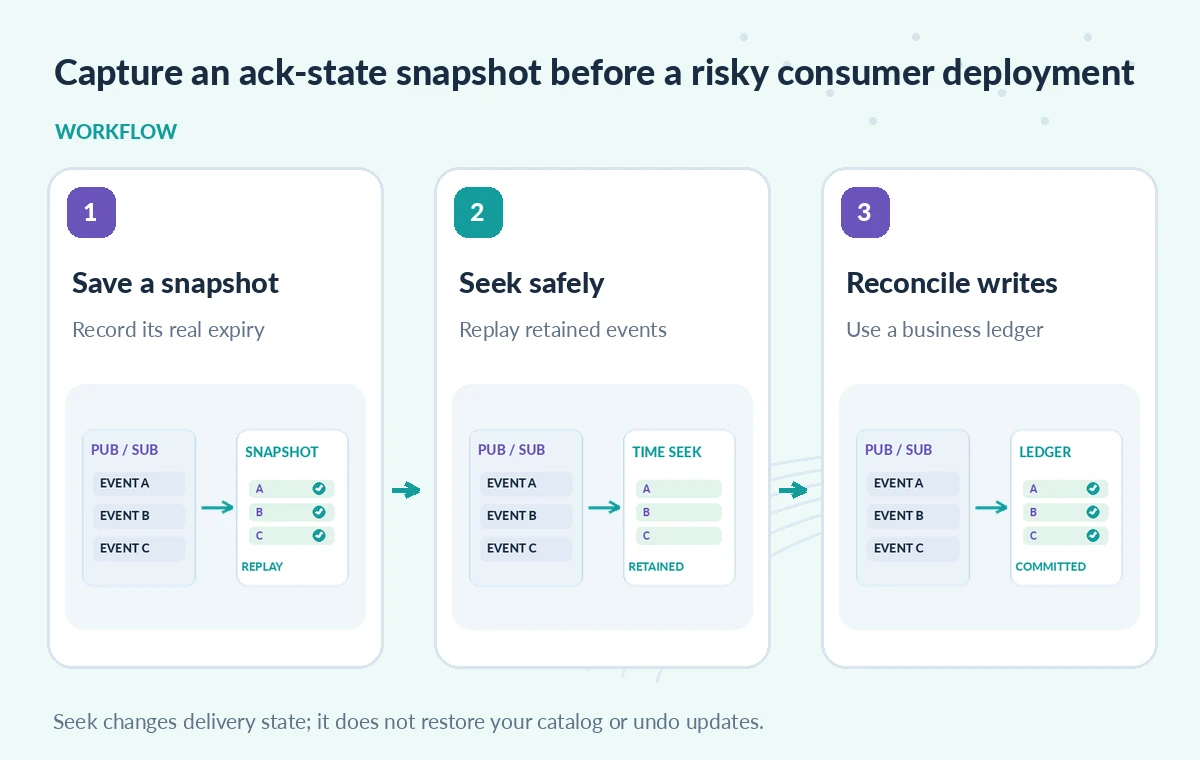
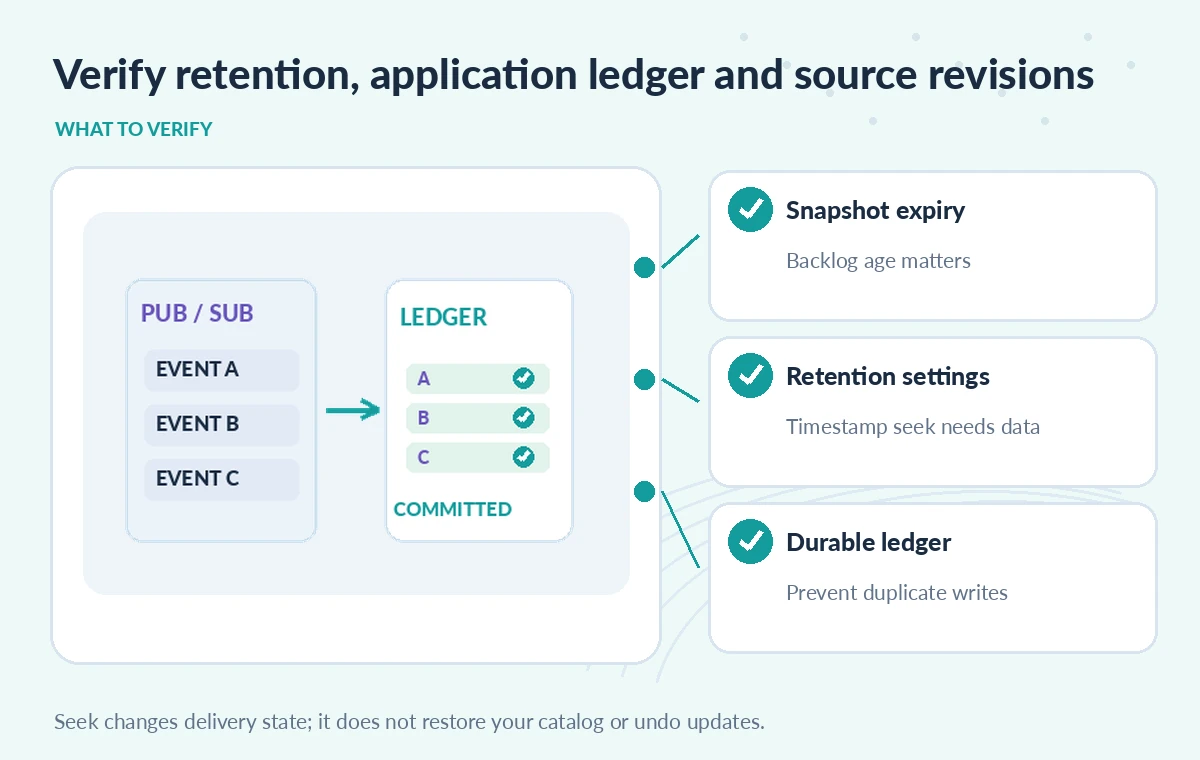
A Pub/Sub snapshot represents the acknowledgment state of a subscription at creation, including its unacknowledged backlog and subsequent messages described by the service’s snapshot semantics. Taking a snapshot before a risky consumer deployment can provide a point of recovery if the new code acknowledges prematurely. Google’s guide says a snapshot lifetime depends on backlog age: at most seven days, minus the age of the oldest unacknowledged message. A snapshot cannot be made if its calculated lifetime would be under an hour. Record the creation time, source subscription, owner and expiry in an operations checklist. Do not assume a week of recoverability simply because someone pressed Create. A huge old backlog can dramatically reduce the usable window.
Understand Timestamp Replay and Retained Messages
Seeking to a timestamp can mark retained messages before the timestamp acknowledged and retained messages after it unacknowledged. However, replaying previously acknowledged messages by timestamp requires appropriate retention: configure topic message retention or subscription retention of acknowledged messages. Seeking cannot resurrect content already removed outside the retention window. A timestamp is also not a reliable substitute for an application event time, because Pub/Sub uses server publication time. A library worker might have uploaded a historical record the next day, for example. Specify a recovery boundary based on verified service delivery data, and document why that boundary is safe. A careless seek to the future can bulk-acknowledge backlog that still needs processing.
Separate Delivery Recovery From Data Correction
Suppose the original subscriber wrote accession A17 successfully, acknowledged its message and then failed to record an audit marker. A later seek might re-deliver the same event. If a consumer blindly inserts another row or sends a duplicate approval email, the recovery creates a new problem. Use an idempotency key tied to the business event and source version, and make the catalog write conditional on the recorded state. The application should distinguish an event needing first-time processing from an event whose effect is already committed. Store a durable processing ledger outside the volatile subscription ack state. A message ID is useful for diagnostics but may not cover two separately published events that represent the same source action. Human review remains essential for disputed archival facts.
Compare Snapshot Recovery, Time Seek and a Bad Replay
In a fictional recovery exercise, a pre-deployment snapshot lets the subscriber see events that were acknowledged incorrectly after the snapshot was taken. That is a useful recovery path when the snapshot remains valid and the target subscription uses the same topic. A timestamp seek can target a known publication period if retention was configured in advance. An unsafe third case replays the entire retained window straight into a system with no idempotency guard: catalog entries or notifications may be duplicated. These are conceptual states, not measured success rates. A recovery runbook should include a pause or quarantine mode in which the worker records intended writes for review before enabling side effects.

Account for Eventual Consistency and Delivery Attempts
Google documents seek as strictly consistent for eventual delivery guarantees, but changes in delivered messages are not immediate: it can take about a minute for the operation to take full effect. A message published before the boundary may still appear, and a client should not infer failure from one quick empty poll. When seeking a subscription with a dead-letter topic, delivery attempts are reset; a retry policy’s backoff state can also change. With exactly-once delivery, acknowledgments from deliveries made before the seek can fail. Record the seek operation result and observe a bounded reconciliation window. Never reuse an old acknowledgment identifier as proof that a newly delivered event is safely processed.
Protect Access and Filtered Subscriptions
A snapshot belongs to a Pub/Sub topic, and seeking a subscription to it is constrained by that topic relationship. If a subscription has an attribute filter, Google documents special behavior about which messages are redelivered during seek. Do not assume an old snapshot will cause a filtered subscriber to see events outside its filter. Restrict who can run seek operations: they can materially alter delivery state, not just inspect it. Keep separate credentials for readers and recovery administrators, and log an approved incident reference rather than raw private event payloads. Before executing recovery, capture the topic, subscription, filter, retention settings and active consumer version so later reviewers can reconstruct what happened.
Reconcile a Bounded Window and Check Missing Records
An operational test should choose a small, harmless set of invented catalog updates in staging. Capture the expected event IDs and the current database revisions, then simulate early acknowledgments and seek back to an allowed boundary. Reconcile which records were missing, which were already applied, and whether each replay generated at most the intended business effect. Include one event with an old version and one with ambiguous provenance. In production, require curator sign-off before committing corrections inferred from replayed messages. A successful seek API response means the subscription’s acknowledgment state is being changed; it does not demonstrate that every source was processed exactly once or that a museum record is accurate.
Document a Recovery Procedure That Can Be Audited
A useful runbook starts by stopping writes that could multiply the problem, preserving observed state, verifying retention, and choosing snapshot or timestamp seek deliberately. It then restarts consumers in a supervised or dry-run mode, checks the durable ledger, and reconciles with the authoritative collection database. Document the publication-time interval, snapshot expiry, environment, and revision of the subscriber code. Keep the incident report separate from public object descriptions. Once the records have been checked, restore ordinary operation and remove unneeded recovery access. Pub/Sub replay is a delivery-management feature, not a substitute for database backup, source provenance or editorial judgment.
How We Research
For this guide, we reviewed the official product documentation on November 8, 2026: Google Cloud Replay and Purge Messages With Seek, Google Cloud Replay a Message Tutorial, Google Cloud Pub/Sub Seek REST Method. We checked the named setting or feature against its published behavior, mapped the documented constraints to the specific hypothetical scenario, and reviewed whether the topic duplicated titles in the supplied LabFin WordPress inventory or prior B0267–B0280 ZIPs. No authenticated vendor service was run; we did not perform a benchmark, observe real customer data, verify third-party rights or claim operational outcomes. All illustrated records and comparisons are teaching examples. Confirm product documentation and security requirements again before implementing a workflow in a real organization.
Frequently Asked Questions
It records the subscription acknowledgment state at a point in time under Pub/Sub snapshot semantics; it is not a backup of your catalog database.
At most seven days, reduced by the age of the oldest unacknowledged message. Google also sets a minimum viability window for creation.
Seeking to a snapshot may recover messages that the snapshot retains. Timestamp replay of acknowledged messages needs suitable topic or subscription retention.
No. Delivery changes are eventually reflected and may take roughly a minute to propagate.
Use a durable event or business-action ledger, conditional writes, source version checks and a supervised reconciliation process.