
Define the residency promise precisely
A regional heritage trust sends donation acknowledgement events to Google Pub/Sub. The legal team wants message content stored only in certain Google Cloud regions and asks whether a topic-level storage policy provides that boundary. Pub/Sub message storage policies specify the regions where message contents are stored and processed. They do not mean that the Pub/Sub topic is a region-scoped resource, that all topic metadata is confined there, or that a message can never cross a network boundary. Start with a written data-classification rule that distinguishes event payloads from topic names, labels, IAM metadata and downstream exports. Avoid storing identifying donor details in event payloads unless genuinely necessary.
Select allowedPersistenceRegions deliberately
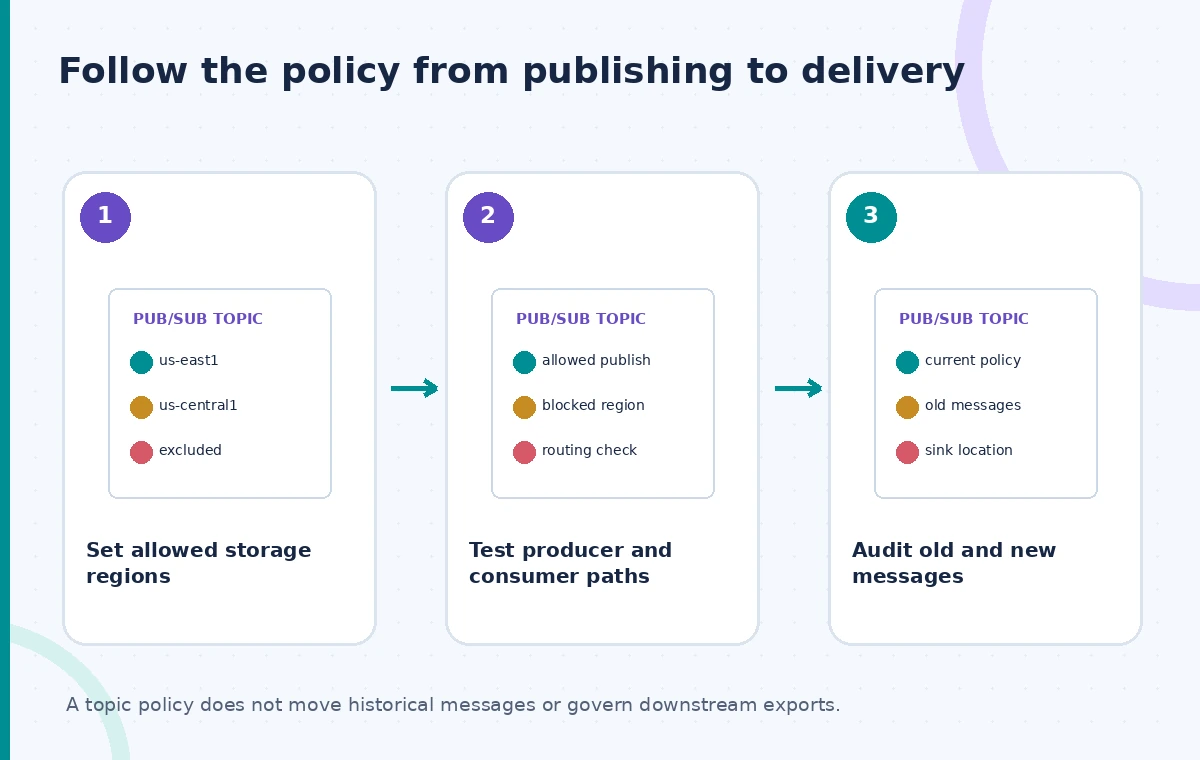
The messageStoragePolicy on a topic can list allowedPersistenceRegions. Choose actual Google Cloud region identifiers accepted by the service, not broad continent labels or unsupported multi-region locations. A topic may be created with the policy or updated later. Without an explicit topic setting, the effective organization location policy may determine the initial values; if there is no restriction, the default policy may permit all regions. Record the policy returned by the service instead of assuming a deployment script successfully enforced its intended list. Consult compliance owners before narrowing a production topic, because a single-region choice changes routing and availability characteristics as well as data placement.
Separate persistence from in-transit restrictions
The enforceInTransit flag is a further control, not an automatic synonym for the allowed region list. When enabled, publish, pull and streamingPull requests arriving in disallowed regions can be rejected with FAILED_PRECONDITION. Client location and endpoint selection matter. A producer outside the allowed regions may need to target a suitable locational or regional endpoint rather than the global endpoint. Push delivery can be constrained and, with certain location combinations, even pause. Write down which access paths the system must support before toggling this setting. Test allowed and denied requests in a safe environment instead of assuming every authorized client will continue working.
Audit existing topics and older messages
Changing an organization location policy does not automatically rewrite every existing Pub/Sub topic. Compare the effective organizational rules with the policy currently attached to each real topic; update topics deliberately where needed. A change to a topic’s message storage policy applies to messages published after the update. Previously published messages are not moved to a new compliant region just because a new region list was saved. If the organization needs proof about historical storage, escalate to a documented retention, deletion or migration review rather than making a retroactive claim. Keep a dated configuration snapshot for audits so policy changes do not erase the record of earlier settings.
Compare three meaningful region states
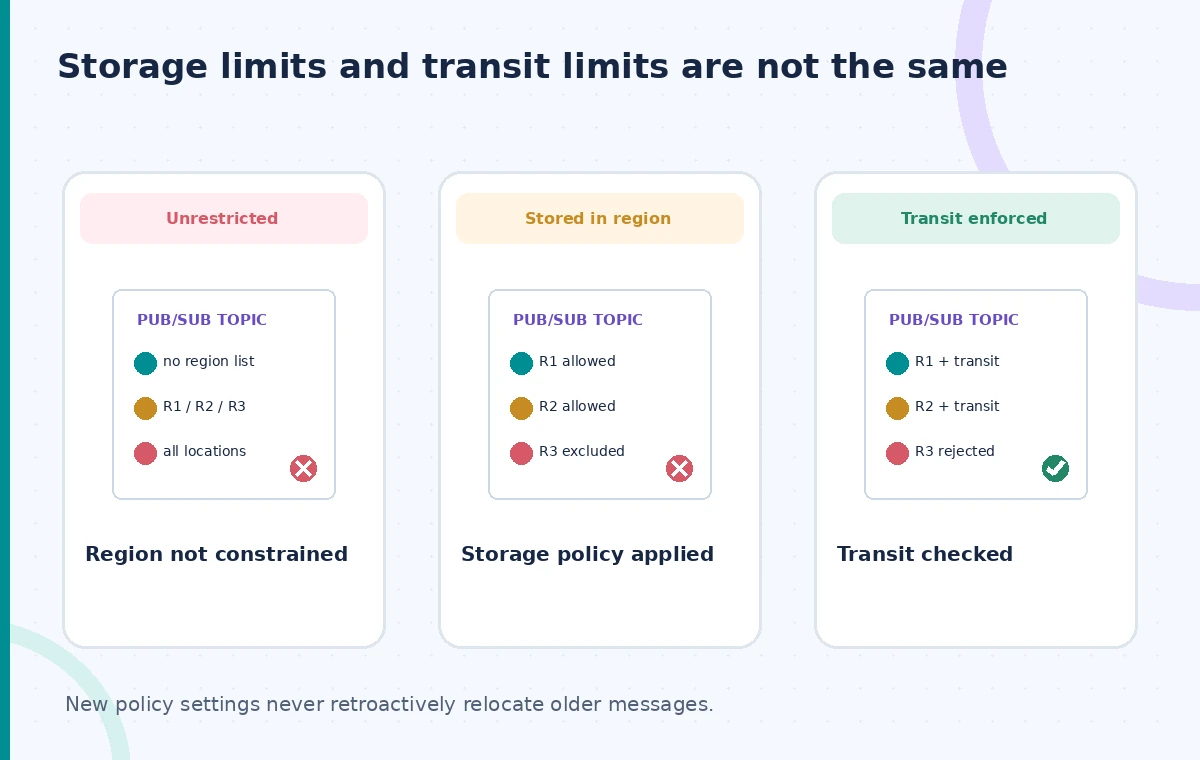
The illustration distinguishes an unrestricted topic, a topic whose message contents are constrained to named allowed regions, and a stricter transit configuration that also tests where publish or subscribe requests are accepted. These are configuration states, not screenshots or proof that a real donor message was stored in a particular place. The middle configuration can still receive requests through paths outside a simple local architecture diagram. The last requires client tests and monitoring, not merely a true flag in a sample JSON body. Be explicit that topic metadata, external downstream sinks and preexisting messages demand separate controls.
Plan for routing, latency and operational failure
A producer in a distant region may send traffic to a permitted region, introducing a longer network path. Restricting available persistence locations can also reduce resilience if that one region has trouble. When ordered messages are involved, an excluded nearby region may cause publishing errors under documented conditions. Evaluate consumer geography, push endpoint constraints and the business consequences of delayed donation acknowledgement. Configure retry and dead-letter handling with privacy-conscious logging; do not make a failed publish look like a completed donor receipt. The Pub/Sub policy is a storage control, not a guarantee of application delivery or payment transaction durability.
Test with non-sensitive synthetic events
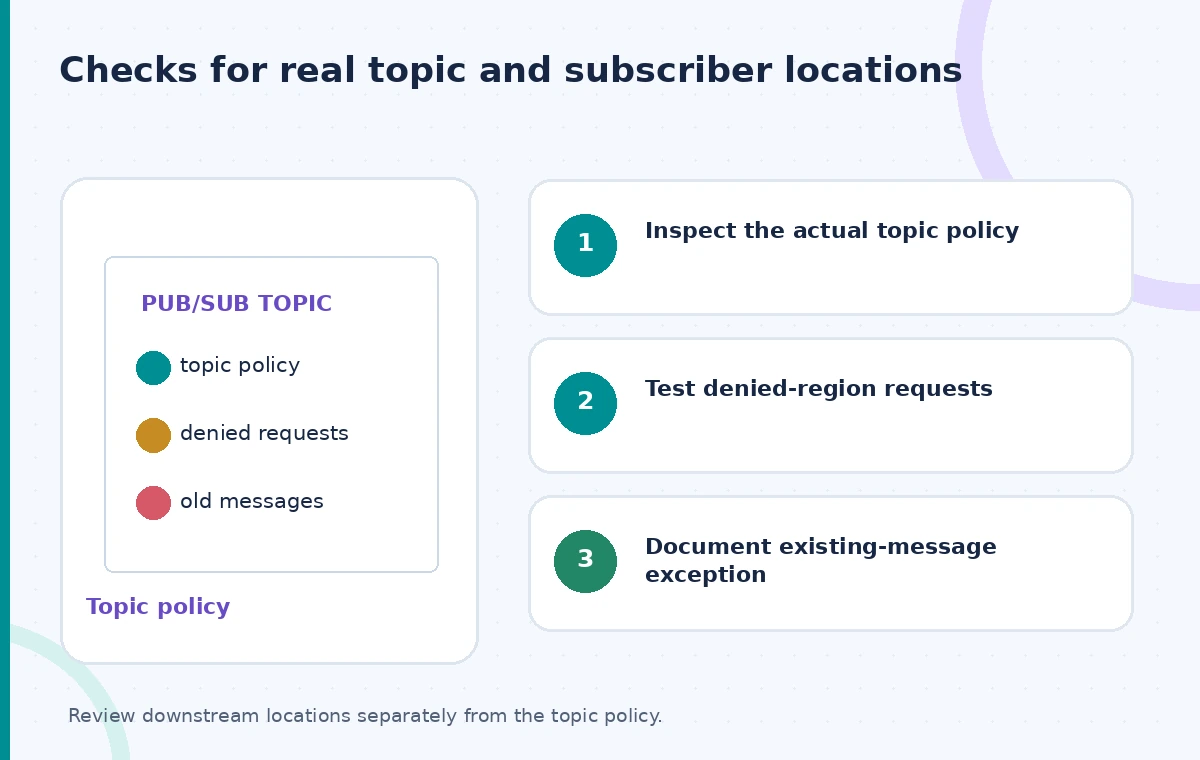
Run a controlled exercise with invented donor-like event IDs. Confirm a publish from an allowed deployment, an attempted publish through a disallowed location with transit enforcement enabled, a valid subscriber pull, and the expected behavior of any push subscription. Record timestamps, endpoint choices, error codes and the effective topic policy. Avoid putting real donor names or payment details into the test. Compare the expected acknowledgements with what your application actually receives. Test the change on a staging topic first because a mistaken region restriction can interrupt production receipts even while configuration checks report a successfully updated topic.
Check metrics without overclaiming
Pub/Sub exposes region-aware metrics such as unacknowledged message counts and retained bytes by region. These can help find unexpected message placement and backlogs, subject to metric availability and scope. Metrics are evidence of observed service activity, not a complete independent residency attestation for every historical byte. Also audit downstream BigQuery subscriptions, Cloud Storage exports and application logs, each of which has its own data-location settings. A message can be correctly persisted by Pub/Sub but later copied by a consumer into an unapproved database. Treat the whole data flow, not only the topic policy, as the compliance boundary.
Approve the final policy as a change-managed control
Make the change record include the old policy, new allowed region list, enforceInTransit choice, affected topic names, subscriber endpoints, operational test evidence and rollback owner. The legal reviewer should approve the specific interpretation of the policy language, not a generic claim that donor data never leaves the selected geography. Keep a separate plan for messages published before the update and for any downstream systems. If rollout breaks delivery, stop or reverse the configuration change through normal authorization rather than dropping messages to restore service. Clear boundaries and verified request paths make the storage setting useful without advertising a stronger guarantee than the platform provides.
How We Research
Our research consulted these named official documents: Google Cloud: Configure message storage policies; Google Cloud: Pub/Sub API endpoints overview; Google Cloud: Pub/Sub topic REST resource. We checked tool behavior, version-specific options, and stated limitations against an illustrative museum scenario. The examples are suggested implementation and editorial review procedures, not production tests. We did not call the services with live patron records, benchmark latency or accuracy, measure storage savings, or obtain third-party consent. All images are original explanatory drawings rather than screenshots or claimed measured results. Verify provider documentation, service availability, access policies and current organization rules before adoption; keep final publication approval with authorized staff.
Frequently Asked Questions
No. The documented policy controls message contents, not every type of topic metadata.
No. Policy updates apply to newly published messages, not to preexisting stored messages.
Yes. Requests received through disallowed regions can fail and some push configurations can be disrupted.
Use supported Google Cloud region names. Multi-region locations and exclusion lists are not supported here.
Review producers, subscribers, export sinks, application logs and historical message handling separately.