
A green caption check may depend on unfamiliar code
A hypothetical museum runs automatic caption checks before releasing short educational videos. The workflow file lives in the institution’s repository, but its steps may execute code published by another organization. A green check means the configured job reported success; it does not disclose who maintains every action or whether a dependency changed between releases. GitHub supplies GITHUB_ACTION_REPOSITORY for a step executing an action, identifying that action’s owner and repository. That variable is a useful provenance clue in a dependency inventory. It must not be confused with GITHUB_REPOSITORY, which identifies the repository where the workflow runs. The audit goal is to identify and verify the action source, not to treat a familiar repository name as an approval certificate.
What the environment variable actually names
The GitHub Actions variables reference describes GITHUB_ACTION_REPOSITORY as the owner and repository name of the action for a step executing an action. The example is actions/checkout. The value is scoped to the relevant step and can differ from the workflow repository. It does not include a guarantee that the selected tag resolves to a particular commit, that the maintainer is trustworthy or that every nested dependency has been reviewed. The corresponding github.action_repository context can be used in the appropriate action context. Do not assume a generic shell step has a meaningful action repository value. An empty or unavailable value should be reported as not applicable, not silently substituted with the workflow’s repository name.
List the actions before writing a provenance rule
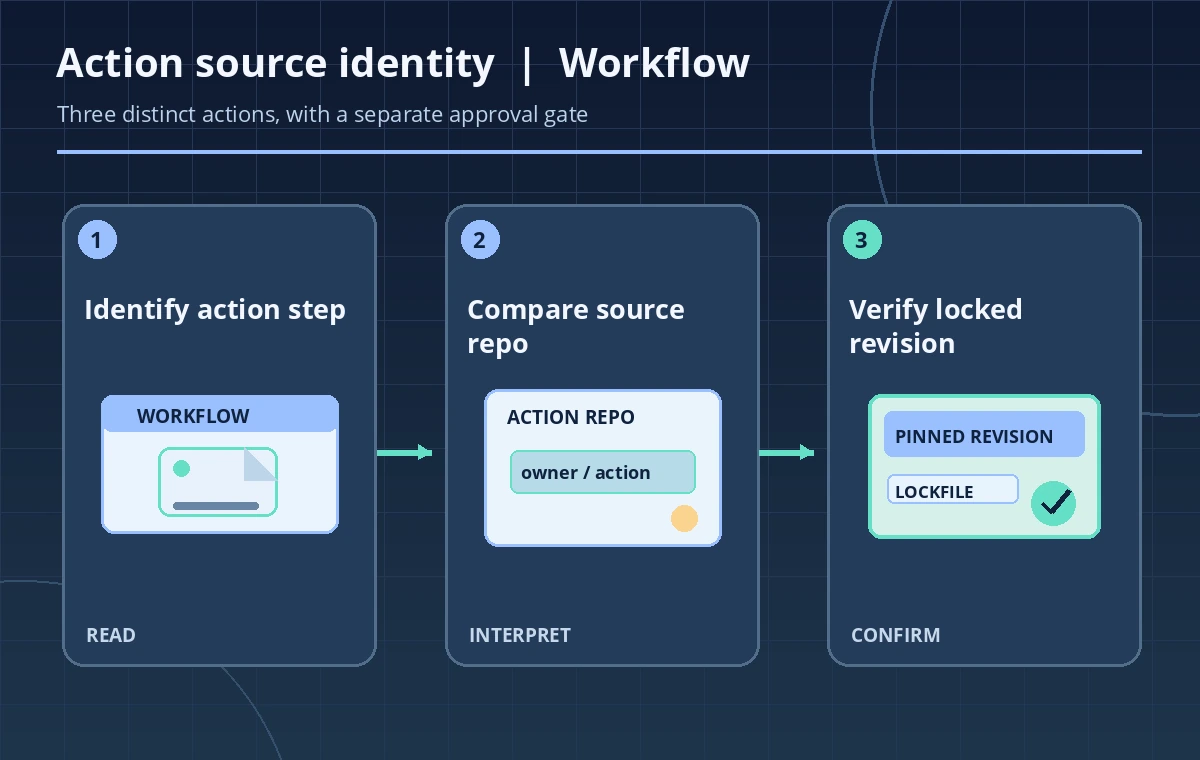
Begin with the checked-in workflow file and enumerate uses entries, reusable workflow calls and any scripts downloaded during a job. Distinguish GitHub-maintained actions, organization actions, external marketplace actions and local actions from the repository itself. Use the runner-provided action repository variable where it is documented and available, while preserving the exact uses reference from the workflow for later inspection. A caption job might invoke checkout, a Python setup action and a third-party validation action; those represent separate supply-chain decisions. Record each source as an inventory item. Do not assume that observing one action name identifies a reusable workflow’s transitive dependencies or all software later installed by a setup script.
Check pinning and dependency lockfiles separately
A source name identifies a repository, not the executable revision. GitHub’s current secure-use guidance recommends a verified workflow dependency lockfile as the strongest dependency integrity measure where supported. For repositories without such a lockfile, GitHub also discusses pinning actions to a full-length commit SHA and verifying that the revision comes from the intended source repository. A mutable tag can point to changing code. The source identity and pinned revision therefore belong in different audit fields. Do not claim that GITHUB_ACTION_REPOSITORY itself provides pinning or signature verification. The authorized maintainer should compare declared dependencies with the organization’s approved inventory and dependency policy before a release.
Know which repository a workflow actually checked
In an illustrative comparison, the workflow belongs to museum/video-site while an action step comes from vendor/caption-check. GitHub gives the runner’s action-source name for the executing step, not the workflow’s publishing authority. The expected audit record includes the workflow repository, action repository, declared uses target, resolved commit or lockfile entry and the run ID. Avoid inventing a real vendor or claiming an actual integration was tested. If a reusable action downloads a separate binary, the download is another dependency that must be reviewed. A green caption report may describe only a script’s checks, without demonstrating that its upstream package supply chain was intact.

Give third-party actions the least authority needed
The identity of an action matters because the code executes within the permissions granted to its job and can read accessible files or tokens. A pull-request caption linter usually does not need broad write permissions, deployment credentials or access to restricted object storage. Use job-level permission scopes and protected secret boundaries, and treat pull-request filenames and content as untrusted input. Do not run unreviewed contribution code with privileged pull_request_target credentials. A provenance check must not echo the value of GITHUB_TOKEN, dump the entire environment into an artifact or expose private repository names publicly. Keep the dependency inventory within the organization’s approved audit storage.
Handle absent variables and composite actions honestly
The action repository variable is meaningful for steps executing actions, whereas a plain run command may provide no source action identity. A composite action may execute scripts that come from the action repository and invoke other approved components. Prefer stable references and review the action definition rather than inferring complete provenance from one environment variable. If a step appears to lack GITHUB_ACTION_REPOSITORY, do not fabricate a value from the checkout path. Label the step type explicitly and inspect its source in the workflow. In reusable workflows, distinguish the called workflow file’s repository from repositories of actions used by its inner steps. Those are related but separate records.
Build an audit with no artificial success claims
Use a sample workflow containing invented repository and action names, and build a checklist that compares the observed source, approved allowlist and pinned revision. The result may be approved, needs review, source mismatch or insufficient evidence. Do not publish fabricated security percentages or claim that an environment variable detects malicious code. A dependency audit complements, but does not replace, workflow permission review, provenance verification, security updates and tests of caption content. Maintain a change history so the team can see when a new action was added or when a pinned revision changed. Every approval should point to a specific reviewed dependency, not a broad trust statement about a provider.

Release captions only with provenance and editorial sign-off
The release record should link the caption QA report to the run ID, checked commit, workflow revision, action dependency inventory and human reviewer. A passing action validates only the checks that code performed under that configuration. It cannot approve translation meaning, reader accessibility, image rights or the correctness of an exhibit statement. An acceptable conclusion is that the executing actions were inventoried and their pinned dependencies matched the approved record at the reviewed revision. Avoid saying that GitHub or the environment variable guarantees a trustworthy supply chain. Revisit the action list and lockfile whenever workflows or upstream dependencies change, and consult the latest GitHub secure-use guidance before modifying release controls.
How We Research
Our November 11, 2026 source review used these named official references: GitHub Actions variables reference; GitHub Actions contexts reference; GitHub Actions secure use guidance. We checked the documented operation or parameter, supported scenarios, error conditions and limitations against an explicitly hypothetical museum workflow. The diagrams depict synthetic examples; we did not send real collection records to an API, inspect private infrastructure, run production benchmarks, measure accuracy or capture authentic vendor UI screens. Where a setting is model-, account-, service- or policy-dependent, confirm the current vendor reference and the actual deployment before acting. Content and compliance approval remain with the authorized operator or editor.
Frequently Asked Questions
The owner and repository name of the action executing in that step, when applicable.
No. GITHUB_REPOSITORY identifies the workflow repository; the action source can be different.
No. Record the workflow uses reference and inspect the verified pinned commit or lockfile separately.
No. The variable is documented for a step executing an action; handle other step types explicitly.
No. It is one result; review source identity, dependency revisions, permissions and human editorial approval independently.