
A museum catalog assistant is asked for an inventory record that is not in the public index. A nearest-neighbor query can still return something, because “nearest” means relatively close among available vectors, not verified relevance. Azure AI Search documents a preview threshold option for vector queries that can suppress weak candidates. The valuable workflow is to let the assistant return “no supported match” rather than dressing an unrelated artifact as evidence. This is a design walkthrough, not a report of tested Azure ranking performance.
Identify the failure mode in nearest-neighbor retrieval
An approximate vector index returns the closest candidates in its search space, even when the question is unrelated to every indexed record. A query for a missing brass instrument might rank a bronze sculpture because their descriptions share semantic language. The presence of a document in the top k set is not proof that it matches a catalog accession or answers a visitor’s question.
Establish a deliberately unanswerable query set, alongside clear positives and confusing near matches. Include old inventory codes, local nicknames and records withheld from public display. Score candidate relevance with human-curated judgments and track why a result is acceptable. This relevance evaluation is separate from authorization: a highly similar restricted record must not enter the public candidate set.
Distinguish cosine similarity from the search score
For cosine vector search, Azure explains that the returned @search.score is a transformed value and not the original cosine similarity. Never label the returned number “cosine 0.8” without checking the transformation and query type. HNSW and exhaustive KNN are also alternative retrieval algorithms, not competing descriptions of certainty.
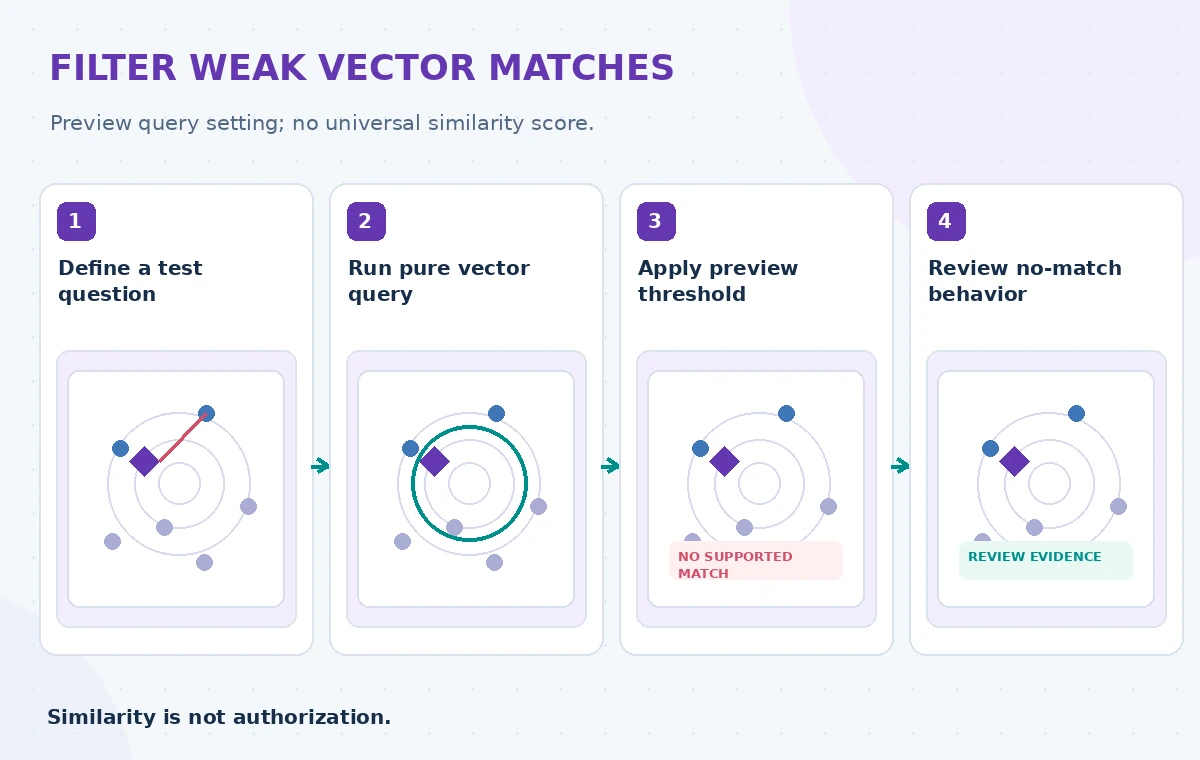
For hybrid text-plus-vector or multiple vector queries, Reciprocal Rank Fusion changes the scoring scale. A numeric threshold copied from a pure vector request cannot simply be reused against RRF output. Label every evaluation row with metric, field, embedding model, retrieval mode and API version so reviewers do not compare incompatible scores.
Treat vector threshold as a preview feature
The Azure query guide describes the threshold option in a preview REST API, with a 2026-08-01-preview example. Confirm the exact currently supported preview version and query schema before implementation; do not present preview parameters as guaranteed long-term stable. The sample threshold is illustrative, not a universal production choice.
A vectorSimilarity threshold is relevant to vector query results; avoid assuming all search modalities or combinations support identical behavior. If the request uses hybrid search, inspect how filtering occurs before result fusion and test the full response, not just raw vectors. Keep a feature flag or rollback path for a preview capability so an update does not silently break a public catalog assistant.
Build a threshold study with labeled records
Start by running a pure single-vector query against a stable test index and an explicitly versioned embedding model. Save the retrieved document IDs and similarity scores in a restricted evaluation workspace. Use annotated examples to find where true matches are excluded and weak matches survive. Do not optimize solely for the lowest apparent false-positive rate at the cost of hiding useful results.
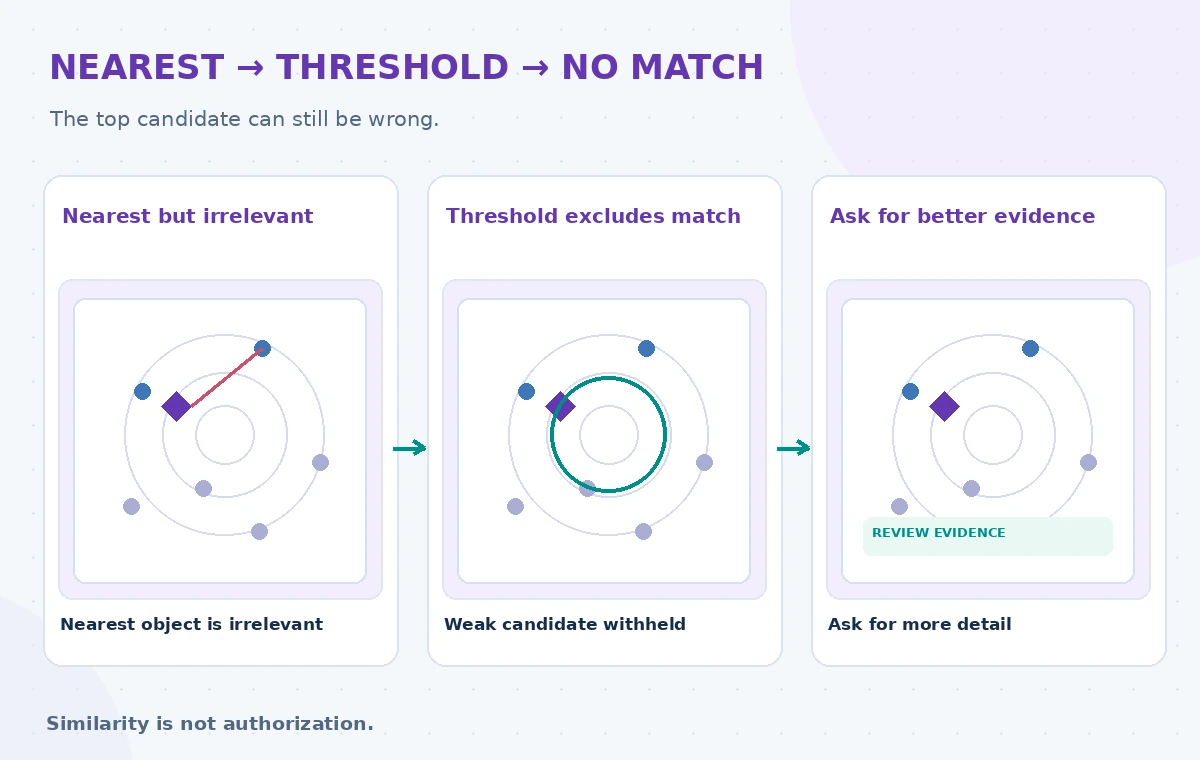
The comparison illustration shows three pedagogical states: an unrelated nearest candidate, a candidate removed by a notional threshold, and an honest no-match response with a request for more detail. It depicts intended product behavior, not measured scores. Avoid placing precise values on diagrams that could be mistaken for vendor benchmarks or empirical acceptance thresholds.
Preserve index permissions throughout the search path
Apply document access filtering or separate indexes as the organization’s search architecture requires. A similarity threshold is not a security feature. Do not first retrieve restricted documents and then rely on a text-generation instruction to keep their contents private. Check filtering on both text and vector paths and ensure snippets, facets, suggestions and citations inherit the correct access policy.
Construct negative tests with a hidden accession whose title resembles a public item. The correct response must not expose the private title, score or number of restricted matches. Test public and staff credentials separately. Log authorization outcomes without copying restricted content into analytics dashboards or model traces.
Design the assistant’s no-evidence response
An empty result set is a successful retrieval outcome when evidence is weak. The UI should plainly state that the catalog search did not establish a matching record and offer a route to refine the query or contact a curator. Do not auto-fill an invented accession number, guessed year or assumed ownership. A human may later identify a relevant record; until then, uncertainty is part of the accurate answer.
If the assistant uses generated prose, pass only allowed, retrieved source identifiers and instruct it to distinguish a record match from a contextual suggestion. A link or citation should lead to an actual available record, not merely an adjacent object. Track “no match” as a desirable class in evaluations rather than counting every empty response as a defect.
Retest after changes to embeddings and index shape
Threshold behavior can change when the embedding model, chunk boundaries, distance metric or index configuration changes. Build a regression set that includes both the nearest distractor and a legitimate but vaguely described object. Rerun calibration after reindexing, compression changes or a switch between HNSW and exhaustive search.
Keep the reference score distributions for each configuration separate. A high vector score cannot prove historical provenance, conservation status or object identity. The source catalog, accession evidence and approval workflow remain necessary even if the threshold improves retrieval precision in a controlled test.
Release carefully and monitor for false negatives
Roll out to a small, authorized audience and record examples of legitimate questions that receive empty results. Have curators review difficult cases, then choose whether to adjust retrieval, add missing records or improve user prompts. Different collections may need different calibration because descriptions and metadata quality differ dramatically.
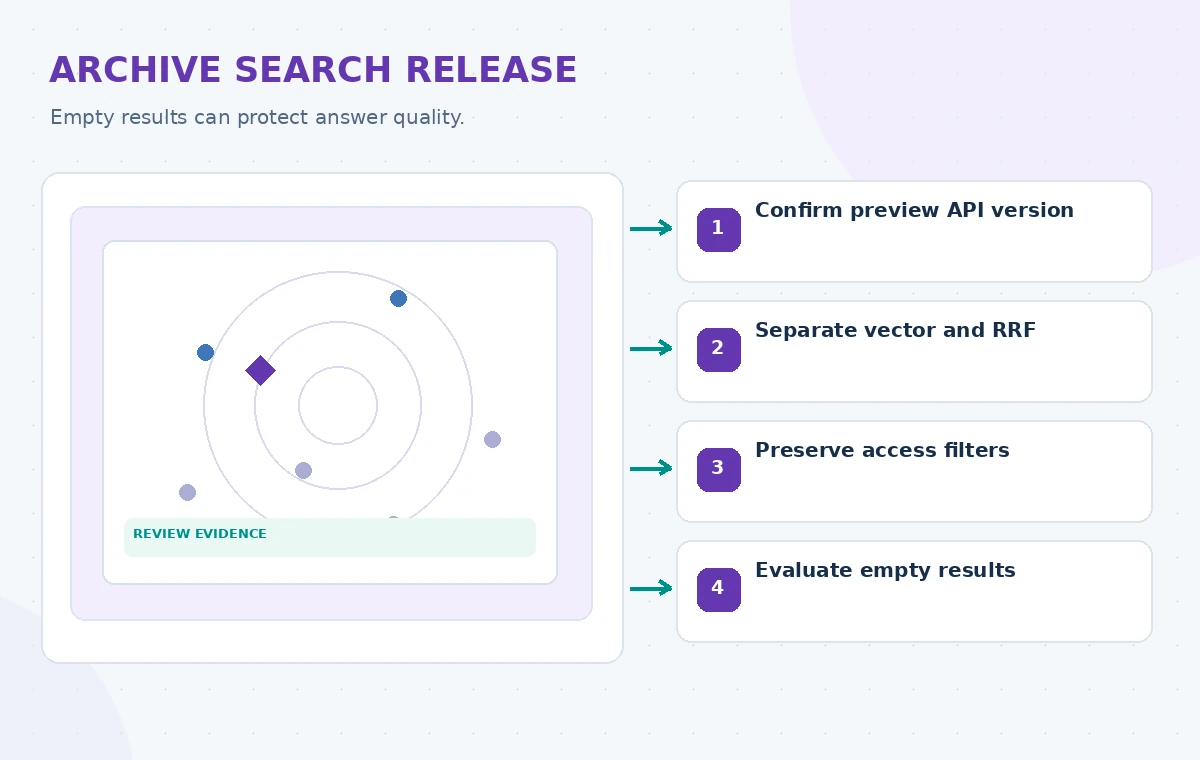
Version the preview API, scoring configuration, embedding model and evaluation set in a release note. A fallback should fail closed on private material but remain helpful about public searching. The goal is not a magic universal score: it is an auditable decision to show only grounded, authorized evidence and acknowledge when the catalog cannot answer.
How We Research
For this November 2026 article, we examined named vendor references: Azure AI Search vector query guide; Azure vector ranking and score semantics; Search Post REST preview reference. We compared documented input options, output fields, supported modes and limitations against an expressly fictional archive or community-service workflow. We did not process private records, make paid API requests, obtain live service results, run a security assessment or measure product performance. All artwork consists of original conceptual examples rather than actual interface screenshots or benchmark evidence. Readers must verify up-to-date product documentation, eligibility, region, legal permissions and authorized environment configuration before deployment.
Frequently Asked Questions
No. The highest-ranked result can still be irrelevant when the correct record is absent.
No. Azure documents a transformed score for cosine vector search, and other query modes use other scales.
The cited Azure documentation describes threshold as a preview feature; verify the current API version before adopting it.
No. Authorization filters and index access controls must be enforced independently of relevance ranking.
Not necessarily. Suppressing low-evidence results can be the correct and safer answer.