
A Small Vector Index Can Lose the Right Catalog Record
A museum may compress its vector search index to reduce storage and improve operational efficiency. Quantization reduces the precision of stored vector representations. When two ceramics look semantically similar, that loss of precision might change which accession record appears first. A missing match is particularly frustrating when an accession number or catalog caption clearly identifies the intended object.
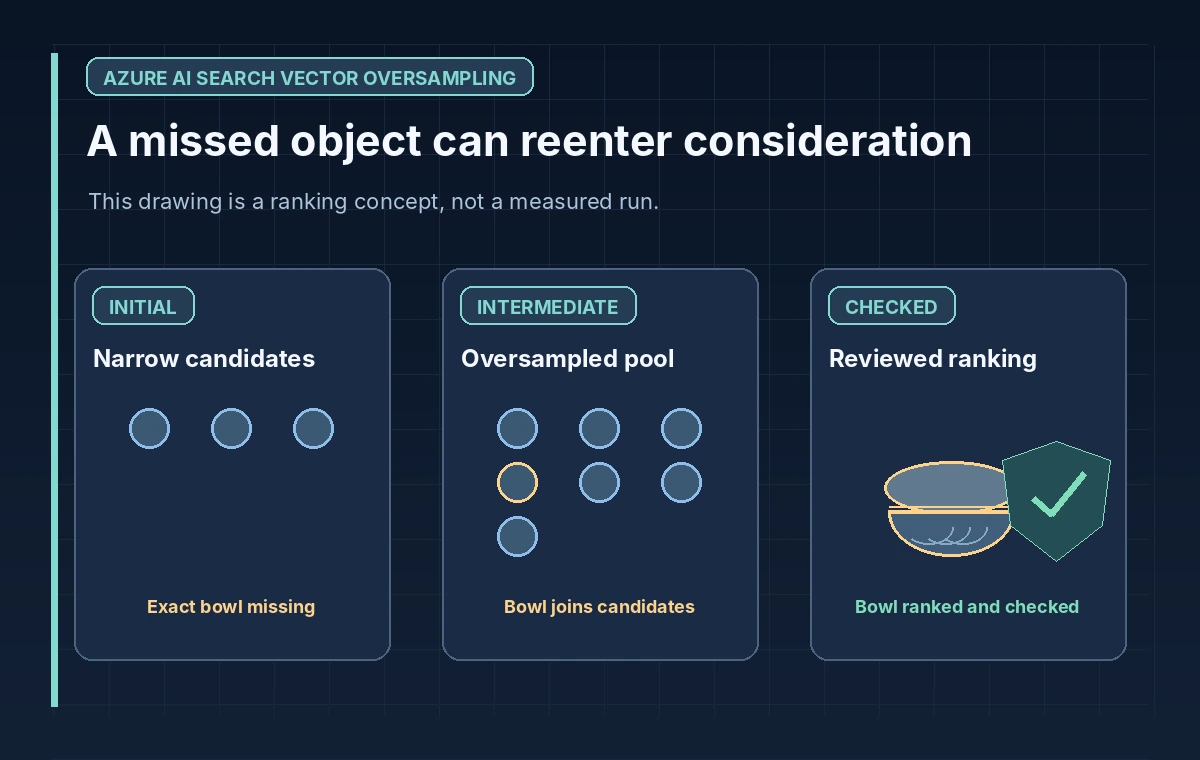
Imagine searching for a distinctive blue-glaze bowl in a hypothetical collection. The compressed nearest-neighbor search returns several broadly related pieces but misses the exact item that the full-precision baseline retrieved. Azure AI Search exposes oversampling and rescoring options intended to consider a broader candidate pool before final ranking. This is a retrieval tuning mechanism, not a guarantee of finding every relevant record.
Check That Your Index Supports the Feature
The documented rescoring path is associated with compressed vector fields and HNSW approximate nearest-neighbor indexes. Exhaustive KNN does not benefit from rescoring in this way because it scans the vectors for its search operation. Review the field’s vector search profile, algorithm, compression method, and whether original vectors are retained before attempting a query override.
Azure documents scalar and binary quantization paths with distinct rescoring options. Scalar quantization needs original full-precision vectors for original-vector rescoring; binary quantization has other documented possibilities, including binary dot-product scoring. Some parameter names have changed between preview and stable API versions. Pin the precise API version in your configuration notes rather than copying an obsolete snippet.

Understand the Candidate Pool Rather Than Guessing
For a query returning a final top k, oversampling expands the number of potential hits considered before rescoring. A documented example with k equal to five and oversampling equal to twenty examines a much larger preliminary pool, then still returns only the top five after the rerank step. The multiplication describes candidate breadth; it is not a claim that quality improves by that percentage.
The request-level `oversampling` value can override the default set in a supported compression configuration. A larger pool may cost additional latency or compute. Start with the platform’s documented defaults and compare against a controlled baseline. Keep a record of field name, search profile, quantization configuration, query text, filters, k, oversampling, and API version for each experiment.
Make a Gold-Standard Set of Difficult Searches
Prepare a small collection of authorized test queries drawn from real cataloging tasks but stripped of sensitive patron activity. Include specific maker names, older material labels, uncommon object shapes, and deliberately similar photographs. For each query, a trained cataloguer identifies the set of relevant accession records from trusted catalog evidence—not from the vector service’s own results.
Maintain two distinct kinds of cases: exact lookup by accession code and semantic discovery by concept. Exact codes may need keyword or hybrid retrieval rather than just embedding similarity. Define recall-at-k and source-version checks for the semantic cases. Do not compare different query wording, filters, or index versions and then attribute the outcome solely to oversampling.
Compare Three Retrieval States Clearly
First record the quantized baseline with its original candidate list. Second run a supported oversampled query and inspect the broader candidate stage using whatever diagnostics your application actually records. Third evaluate the rescored top-k against the cataloguer’s relevant set. A schematic can illustrate a missing bowl reentering consideration without claiming that a particular production index behaved that way.
Keep the same authorized scope throughout. If a record is embargoed, oversampling must not make it visible in the visitor interface. Access filters and permission checks remain separate from similarity calculation. In a user-facing response, absence from top-k should be expressed as limited retrieval evidence, never proof that the object does not exist in the museum.

Evaluate Latency and Stability Alongside Recall
A wider candidate pool can improve ranking opportunities but it is not free. Measure latency on your own infrastructure, track index size and build, and compare representative repeated queries. Record the number of relevant results in top-k and the order in which they appear. Do not manufacture a performance percentage from an illustrative diagram or assume the official default is optimal.
Use a rollback baseline. If a new configuration yields marginal retrieval benefit but disrupts response time for accessibility kiosks, leave the older setting in place while investigating. Check that baseline and comparison use the same source index revision and query filters. Quantization changes should be reviewed together with embedding model changes, not conflated with them.
Keep Index Management and Access Boundaries Separate
Rescoring can change order, not authority. A private catalog chunk and an approved public description might be vector neighbors, but permission filtering must determine which can be returned. Apply the same authorization rules in all candidate and rerank stages, and independently test that an anonymous search never exposes restricted descriptions.
Store query identifiers and evaluated relevance labels without personalizing the search logs unnecessarily. If a field is recreated or a compression policy is changed, reindex and benchmark deliberately. A configuration that works on today’s catalog might shift as new accession records are added, so schedule regression checks after major imports.
Decide When Oversampling Is Worth Keeping
Adopt the smallest supported candidate expansion that meets your documented relevance and latency targets. Use an annotated retrieval set to detect whether a previously missed object improves; also record wrong matches that move upward. The tuning decision should consider curator workload and user expectations, not only a single score.
If no setting recovers the relevant record, investigate chunk text, embedding quality, catalog metadata, filters, and hybrid search before increasing the multiplier further. Keep reviewers informed that the service offers an approximate ranking workflow. A final public answer still needs a verified accession number and source description, even when the vector score looks convincing.
How We Research
We reviewed the following official developer documentation on November 8, 2026: Microsoft: Compress vectors using quantization; Microsoft: Create a vector index. We compared the documented parameters, data flow and stated limitations with this hypothetical editorial scenario. The diagrams are original instructional illustrations, not real vendor screenshots or outputs. We did not submit private archive material, run a production API evaluation, measure tool accuracy, obtain legal consent, or test a live service configuration. Product behavior, access rules, quotas and supported settings may change; confirm the latest documentation and your organization’s policies before deployment.
Frequently Asked Questions
Not necessarily. It broadens the candidate pool before rescoring; the final top-k count remains governed by the query.
Azure documents that exhaustive KNN does not use this HNSW rescoring path.
No. It cannot repair irrelevant source text, mismatched embeddings, or faulty permissions.
That depends on the compression and rescoring method. Scalar quantization requires preserved originals for original-vector rescoring; check the exact profile.
It must not appear in an authorized public result. Enforce and test access rules separately from similarity ranking.