
A corrected museum record does not always need a full rebuild
A cataloger fixes a misread accession suffix in a source system, but the visitor-search index still returns an old OCR value. A full indexer reset could be expensive and may interrupt other processing. Microsoft documents a preview operation named Reset Documents that can queue selected documents for re-ingestion instead.
The important promise is narrow: this is a controlled reprocessing request, not a command to make every search result instantly correct. The source record must already be approved and the indexer mapping must still be valid. A corrected accession field also may affect identifiers, cross references and records not covered by a one-document refresh.
Check that you are using the preview contract
Microsoft currently labels Reset Documents as a preview operation. Its REST reference includes an API version such as 2026-08-01-preview. Preview behavior and support terms can differ from stable service features, so verify the deployed service, version and organizational change policy before building production automation around the endpoint.
Do not describe this as a universally available one-click portal control. The reference documents a REST operation with documentKeys or datasourceDocumentIds, and the run/reset guide explains how it interacts with an indexer. An application that cannot use the preview should prefer a supported, reviewed maintenance path rather than silently falling back to a full reset.
Identify the exact document to reprocess
The API can accept search-index document keys or identifiers for source documents. These are not always the same string. Blob indexers can create keys through mappings, and a parser that emits multiple documents per blob may generate keys that a cataloger cannot predict from the filename.
First query the index for the relevant key, and compare it with the approved source object or row. Record both values when they differ. In a hypothetical archive, an accession label visible to visitors might be PHOTO-082, while the underlying search key is an encoded storage path. Resetting the display label as if it were a key could have no effect.

Understand what resetdocs actually queues
Microsoft explains that Reset Documents marks selected documents for re-ingestion on the next scheduled or on-demand indexer run. It does not immediately execute the refresh. A call can include a list of documentKeys or datasourceDocumentIds and, where supported, overwrite semantics for replacing a previously queued list.
Be cautious about sending a second request: the documented behavior can add new keys to the pending set unless you explicitly use the overwrite option. Treat a reset request as a durable change to indexer state, with an audit record and an operator-reviewed list. Repeated submission is not the same as an idempotent no-op.
Follow the reset with the required run sequence
The Microsoft how-to says to run the indexer after Reset Documents to process the selected items, then run it again to return to normal incremental processing from the last high-water mark. A success response to resetdocs alone is therefore insufficient to claim the catalog index now contains the corrected source.
Check indexer status and the resulting search document after the relevant run, and keep the record of both executions. If the selected key is wrong or the source is no longer available, the expected correction may not appear even though the reset request was accepted. Do not upgrade a draft exhibit description from that acceptance signal.
Know which content will be refreshed
Reset Documents reprocesses fields for the selected documents from source data and metadata; it is not a field-level patch. If a configured skillset enriches the source, corresponding cached enrichment for selected documents can be updated during this process. Recheck any generated OCR or caption text against the source scan after the run.
For a record with rights restrictions, changing the source metadata and reprocessing it does not prove a public search view is safe. Confirm that the target index uses approved fields and filters, and independently test what anonymous users can retrieve. A rebuild operation should never act as a substitute for a permissions review.

Watch preview reset status, not a green general badge
Microsoft shows a currentState section in a preview Get Indexer Status response for reset-related modes, including indexingResetDocs and resetDocumentKeys. This can help an operator see the pending scope. A general successful indexer execution may still miss the intended document if the key list or mapping was wrong.
Keep a reconciliation record showing intended source ID, requested key, indexer revision, observed status and returned document field values. Search for the exact corrected accession string, not just any result on the same topic. An apparent improvement in ranking is not proof that the original wrong field has been replaced.
Compare the stale, queued, and verified states
The conceptual comparison shows a stale indexed record beside an approved corrected source, then the selected reset request, then an indexed entry that has been checked against the current source revision. These are instructional representations and not outputs observed from a live Azure subscription.
A queue state belongs in the middle, not at the end. A catalog correction can change more than spelling: cross-references, rights codes and inherited collection descriptions may need separate reviews. If there are multiple documents derived from one file, explicitly identify all affected keys instead of assuming one reset covers the whole source.
Plan rollback and incident handling
Microsoft notes that reset operations are not undoable in the simple sense; actual reprocessing changes indexed documents. Keep versioned source exports and a reversible release plan for the visitor application, including a means to hide an affected item until corrections are checked. Never erase the provenance of the earlier published record.
Exercise a fictional bad-key request, a missing source object, an interrupted run and a rightfully denied public document. Test the application’s ability to show a clear pending state. The operator should know whether to retry the same key, correct the source mapping, or escalate to a full index review instead of pushing updates blindly.
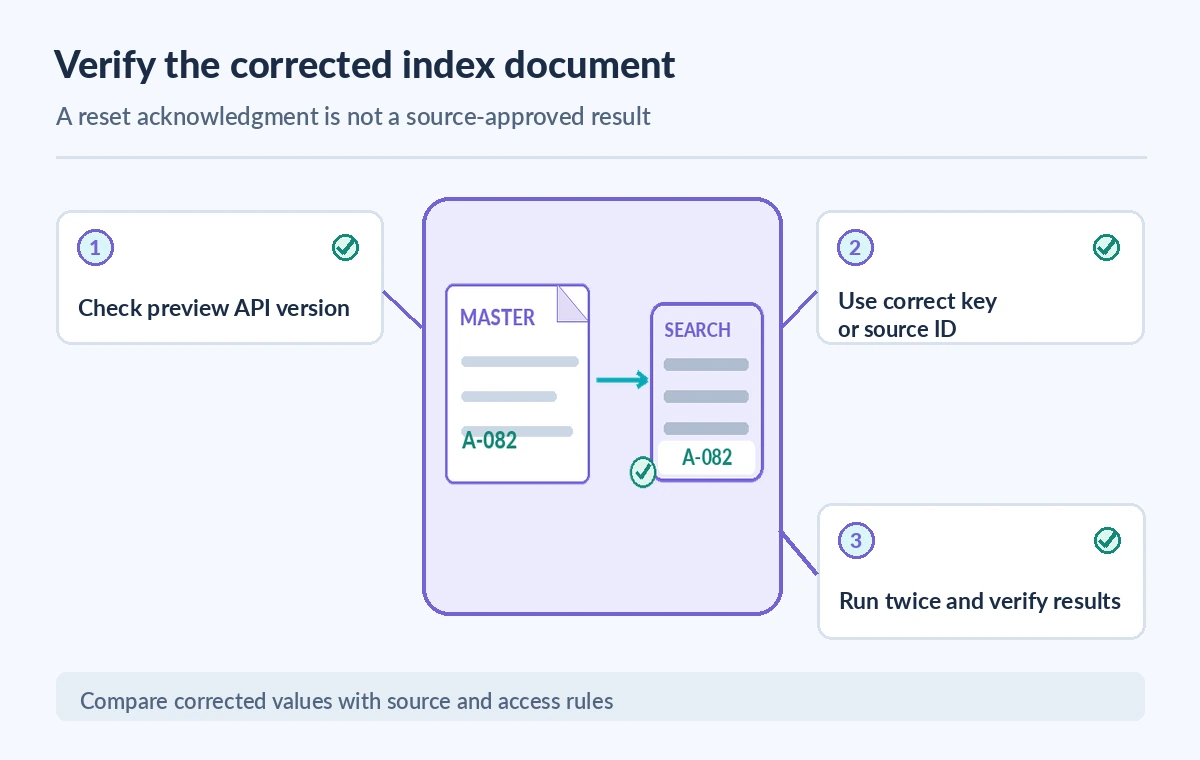
Treat selective indexing as an engineering aid, not an editorial verdict
A sound workflow starts with a verified catalog correction, maps the correct document key, queues the preview reset, runs and checks the indexer, then submits the result to a separate editorial and access review. Every stage has distinct evidence; the final sign-off is not part of the resetdocs API.
We consulted Microsoft primary documentation and created a hypothetical museum example. We did not call a preview API, run an indexer, inspect tenant status or measure resource savings. Recheck the supported API version and operational terms before turning these steps into an automated production job.
How We Research
For this November 11, 2026 desk review we checked named primary documentation: Microsoft run or reset indexers guide; Indexers Reset Docs preview REST API; Microsoft search indexer overview. We compared the vendor-defined fields and limits with a fictional museum workflow, identified states that the API cannot prove, and designed original diagrams to show the boundaries. We did not access a live customer account, upload or modify files, run API calls, inspect private records, verify service performance, or claim empirical success rates. Preview features, permissions and product behavior can change; confirm current release notes, your organization’s contracts, and human legal or editorial approval before deploying.
Frequently Asked Questions
The cited Microsoft documentation currently labels Reset Documents as preview; confirm your service and supported API version.
No. It queues selection for a subsequent scheduled or explicit Run Indexer operation.
Only if it is actually the index document key. The displayed accession field and an encoded source key may differ.
Microsoft describes running once for the selected reset documents and again to resume regular incremental processing.
It cannot reconstruct an absent source. Verify the source, mappings and intended deletion behavior separately.