
Why a sample cannot certify a preservation master
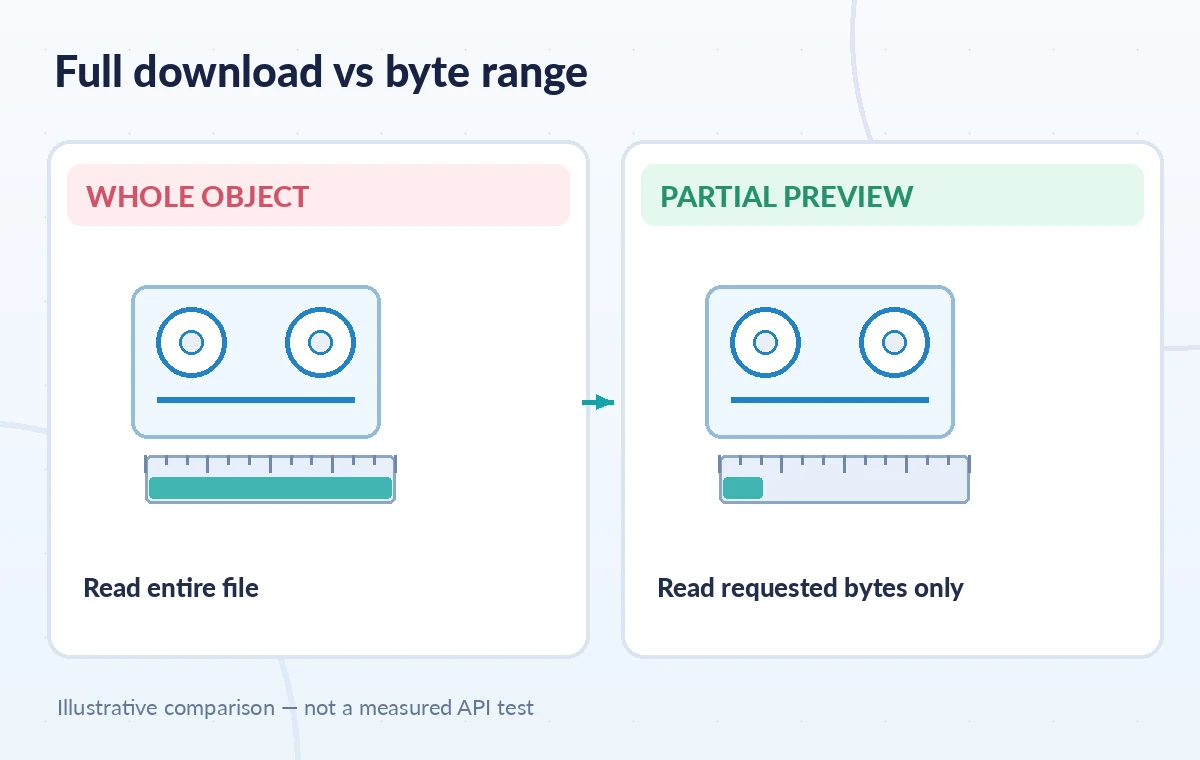
A fictional archive stores multi-gigabyte oral-history masters in S3. A partner asks whether the beginning of a particular file has the expected header before downloading the entire object. A byte-range request can retrieve only the needed portion, reducing unnecessary data transfer for that diagnostic. However, a few opening bytes do not prove that the remaining recording is complete, legally shareable or unmodified. Treat the result as a file-format preflight, not a preservation checksum, a rights review or a replacement for verifying the whole master.
Pin the correct object and version first
Record the bucket, exact key, verified owner, region and intended versionId when versioning is used. A key can point to a different current version after a later upload, so an unpinned example risks comparing metadata from one version to content from another. Confirm the archive accession record before requesting any bytes. If the bucket has Requester Pays, ownership restrictions, KMS encryption or access-point rules, those controls still apply. Never weaken storage policy simply to make a preview request succeed.

Choose a defensible byte range
The GetObject API accepts a Range request header for a byte interval, for example bytes=0-4095 as an illustrative header preview. Choose the interval according to the format being inspected and document why it is sufficient to inspect that structure. Amazon S3 does not support requesting multiple disjoint ranges in one GET. A short range is not a universal audio validation technique; some containers place important metadata elsewhere. For format-specific parsing, consult the relevant codec and container specifications instead of assuming every header lives at offset zero.
Interpret the response as a partial transfer
An eligible range request normally returns partial content with range metadata, but clients must still handle errors, changed objects and unsupported assumptions. Inspect the response status and byte positions rather than trusting that a command downloaded the requested segment. Persist the associated version ID and expected object size when available. If the requested range falls outside the object, handle the service response as a diagnostic failure. Do not overwrite a local preservation copy with the short preview; save the excerpt under a clearly labelled temporary diagnostic filename.
Do not confuse Range and partNumber
The GetObject API also supports a partNumber query parameter, which performs a ranged GET for the selected multipart part. That is not interchangeable with requesting an arbitrary byte offset: multipart boundaries depend on how the object was uploaded. Choose one mechanism based on the actual diagnostic goal. For a fixed header preview, a byte Range is usually easier to explain. For part-specific troubleshooting, use documented multipart metadata. A multipart ETag should not be treated as a universal full-object MD5 digest.
Separate preview permission from release permission
An authenticated GetObject request needs appropriate object access, and encrypted objects can require additional key permissions. A successfully retrieved chunk only establishes that those bytes could be read by that caller at that time. It says nothing about consent for public distribution of an interview, donor restrictions, archival handling policy or the right to create a derivative. Review the oral-history release record independently and never put the excerpt in a public URL unless a rights owner has authorized that use.
Verify the full object for preservation decisions
When deciding whether a master is intact, download and verify the full object with an approved checksum or other documented integrity process. S3 offers checksum-related features, but supported algorithms and multipart checksum semantics must be handled correctly; they are not automatically inferred from a short GET. Compare with an authoritative accession checksum recorded when the preservation copy was accepted. An independently produced full-file digest and a version-pinned read provide stronger evidence than a visually plausible opening waveform or correct extension.
Control cost, logs and temporary data
A small sample still incurs permitted request and transfer charges and may expose sensitive bytes. Keep preview logs limited to key references, byte interval, HTTP outcome, version and approval ticket. Do not log the interview content or credentials. Ensure temporary excerpts have an explicit retention and deletion policy rather than leaving pieces of recordings in support folders. For large collections, a repeated range-scanning script could still create unwanted costs and privacy risk, so gate it by an approved inventory and request budget.

Acceptance checks for a repeatable workflow
Use a synthetic media file in a test bucket and compare a pinned range response with the corresponding bytes of a separately verified local copy. Test invalid ranges, missing versions, access denied and deliberately changed latest versions. Confirm that the application labels excerpts as partial and blocks release without a separate provenance and integrity review. These are recommended test cases rather than claims of measurements. If the header check fails, return a clear diagnostic result and preserve the original object unchanged for archive staff.
How We Research
For this guide, we compared these official primary sources, consulted on November 10, 2026: S3 GetObject REST reference; S3 HeadObject REST reference; S3 checksum documentation. We traced the named API field or operation to its documented behavior, separated guaranteed platform semantics from hypothetical museum workflows, and checked for related topics already in the LabFin archive. No production API calls, live benchmarks, measured performance, commissioned user trials or real museum data were involved. Names, statuses and diagrams are instructional examples; verify the version, access model and retention settings in your own environment before applying the procedure.
Frequently Asked Questions
No. It checks only the returned bytes; full-object integrity needs an appropriate independent verification.
No. The GetObject documentation says multiple byte ranges are not supported in a single request.
No. partNumber selects a multipart part; Range addresses a requested byte interval.
It anchors the request to an intended version rather than whatever is latest when the request happens.
No. Technical retrieval rights and legal or donor-release permission are separate decisions.