
Why routing raw intake events is the wrong default
A museum receives an online donor-interest form containing a contact address, a possible collection subject and a private note to the registrar. An internal event signals that the intake record was created. The communications team needs only a record reference and a workflow status so it can prepare a generic acknowledgment. Forwarding the entire event to every notification target would expand the number of systems that can see the private note. Amazon EventBridge offers an InputTransformer for rule targets that extracts selected values and constructs an alternate payload. Use it to reduce routine exposure, while remembering that a template is not a substitute for authorization or for keeping the original event bus secure.
Understand InputPathsMap and InputTemplate
EventBridge target input transformation has two main components. InputPathsMap assigns short variable names to JSONPath expressions over the original event, such as a stable record ID at a detail path. InputTemplate combines those variables with fixed text or JSON structure to create the input delivered to a particular rule target. The EventBridge user guide documents a subset of JSONPath syntax, not every feature of a general JSONPath engine, and allows up to 100 variables. The InputTransformer API documents separate formatting rules for variables in JSON strings versus object values. Do not assume a path transformation can perform arbitrary data masking, validation, or field-level policy enforcement on its own.
Define the minimum message contract first
Work backward from the notification service: which fields are necessary to select the approved message template and locate the intake record? For the hypothetical museum, those could be a random opaque intake ID, the public event type and a versioned processing state. Do not include the donor’s name, email, health-related context or free-text note in the transformed event merely for convenience. The target can fetch the authorized contact details from its own protected system after authenticating the request. Give the output contract a version and document its owning team. This supports later changes without inviting downstream consumers to depend on confidential fields they should never have received.
Build a field map with a realistic fixture
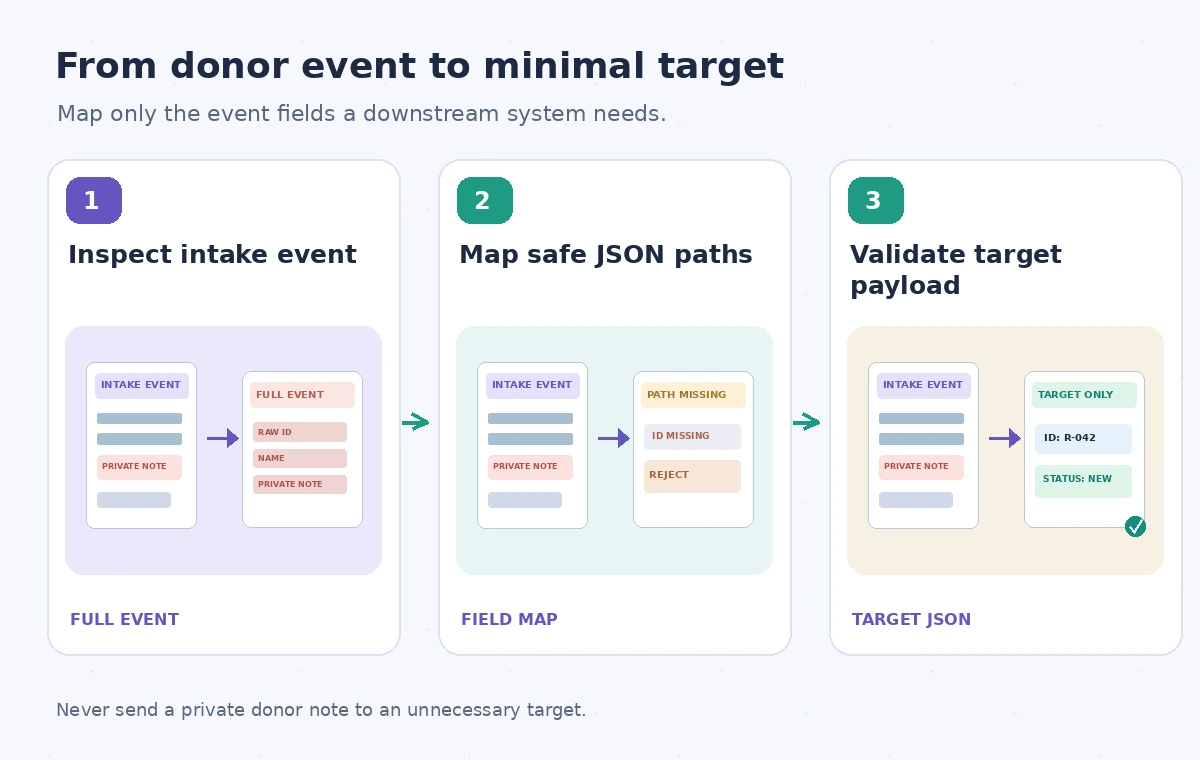
Create a synthetic input event with detail.intakeId, detail.status and detail.privateNote. Then define input paths for only the first two. Use a template that emits a compact JSON object with a known schema version and the selected variables. Test the resulting payload against a JSON parser and a schema validator before connecting a real destination. Be precise about quotation: the AWS documentation explains that string path values and JSON objects need different treatment inside input templates. Avoid assembling JSON strings by intuition. The transformed object should be clearly distinguishable from the source event in the process illustration, and the privateNote must never appear in the outbound fixture.
Test absent fields before enabling the rule
One important failure occurs when the original event omits the path named by an InputPathsMap entry. The EventBridge documentation explains that a variable without a matching JSON path is not created and will not appear in the output. That can produce a target payload that is malformed or missing an expected reference. Build tests for absent, null-like, unexpected-type and renamed fields, not just the happy path. The target must reject incomplete payloads rather than treating a blank identifier as a valid record. Keep a dead-letter or operational failure path that does not dump the full confidential source event into an overbroad support channel.

Compare three materially different payloads
The initial state forwards the raw intake event and exposes the donor note to a downstream system unnecessarily. The second state attempts a narrow template but refers to a missing path, leaving an unusable target message. The reviewed state includes only the opaque record identifier and approved status, with a target schema that rejects missing required values. These are illustrative designs to test, not measured AWS results. A privacy reviewer should trace every field from its source location to its final target and retention policy. If the target needs to look up donor contact details, audit that later lookup separately; InputTransformer cannot control the target’s entire data path.
Separate mapping from access control
An InputTransformer changes what a target receives, but the original event may still exist on the event bus, in archives or in logs according to the configured services. Review which producers can put events, which rules can match them and which identities can read target resources. Restrict permissions and encrypt or minimize source fields before publishing where feasible. A transformed payload does not prevent another rule from targeting the same event with a broader configuration. Check permissions for operators who can modify rule targets and templates, and use infrastructure review to catch accidental expansion of the field map. Privacy design must cover producer, bus, transformation and destination, not one API option.
Monitor template changes and downstream failures
Version the field-map configuration alongside the notification service’s schema. A renamed property in the source can break a template while the EventBridge rule still exists, so add contract tests to deployment checks and replay synthetic fixtures after every source-event revision. Inspect invocation failures and target responses without logging raw personal data. Record which rule version delivered a particular notification reference. If a target fails, retry and replay paths should use an idempotent event or business identifier so one donor does not receive duplicate acknowledgments. The message template must be signed off by the communications team independently of the transport layer configuration.

Approve a traceable, minimal target message
Before production release, provide the registrar and platform owner with a sample source schema, the exact input-path map, the transformed target JSON and a redacted execution log. Verify that the private note is absent, missing fields produce a controlled rejection, and duplicate event deliveries do not create duplicate notifications. Document what cannot be proved by an input transformer: donor consent, legitimacy of the source record and recipient address correctness. For those questions, the target must consult the authoritative system. With a narrow contract and explicit checks, EventBridge can route operational signals without turning a simple acknowledgment into a second copy of the donor database.
How We Research
For this guide we consulted the official documentation: Amazon EventBridge input transformation; EventBridge InputTransformer API; Input transformer tutorial. We compared named fields, supported behaviors and stated limitations, then developed an instructional museum scenario with explicit failure states. We did not run a live vendor API benchmark, inspect a production museum system, or measure vendor performance. The workflow and illustrations are proposed review steps; verify API-version support and your organization’s current policy before applying them.
Frequently Asked Questions
It builds an alternate rule-target input from values extracted from the original event and a template.
No. The EventBridge user guide documents a limited supported subset; test each path against representative events.
A mapped variable without a matching path is not created; ensure your target rejects incomplete output.
No. It affects that target input, not the original event or other consumers and logging paths.
Use a stable business event ID and an idempotent notification ledger at the destination, including retry paths.