
A Catalog Date Changes, but the Review Queue Sees Only the Current Value
A museum collection database may store object descriptions in DynamoDB. A staff member updates an attribution date and later discovers that the supporting document was the wrong edition. DynamoDB Streams offers change data capture: it can emit a record when an item is created, updated or deleted. The feature can support an editor-notification workflow, but it should not be advertised as indefinite revision history. Amazon documents a 24-hour life for stream records. If the consumer stops for too long, older events can be trimmed before anyone reviews them. A sustainable design preserves important events in a separate durable record system, honors field-level privacy, and makes the source document available for human verification. The catalog entries and changes described below are invented examples.
Select the Stream View Type for a Real Review Requirement
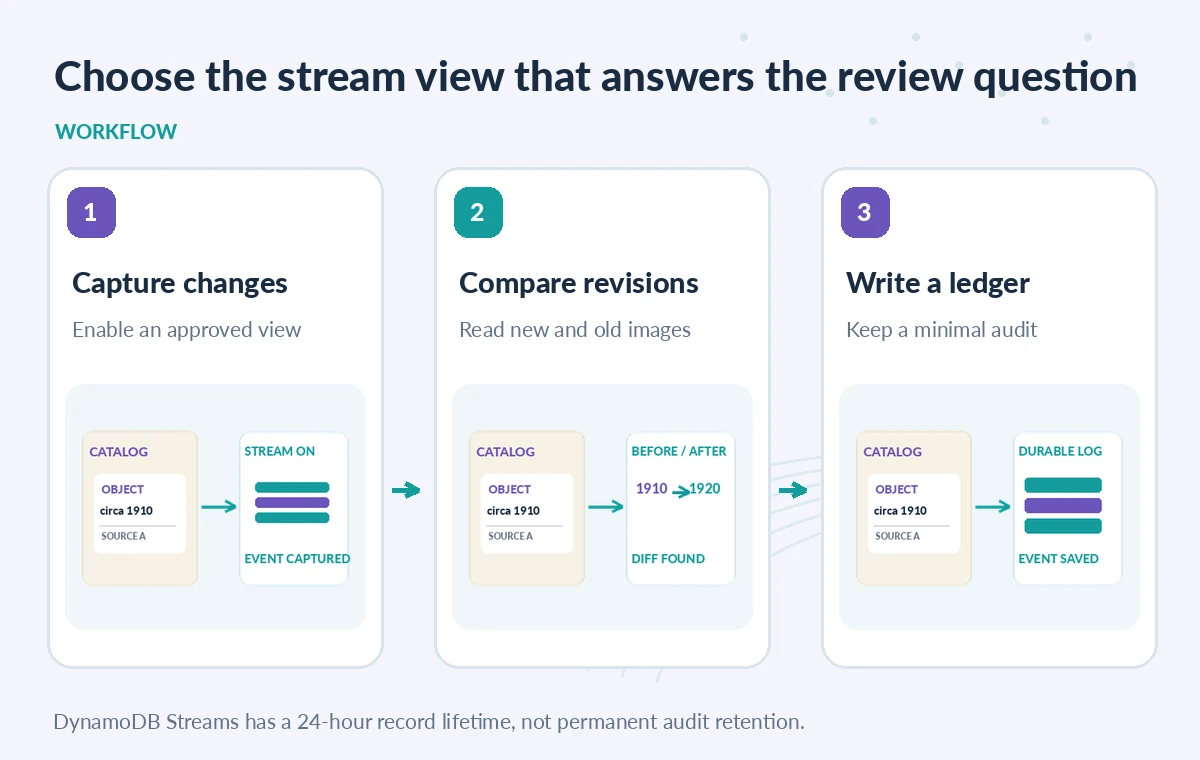
StreamViewType determines which item attributes appear in a change record. KEYS_ONLY carries identifying keys; NEW_IMAGE contains the item after a change; OLD_IMAGE records the pre-change item; NEW_AND_OLD_IMAGES includes both. A curator investigating a changed date may need before-and-after values, but a privacy officer may prohibit copying donor contact details into the stream consumer’s permanent audit table. Choose the smallest view that fulfills the review purpose. Enabling full images does not automatically mask sensitive fields. If full changes are necessary, filter or redact in a controlled consumer and restrict access to the resulting evidence store. Avoid claiming that KEYS_ONLY alone can reconstruct exactly which sentence changed; it cannot include the old or new body text.
Plan Around the 24-Hour Retention Boundary
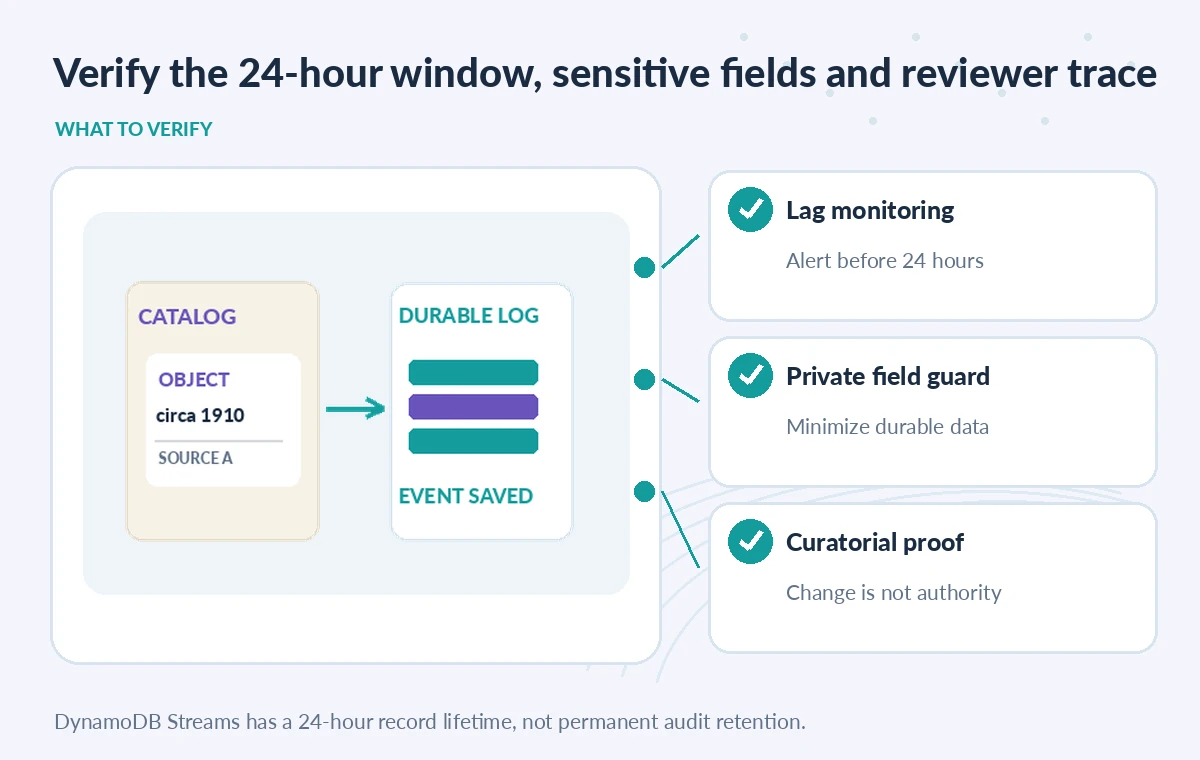
Amazon states that data older than 24 hours is susceptible to automatic trimming. Disabling a stream does not turn it into a permanent journal; existing records remain readable for a limited period and expire. Alert on consumer lag and processing failures well before that boundary. A long weekend or an unexpected outage must not turn a missing edit record into an untraceable event. A durable downstream archive can store a minimal, approved change event with source item key, old and new revision identifiers, relevant reviewed fields, event time and the consumer’s processing marker. Decide the destination retention schedule under organizational policy. Never assert that the stream is your legal audit archive or that a single consumer can reconstruct changes beyond the platform retention window.
Treat Sequence Numbers as Stream Ordering Clues
Stream records receive sequence numbers and are grouped into shards. Amazon documents that shards can split as workload changes, so consumers need to discover child shards and manage iterator progress. A sequence number helps process the stream, but it is not a global truth about the chronology of every historical decision. A document can receive two successive technical updates before a curator confirms either one. Track the item’s application-level revision and the source authority separately from stream position. If processing fails midway, re-reading some records may be necessary; deduplicate downstream effects using a durable key and revision. Alert when a shard iterator is invalid or a consumer falls behind rather than assuming an empty read means the catalog is unchanged.
Compare Keys Only, New Image and Old-Plus-New Views
A useful hypothetical change modifies ‘circa 1910’ to ‘circa 1920’. In KEYS_ONLY mode, the consumer can identify the accession row but cannot see that date transition from the event alone. With NEW_IMAGE, it sees the revised state but not the prior date; a separate source may be needed for a before-and-after comparison. With NEW_AND_OLD_IMAGES, it can compare both representations and queue a precise review. These are configuration differences, not evidence of the historically correct date. A safe diagram highlights missing context and review requirements rather than drawing an automatic check mark next to a changed year. The authoritative conservation file must still be opened before publishing a corrected attribution.

Build a Minimal, Durable Change-Review Ledger
The downstream ledger should store what the editorial team actually needs: key, event type, before/after field diff if permitted, processing ID, source revision and review status. Keep access permissions tighter than those for the public catalog. If a change contains a donor’s private address, avoid persisting the entire item image when a field-level event marker is sufficient. Use encryption and retention rules appropriate to the organization, but do not mistake infrastructure controls for consent or legal clearance. A reviewer should be able to distinguish ‘captured from stream’, ‘compared with evidence’, and ‘approved for public display’. These three timestamps answer different questions. The stream event itself is not an approval record.
Test Consumer Failure and Duplicate Delivery Safely
Design staging cases for an insert, a correction, a deletion, a repeated update, and a write that contains a sensitive field. Simulate a consumer crash after the durable ledger write but before its progress marker is saved, then verify the record is not committed twice. Simulate a delayed consumer approaching retention expiry; ensure monitoring creates a visible incident before the stream window closes. Inspect what each stream view actually makes available and how the redaction logic behaves on deleted items. These are suggested verification exercises and not test results gathered for this article. If an event can no longer be retrieved, say the evidence is missing and use independent historical backups and source records to reconstruct the change.
Separate Technical Change Capture From Curatorial Authority
An automated system may detect that a caption field changed, but that does not establish whether the change was justified, reviewed or licensed for publication. Treat a public label edit as an independent action requiring named source references and authorized sign-off. For an uncertain creator, preserve cautious language even if the latest database row appears confident. Provide curators with a compact diff and links to the actual source files instead of copying arbitrary notes into an AI prompt. Do not have an AI assistant reverse edits merely because a stream event looks unusual; it could overwrite a newer approved version. Escalate conflicting updates to a human editor.
Review the Audit Design After Every Schema Change
A new attribute in the DynamoDB item may inadvertently become part of a full-image stream record. Recheck downstream fields and access policies whenever a new donor, loan, or conservation field appears in the schema. Run periodic checks that the consumer is connected, lag is bounded, stream settings match the approved design, and durable ledger entries reconcile with catalog revision markers. Keep operational alerts from exposing private record payloads. Also document which stream consumers are only for analytics and which create external notifications; those have different consequences if an event is replayed. With this separation, DynamoDB Streams can support timely change detection while a dedicated evidence process carries the longer-term accountability.
How We Research
For this guide, we reviewed the official product documentation on November 8, 2026: Amazon DynamoDB Streams Developer Guide, DynamoDB StreamSpecification API, DynamoDB StreamRecord API. We checked the named setting or feature against its published behavior, mapped the documented constraints to the specific hypothetical scenario, and reviewed whether the topic duplicated titles in the supplied LabFin WordPress inventory or prior B0267–B0280 ZIPs. No authenticated vendor service was run; we did not perform a benchmark, observe real customer data, verify third-party rights or claim operational outcomes. All illustrated records and comparisons are teaching examples. Confirm product documentation and security requirements again before implementing a workflow in a real organization.
Frequently Asked Questions
Amazon documents a 24-hour lifetime; older records can be trimmed automatically.
NEW_AND_OLD_IMAGES includes both item images. Configure access carefully because full images can contain private fields.
No. KEYS_ONLY includes the modified item keys, not the before-and-after description values.
No. Preserve approved, minimal events in a separate durable evidence system that follows the organization’s retention rules.
No. It captures a database change; a curator must still verify source provenance and authorize publication.