
An Exhibit’s Revision Events Need Local Order, Not One Global Queue
A museum audio team updates several gallery narrations. For one exhibit, the editor uploads an approved script, a sound engineer exports a new voice track, and a curator marks the revision ready to review. A worker reading those events out of order might attach the sound file to an older script or announce publication too early. Google Cloud Pub/Sub supports message ordering using ordering keys. When published in the same region with a shared key and received by an ordering-enabled subscription, events for that key are delivered in their publication order. That property applies per key, not as a total order across unrelated exhibits. The case IDs and audio assets in this guide are invented examples, and no queue behavior is claimed to have been measured here.
Define the Ordering Key as One Logical Exhibit Stream
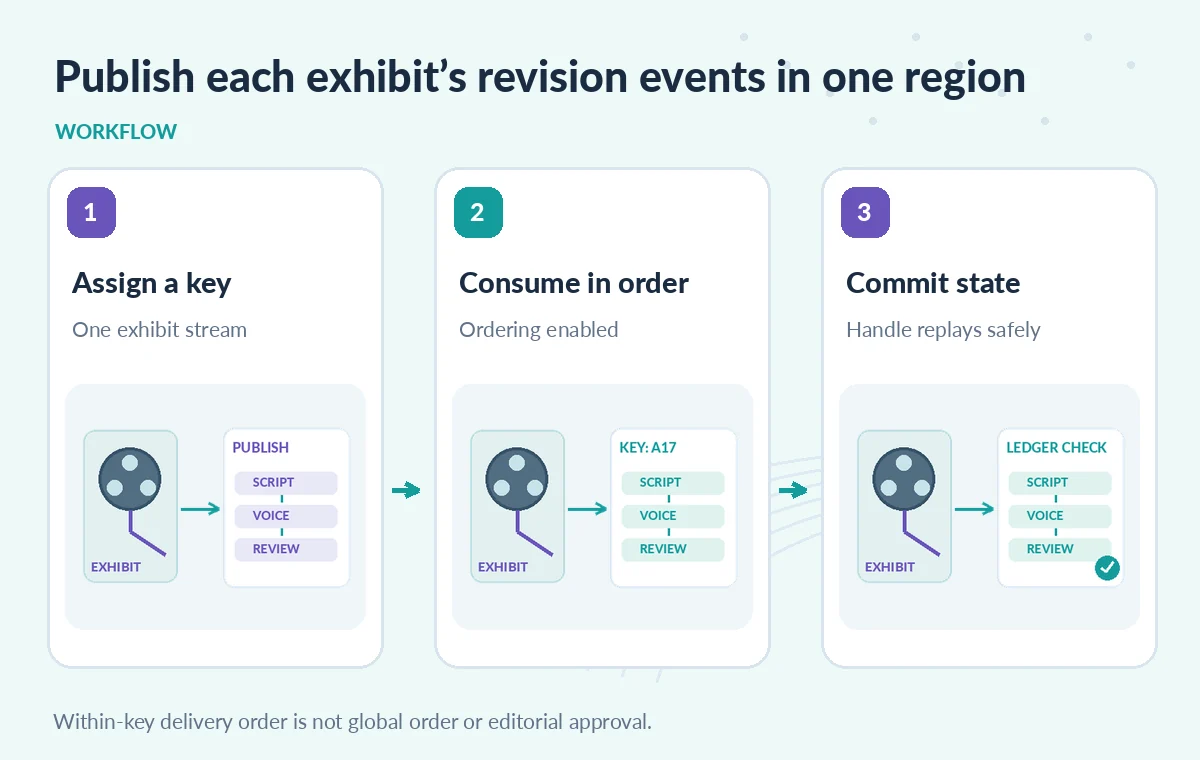
Choose an opaque stable key such as an internal exhibit-workflow ID, rather than a staff member’s email or a visitor’s name. All related events that require ordering should use the same key. For example, EXH-A17 can carry script-approved, audio-rendered and curator-reviewed events, while EXH-B04 uses a different key. Google’s documentation emphasizes that publishing for a particular ordering key must occur in the same region to obtain the ordering guarantee. Publishing events across regions for the same key is not a safe way to construct one logical sequence. A single giant key for every museum object also harms concurrency: a slow event can hold up a larger amount of unrelated work. Start with the smallest business unit that truly requires sequential handling.
Enable Ordering on the Receiving Subscription
Assigning keys on the publisher is not sufficient by itself. The subscriber must use a subscription configured for message ordering; without it, the service may deliver messages in a different order from publication. Google’s subscription reference states that ordering configuration is set when the subscription is created. Confirm this before using a subscription for editorial release orchestration. A second subscription on the same topic might legitimately have a different configuration. Document which receiving process makes editorial decisions and which consumes events for analytics only. A dashboard that combines logs from two subscriptions may show a different interleaving even when each individual key’s ordered stream is correct. Avoid interpreting cross-subscription display order as a new guarantee.
Handle Redelivery Before Advancing a Release State
Pub/Sub still has at-least-once delivery behavior. Google notes that if a message for an ordering key is redelivered, subsequent messages for that key may also be redelivered, including messages previously acknowledged. A worker must therefore recognize already-applied events. Give every revision event a durable event ID and expected source revision, then persist the transition atomically. If an audio-rendered event repeats, the app should not send a second reviewer notification or silently attach another file. Acknowledge only after the intended durable state is recorded. Do not equate acknowledgment with approval of the audio content. A media file still needs listening checks, rights review and source-script alignment before it is marked suitable for the exhibit.
Compare Ordered, Mixed-Key and Retried Sequences
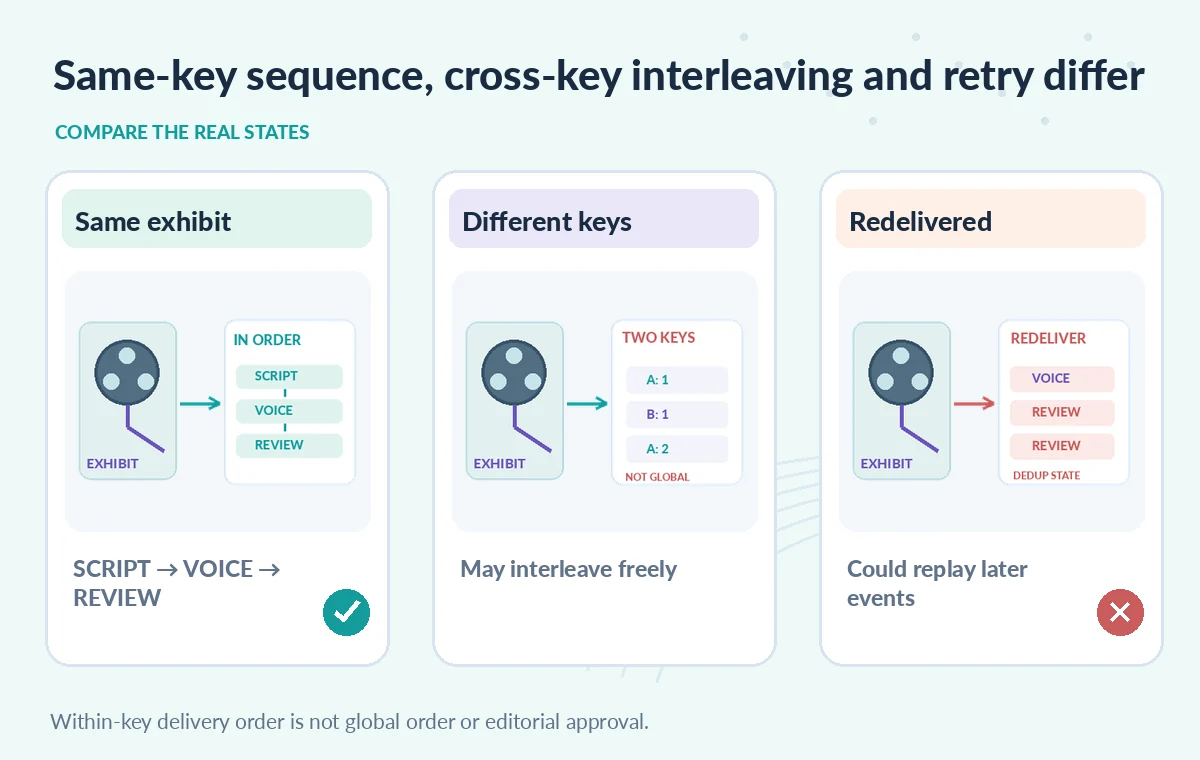
Imagine three fictional views. EXH-A17 carries script-v2 then voice-v2 then review-request; the subscriber receives those events in order under the documented conditions. In a second view, EXH-A17 and EXH-B04 events interleave: there is no cross-key delivery order to preserve, and the interface must group them by exhibit before showing history. In a third view, an acknowledgment deadline expires and EXH-A17 receives a later event again following redelivery of an earlier one. The final business state should remain stable through replay. Do not mark that replay as evidence the earlier editorial operation occurred twice. Present the diagrams as conceptual system behavior rather than screenshots from a running Pub/Sub project.
Distinguish Delivery Order From Completion Order
Even if callback delivery is ordered, a subscriber that launches asynchronous work and returns immediately can let the actual side effects complete out of sequence. Google explains that high-level StreamingPull client callbacks run to completion in order for a given key, but additional background work must be coordinated by the application. If rendering a transcript takes longer than publishing a short notification, use explicit processing states and ensure dependencies are checked before moving ahead. A message labeled review-request must not automatically pass if the audio or caption artifact is still missing. Build a per-exhibit state machine instead of relying on timing assumptions. A useful state is waiting-for-audio, which represents a missing prerequisite without publishing a misleading success notice.
Watch Hot Keys, Dead Letters and Slow Acknowledgments
A very busy ordering key can become a bottleneck because its events must be handled in sequence. Pub/Sub documents throughput considerations and warns that retries and slow acknowledgments affect ordered streams. Monitor backlog and oldest unacknowledged message age, but do not invent a safe universal latency threshold. A dead-letter topic can help investigate repeatedly failing messages, although Google documents that interactions with dead lettering can affect strict ordering expectations. A human operator should be able to inspect a failed event, the associated source version and whether it was committed downstream. If an event is skipped, avoid automatically applying later release actions; instead put the exhibit into a visible exception queue for editorial review.
Audit the Event Trail With Known Synthetic Cases
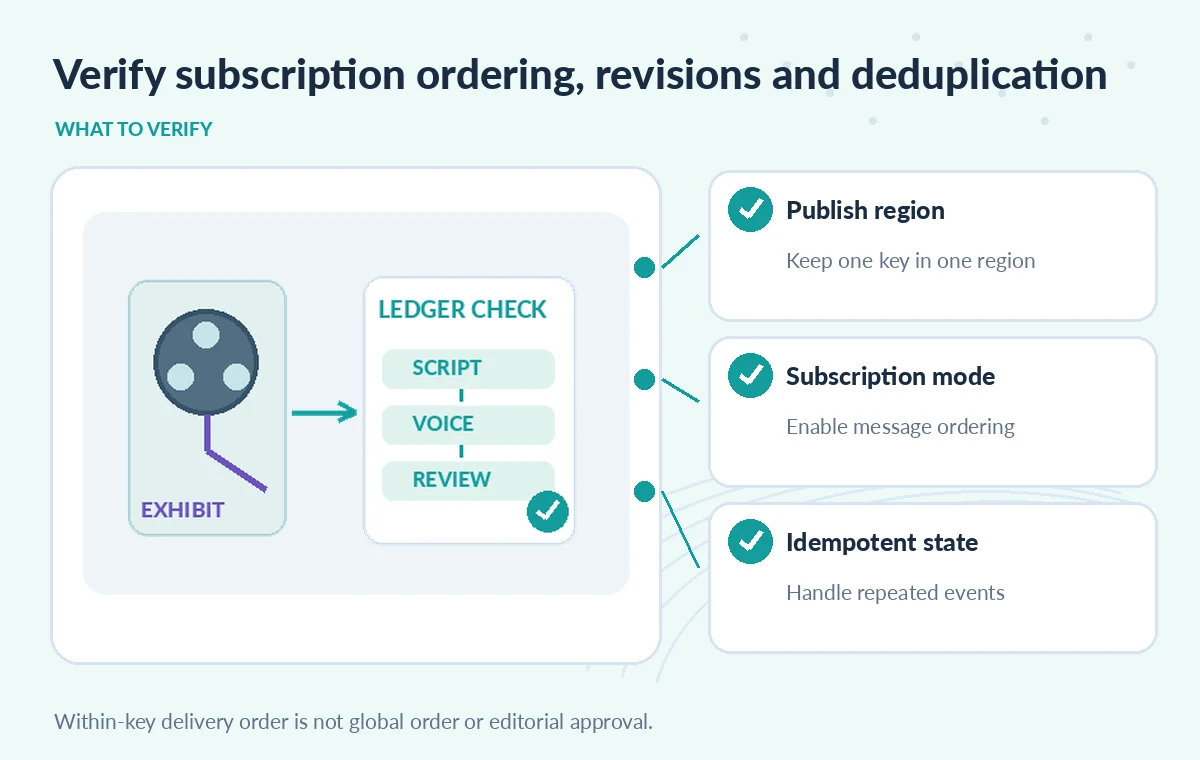
Construct a staging sequence with two exhibits, three numbered events each, a delayed handler and a forced retry. Inspect whether same-key messages arrive in order and whether the database resists duplicate transitions; separately verify that cross-key events may interleave. Test publisher-region configuration, subscription ordering settings, acknowledgment handling and the worker’s error path. Use synthetic event payloads that do not contain private volunteer information or embargoed audio. This guide documents a test design, not a service benchmark. The audit output should list which event revision was accepted, ignored as a duplicate, blocked for missing prerequisites or escalated to an editor. Those distinctions make the workflow recoverable and prevent transport mechanics from masquerading as publication approval.
How We Research
For this guide, we reviewed the official product documentation on November 8, 2026: Google Cloud Order Messages, Google Pub/Sub Subscription Properties, Google Pub/Sub Pull Troubleshooting. We checked the named setting or feature against its published behavior, mapped the documented constraints to the specific hypothetical scenario, and reviewed whether the topic duplicated titles in the supplied LabFin WordPress inventory or prior B0267–B0277 ZIPs. No authenticated vendor service was run; we did not perform a benchmark, observe real customer data, verify third-party rights or claim operational outcomes. All illustrated records and comparisons are teaching examples. Confirm product documentation and security requirements again before implementing a workflow in a real organization.
Frequently Asked Questions
No. The documented guarantee concerns messages sharing a key and published in the same region to an ordering-enabled subscription.
Do not rely on ordered delivery in that design. Publish the same key in one region to meet the documented conditions.
No. At-least-once delivery and ordered-stream redelivery still require idempotent processing.
Yes, if the application launches additional uncoordinated asynchronous work after receipt.
A separate documented editorial review of script, audio, provenance and rights—not delivery order alone.