
Why Two Fast Answers Are Not One Verified Notice
A library assistant is preparing a short notice for a hypothetical Saturday repair workshop. The venue record and the registration spreadsheet can be checked separately, while the coordinator’s approval is stored elsewhere. An AI workflow might request the room address and the booking status in the same turn, then blend them into a confident sentence. That blend can be wrong even when each lookup returned a plausible response: one record may refer to a previous workshop, and another may describe registration for a different session. OpenAI parallel tool calls are a control over how functions are requested, not a claim that all returned facts describe the same event. Keep each source identity and revision attached to the particular assertion it supports.
Understand What parallel_tool_calls Actually Controls
OpenAI’s function-calling documentation says a model may propose more than one function call in a turn. For supported models, setting parallel_tool_calls to false prevents multiple simultaneous calls and ensures zero or one tool call at that stage. Allowing parallel calls can be useful for independent read-only lookups, but it does not make the model’s output authoritative. The application must still execute each proposed tool call, return the corresponding function_call_output associated with its call_id, and decide how to proceed. Built-in tools have their own limitations in parallel batches, so do not assume every combination can run concurrently. Verify the behavior against the chosen model and current API documentation rather than treating this flag as a universal speed setting.

Split the Sources Into Three Explicit Functions
For the workshop scenario, define get_event_record, get_room_schedule and get_registration_status as separate functions with strict parameter schemas. The event record should return a stable event ID and its current revision, not only a headline. The room schedule should return a booking reference, time zone and approved capacity for the same event ID. The registration function should report whether booking is open, closed or unknown, with a snapshot timestamp. Make the functions read-only; no publish_notice or email_attendees capability should be exposed during the research step. Validate returned IDs in application code, since schemas protect formats better than the truth of any particular calendar entry.
Decide When to Serialize Instead of Parallelize
Use concurrent calls only when one lookup cannot change the appropriate inputs for another. A room schedule and an independent registration status may be fetched together after the event ID has been resolved. If the first call determines which venue or registration table is correct, perform it before any dependent queries. Set parallel_tool_calls to false for that dependency-sensitive stage, then optionally allow a later independent read stage. This reduces the chance of looking up a similarly named but unrelated event. The trade-off is some latency, but avoiding a published wrong address matters more than shaving a moment off the preparation of a public notice.
Compare an Attractive Summary With a Traceable One
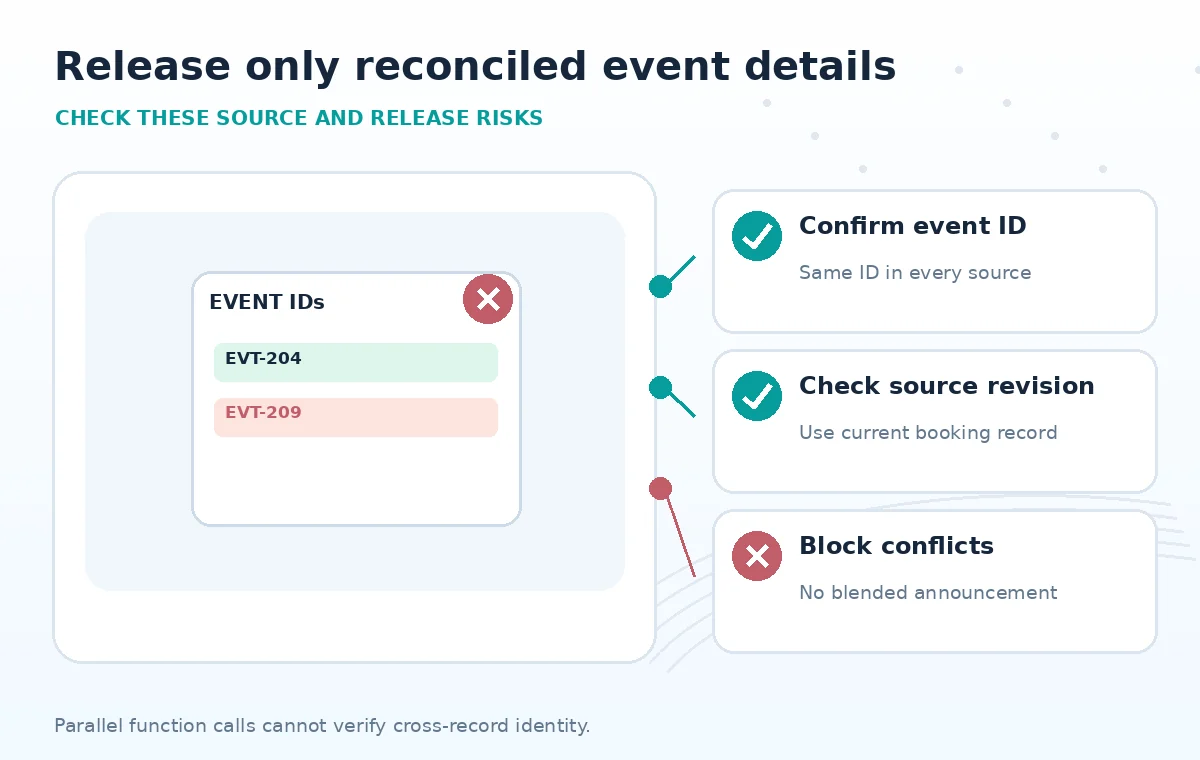
Imagine the assistant receives a room record showing Hall A at 10:00 and an enrollment sheet showing twenty open places, but the two records have different event IDs. The unreliable outcome is a polished announcement combining those values. The reliable outcome is a pending card listing each source separately, the mismatch, and a request for a coordinator to reconcile the records. A diagram of these states is an instructional model rather than the result of an API benchmark. Design the output object with fields for source_id, checked_at, value, evidence_link and status so that a downstream renderer can decline to display unconfirmed facts.

Match Function Outputs by call_id
When multiple function calls are returned, associate each function_call_output with the exact call_id that requested it. Do not depend on arrival order or concatenate tool outputs into a single blob without provenance. If a lookup times out, record a distinct missing state; never fill it from the nearest available result. Validate that the event ID, venue ID and booking ID refer to the same edition of the program. Store request correlation identifiers and sanitized error categories for review, while avoiding private attendee records in public logs. For an AI assistant, ‘no data’ is a result to represent, not a prompt to improvise.
Add a Review Gate Before Publishing
Define a clear release rule: required facts include an approved event title, start time, location and registration link, all attached to the same event identifier. A curator or program coordinator must approve changes to public-facing copy, especially accessibility details and cancellation policies. The generation component can draft from an approved structured record but should not decide that conflicting records are close enough. Keep write credentials out of tool-calling research functions. If a notice is later revised, save the prior approved version and identify which source changed. This approval process works whether calls were parallel or sequential; concurrency never supplies authority.
Test Partial Results, Misordered Replies and Stale Records
Build a review fixture containing three simulated outcomes. First, all sources agree and a notice is eligible for human approval. Second, the venue record and registration response disagree on event ID and the notice remains blocked. Third, the registration service fails, so the assistant must say that enrollment status is unknown. Shuffle the order of tool responses in the test harness to ensure call_id matching is correct. Also test a stale room revision, duplicate function requests and a model turn that returns no call. These proposed test cases are not claims that the OpenAI API was exercised for this article; they are a repeatable checklist for a local integration.
Publish Only the Facts the Records Can Support
Use the final event notice as an evidence-driven artifact. A valid location should link to the current venue record; a valid registration sentence should reference a current, access-controlled booking status. Do not expose attendee names, internal reservation tokens or raw internal function payloads on the public website. If information is incomplete, draft copy can remain in review rather than pretending certainty. Document the active model, tool definitions, whether parallel_tool_calls was enabled, and the human approval that completed publication. The practical gain from careful tool orchestration is not merely fewer calls but a notice whose claims remain independently checkable after release.
How We Research
We reviewed the named official primary sources on November 8, 2026: OpenAI function calling guide, OpenAI Responses API guide, OpenAI production safety practices. We compared documented parameter scope, practical boundary cases and implementation risks with the review workflow in this article. We checked the topic and slug against the WordPress title inventory supplied by LabFin and previous B0267–B0272 batches. We did not authenticate to a vendor account, run a live API request, conduct a performance benchmark, review real confidential archive material or verify deployment outcomes. All documents, sample states and diagrams are hypothetical teaching illustrations; product UI is not reproduced.
Frequently Asked Questions
No. The model chooses calls, and support depends on the model and tool mix. Turning the flag off prevents multiple function calls in the same stage.
No. Match each output to its request using call_id and verify that record identifiers agree.
No. Schemas constrain data shape; dates and venue claims require current source evidence.
Keep fact collection read-only and separate publication behind a specific approval step.
Mark that fact unknown and block any announcement that depends on it rather than inventing a value.