
An archive assistant is asked whether a fragile photograph may be handled without gloves. Its memory store contains an approved handling manual, an older draft, and notes from a different collection. LangGraph Store semantic search can retrieve relevant entries by meaning when indexing is configured, but relevance does not establish which policy is approved or who may see it. The design below scopes searches to the right repository and collection, filters status fields, and asks a responsible conservator to resolve conflicts before a procedure is presented as official guidance.
Separate documents, memories, and approved policy
Start with a policy register, not a pile of unlabelled memory snippets. Each entry should carry a source ID, exact revision, approval status, owner, effective date, and collection scope. Decide which text is safe to index and which information should be available only by direct authorized lookup. A conservator’s personal note may help explain a workflow but should not silently overrule the approved handling protocol for visitor-facing instructions.
In a hypothetical archive, a draft note says ‘gloves required for every print,’ while an approved protocol distinguishes material types. If the assistant retrieves the draft because its wording is closer to the question, an unqualified answer could mislead staff. Preserve both records with their correct statuses for internal auditing, while keeping the draft out of the default approved-policy retrieval path. Never treat a stored item as true merely because it was found.
Configure semantic indexing intentionally
LangGraph’s BaseStore interface supports key-value records under tuple namespaces. Semantic search is optional, depends on the store implementation, and requires embedding/index configuration. The documented setup can identify embedding dimensions and which content fields are indexed. For a policy record, index the controlled procedure text and descriptive title, not every administrative note or confidential comment. Keep the source identifiers and status available as structured metadata for filtering.

When adding a record, the BaseStore put reference supports index=False to exclude an item from semantic indexing on capable backends, or selected field paths for indexing. This does not automatically remove an item from direct retrieval or solve access controls. Test the actual backend rather than assuming all stores behave the same. Record the embedding configuration so a migration or model change does not quietly alter retrieval behavior.
Design namespaces as scope, not as authorization
Organize entries by institution and approved collection, for example a namespace representing the library’s photography handling manual. The store search method accepts a namespace prefix, so reviewers should know that a broad prefix can include sub-namespaces. Apply application-level authorization before any search and again before supplying passages to a model. A clever namespace name is not a security boundary, and a semantic index should never be relied on to hide restricted items.
A staff member requesting an open reading-room procedure should not receive conservation details from a restricted donor collection simply because the words are similar. Build tests that query with plausible cross-collection phrases and confirm that no unauthorized text appears. Store secrets and personal identifiers outside the searchable memory when possible. Document who grants permissions and how the assistant handles a denied or unavailable source.
Use search filters, then verify status and revision
The BaseStore search API documents semantic query text, metadata filters, limits, and offsets. Ask for current approved policy within the correct namespace and inspect the returned source records rather than accepting similarity rank as a verdict. Use a stable approval field and ensure your application checks it again when building the final answer. If a record has been superseded, search for the active revision or escalate the question.

For an illustrative three-panel comparison, an old draft is a highly relevant match, a middle panel shows semantic similarity alone, and the final panel shows a current approved protocol with its revision displayed. The panels are conceptual examples and not evidence of a benchmark result. The crucial transition is from ‘similar passage’ to ‘authorized, current source,’ not from a low numerical score to a high one.
Preserve citations and policy context in answers
When a relevant result is found, pass only the authorized passage and its source metadata to the language model. Ask for a concise answer that cites the exact policy document and section, and instruct the application to refuse unsupported procedural assertions. Do not let the assistant fabricate a page number or fill a policy gap with general conservation advice. If two current sources conflict, give staff an escalation path rather than averaging them.
Include the effective date and collection-specific exceptions in the output where they affect action. For example, a procedure might change when handling nitrate film versus an ordinary photographic print. A general summary may omit the distinction that matters most. When sources are incomplete, the best answer names the uncertainty and the policy owner who can confirm it; a fluent unsourced answer should not be treated as a completed search.
Test retrieval failures with controlled examples
Assemble a small offline evaluation set of real policy questions approved for testing: common procedures, obsolete wording, rare exceptions, and deliberately misleading queries. Label the expected source ID and revision, not merely the expected answer text. Score retrieval validity, access isolation, and citation correctness separately. Do not claim measured performance unless the team actually runs a controlled evaluation and records the result.
Check prefix-search behavior, truncation at result limits, and the effect of embeddings on approximate matches. A source can be absent because it was never indexed, has the wrong namespace, lacks required fields, or is beyond the result limit. Make those states visible in logs. When an error occurs, preserve the query and permitted source references without dumping restricted policy text into an unprotected troubleshooting channel.
Release a governed retrieval workflow
Before rollout, have policy owners approve the ingestion list, current revision register, source display format, and contact for exceptions. Create a simple process for revoking an obsolete entry, updating embeddings, and testing that future searches no longer surface it as current. Keep an audit trail of what was retrieved and what the human or application accepted as the governing source. Staff should be able to view the original record before acting.
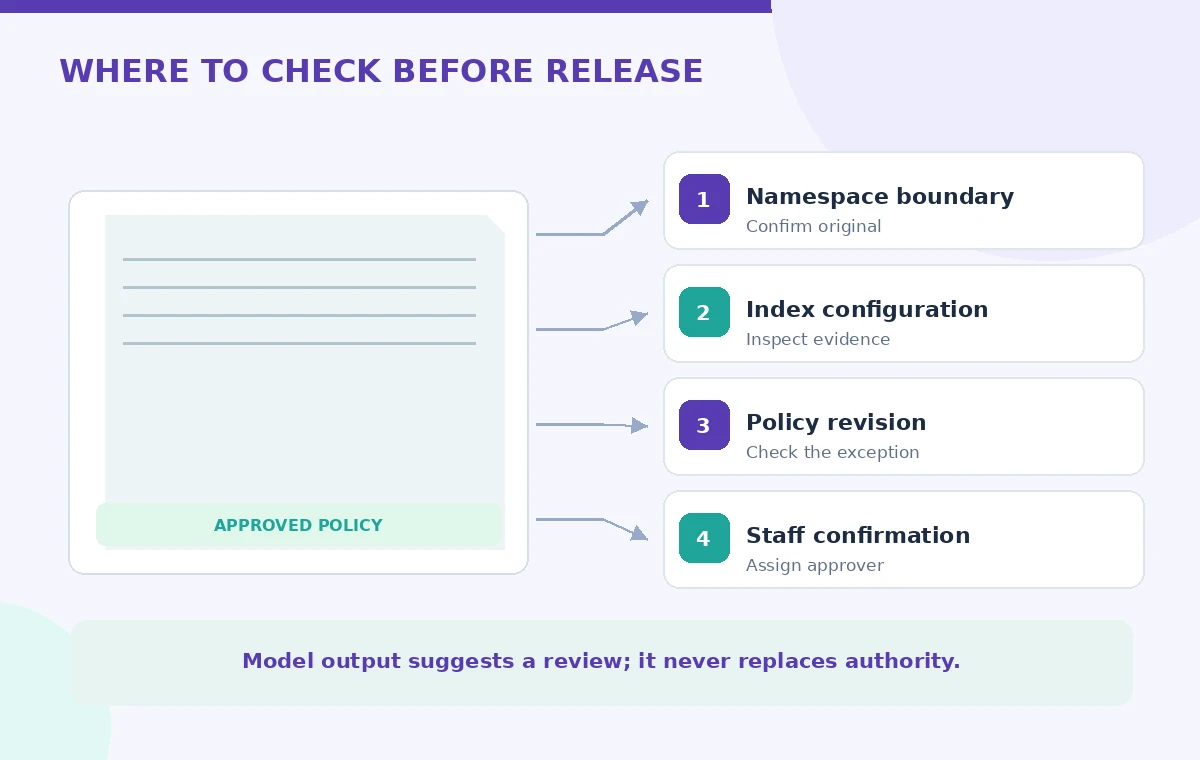
Monitor retrieval drift after indexing changes and compare answers to a fixed evaluation set. If the assistant cannot reach an approved policy or a user lacks the right scope, return a neutral message and direct them to the owner. LangGraph’s store can organize useful searchable memory, but the institution must still control provenance, permissions, revisions, and the actual handling decision.
How We Research
For this November 2026 editorial review, we checked named official vendor and framework documentation: LangGraph store documentation; LangGraph BaseStore search reference; LangGraph BaseStore put reference. We compared the documented inputs, output types, configuration options and stated limitations with a hypothetical, non-production workflow. We did not run paid API calls, upload actual patron or donor records, measure accuracy, certify legal compliance, or obtain sponsorship or staff consent on anyone’s behalf. All illustrated comparisons are synthetic examples designed to explain what a reviewer should inspect. Product availability, endpoint behavior, regional terms and pricing can change; consult the linked sources and your own organization’s policies before deployment.
Frequently Asked Questions
No. Semantic retrieval requires a compatible store implementation and embedding/index configuration; availability varies by backend.
No. Namespaces organize queries and scope lookups, but authorization must be enforced by the application and storage permissions.
Yes. The BaseStore put reference documents index=False for implementations that support indexing configuration.
The matched policy might be superseded, unapproved, or outside the requester’s authority. Semantic similarity does not establish policy validity.
A current approved source identifier, revision and relevant passage, with an owner-approved route for questions the search cannot resolve.