
A student preparing a fictional scholarship essay wants to demonstrate how the text was developed, not just upload a polished final page. Grammarly Authorship can capture a writing process and categorize where inserted text came from in supported editors. That makes it useful for reflection and discussion, but it is not a plagiarism verdict, proof that every sentence is factually correct, or a substitute for a school’s disclosure rules. This workflow focuses on preserving actual source attribution, recognizing unknown pastes, and sharing the report only with an appropriate reviewer.
Confirm the editor and tracking mode
Grammarly documents Authorship in Google Docs through its browser extension, in Microsoft Word through its desktop application, and in Grammarly’s own docs writing surface. Tracking behavior differs by environment: the docs surface records drafting automatically, while the other supported editors require the tracking capability to be active. Before starting a scholarship essay, verify that the account and editor expose Authorship and that the student understands what the report can include. Do not assume that a draft typed in another application will gain retrospective provenance when pasted into Word. Begin with a test paragraph in a private practice document and inspect how typed and copied text appear; this is a recommended user check, not a test performed for this article.
Build an evidence-friendly research folder
Keep a small research log outside the essay with the scholarship’s actual prompt, eligibility rules, official deadline, and any independently obtained facts used in the application. For every quotation or paraphrase, retain the source title, link or bibliographic detail, and a note explaining why it matters. Authorship can categorize a paste from a recognized browser source, but the author still needs normal citations and permission to reproduce any quoted material. A writing-process report cannot confirm that a third-party page was reliable. In the fictional example, a student quotes a program mission statement; the editor should compare it directly with the scholarship provider’s current page before describing it as an official requirement.

Separate typed, copied, and AI-assisted passages
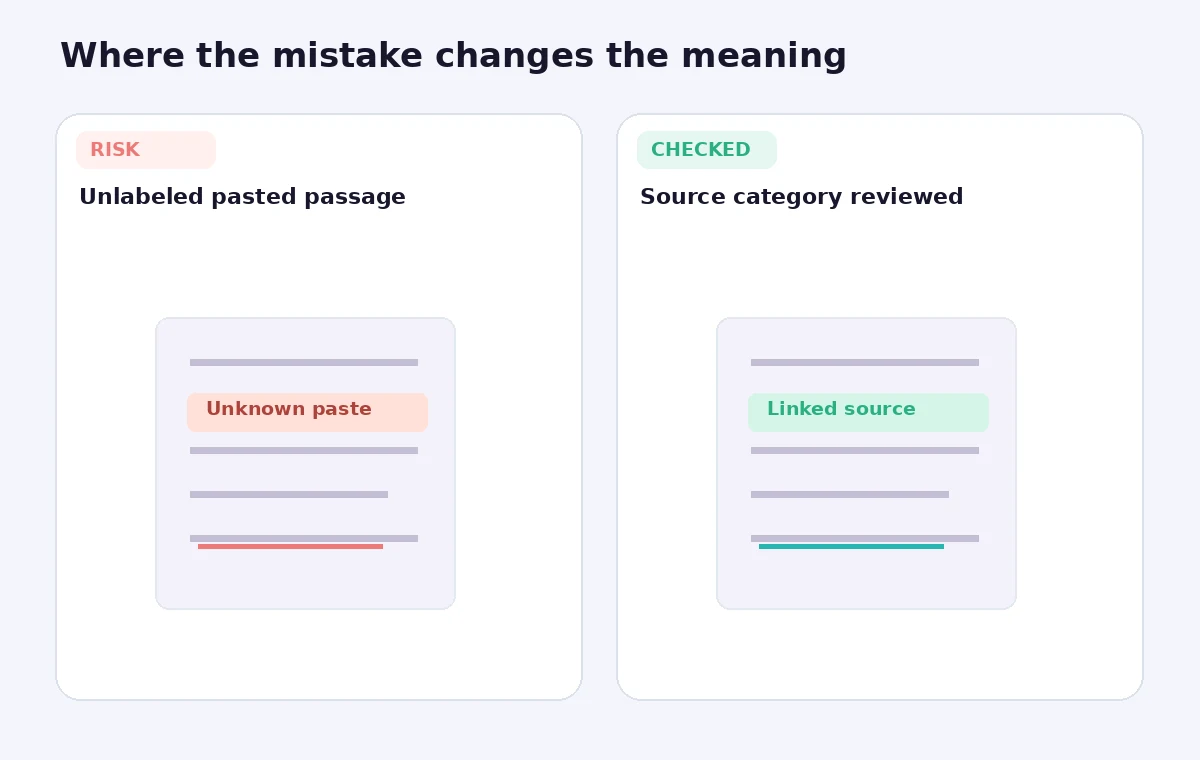
Draft core reflections in the supported editor while tracking is active. If a passage is copied from a web page or an AI assistant, keep the origin visible in the working notes rather than trying to make it look manually typed. Grammarly explains that it distinguishes some text entered by the user, some material pasted from known browser sources, and text pasted from unknown sources. On Word, desktop application context may also contribute. These categories describe observed input pathways; they do not measure originality, intellectual effort, or permission to use material. A pasted personal note may be perfectly legitimate yet still appear under an unknown-source category, so explain ambiguous blocks before a reviewer interprets them.
Review attribution before polishing
After a first draft, open the Authorship report and inspect a paragraph-by-paragraph distribution rather than relying on a single percentage. Look for long copied blocks that should be paraphrased with citation, quotation marks that disappeared during editing, and unexpectedly categorized passages caused by moving text between editors. If a passage is flagged as unknown, retrace the workflow and locate the original notes where possible. Avoid rewriting text solely to change a metric; that would make the process less transparent. The useful question is whether an honest reader can distinguish the student’s own experience, referenced facts, and outside assistance. Retain the draft history or source notes when a report cannot explain the source conclusively.
Keep admissions claims under human control
AI or writing suggestions can improve sentence flow without checking the applicant’s lived experiences. Review every claim about hours volunteered, awards, leadership, personal circumstances, and grades against real records. In a hypothetical essay, changing ‘helped coordinate the event’ into ‘directed the entire program’ would be a substantive exaggeration even if Authorship identified the rewrite correctly. Restore the precise description. Likewise, distinguish a scholarship’s selection criteria from speculation about what reviewers prefer. A provenance report traces text entry, not truth. The strongest submission is one where the applicant can explain each specific claim, produce supporting evidence when appropriate, and stand behind the final wording in their own voice.
Treat the share link as sensitive information
Grammarly’s documentation describes a shareable report link. Review what the report reveals about the document and its text origins before sharing it. A scholarship essay can contain private family stories, financial details, or references to other people; an open report link deserves the same deliberate audience choice as the finished essay. Check the school’s requested format first, and do not send a provenance report when it was not requested. A report can help a mentor discuss revision methods, but it should not be circulated broadly or used to shame a writer for an unexplained pasted passage. Ask for clarification and preserve the student’s opportunity to correct the record.
Understand the blind spots of source categorization
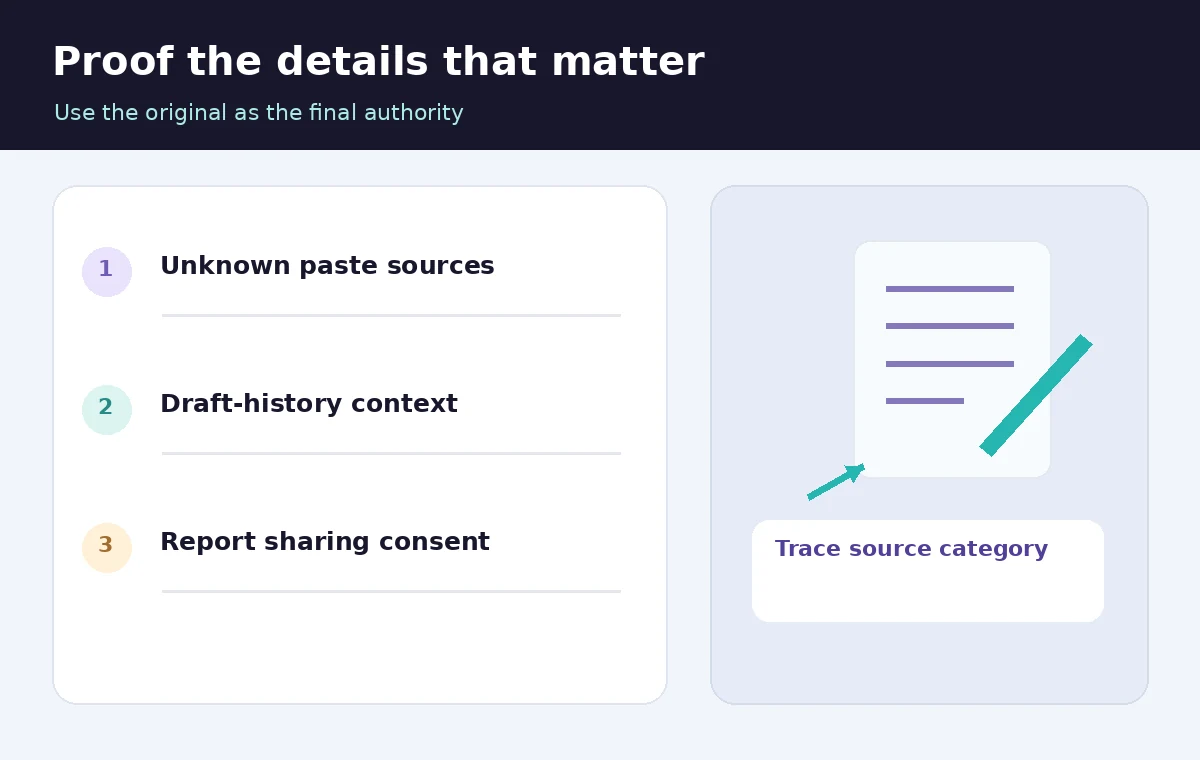
Authorship has practical limits that its support documentation describes. Material copied from a private window or desktop source may be classified as unknown; different host editors have different levels of source detail. Screenshots, handwritten notes, offline conversations, and facts memorized before drafting are not automatically verified by the system. Nor does tracked authorship imply that third-party AI detectors will agree with it. A reviewer should avoid turning these categories into an automatic pass/fail score. Use the report as one artifact alongside citations, drafts, and an ordinary conversation about the writing process. Where a source is unclear, mark it as unresolved instead of inventing a definitive explanation.
Finish with a provenance and privacy checklist
Before submitting, proofread the essay without automated rewriting, check that quotations remain correctly attributed, verify dates and named organizations, and compare factual claims with original records. Review the Authorship timeline for unexplained large inserts and document legitimate reasons for them. Export the required scholarship format, check its word count, and confirm that it does not contain internal research notes. If an institution requests a process report, inspect its sharing permissions and provide the link only through the approved channel. The result is not a certificate of originality: it is a clearer, honest record of how a student produced a specific essay while respecting the rules of that application.
How We Research
We consulted the official Introducing Authorship and Submit your Authorship report for a Canvas assignment documentation on November 1, 2026, focusing on tracking activation, clipboard attribution, known blind spots and report sharing. We cross-checked the stated options and limits against the proposed steps; dates, requirements and controls may change after the source review. The people, organizations, numerical illustrations and diagrams are hypothetical instructional examples. No live account workflow, original photo processing, meeting recording or reliability benchmark was performed. The quality checks are an editorial methodology, not claims of product test results.
Frequently Asked Questions
No. It categorizes observed writing and insertion sources. It does not certify plagiarism status, factual truth, or compliance with an institution’s policy.
Do not assume retrospective tracking. Start with the supported editor and check recording is active before drafting.
Private windows and some desktop copying paths may not provide origin details. Review the actual drafting notes rather than treating the label as misconduct.
No. Cite sources normally and verify all externally sourced factual claims.
Not by default. Review its content and privacy implications and share only with the intended reviewer when appropriate.