
A practical guide to consent records, speaker verification and safe synthetic-audio approvals. This guide focuses on decisions a real editorial team can verify, not unperformed lab tests or vendor marketing scores.
Decide whether a clone is necessary
Voice cloning produces speech in the recognizable style of a particular person. It is useful for authorized narration fixes and an accessible update process, but it is unnecessary for many projects that can use a licensed generic voice. Begin with a one-sentence justification: whose voice is needed, for what work, in which channels, and for how long. If the purpose is simply to avoid booking a narrator, compare the privacy and reputational implications with a stock voice.
Do not treat publicly posted interviews, old voice messages or a signed general media release as automatic permission to synthesize new statements. The capability to copy a timbre is not an entitlement to put words in a person’s mouth. An employee, contractor or guest must understand the specific synthetic uses before a recording enters a cloning service.
Scope consent to a real production contract
Create a consent record specifying the speaker identity, project, authorized organization, generation purpose, allowed channels, languages, date, retention terms, compensation if applicable and how a speaker can report misuse. Record whether the producer may make ads, customer-facing announcements, training edits or only repairs to an existing authorized performance. Each category changes the practical risk.
Keep the signed permission in the organization’s restricted rights folder and link it to a separate production identifier. Staff should not infer permission from a file in the shared drive. If the brief changes materially, obtain an updated agreement before generating the new content. Agreements should reflect applicable laws and platform rules; this workflow is not legal advice.

Follow the platform verification flow exactly
ElevenLabs documents two main cloning routes: Instant and Professional. For Professional Voice Cloning it requires you to verify your own voice; you cannot create somebody else’s Professional Voice Clone inside your own account even if you have their consent. The speaker can create, verify and privately share their clone. This is a product limitation, not a suggestion to work around verification.
Descript’s current custom AI Speaker workflow requires an explicit recorded authorization statement. It also provides a route for a collaborator to send that statement when they cannot record inside the app. A contractual permission and an in-product verification step serve different purposes: complete both when the workflow calls for both.
Capture clean training audio without collecting too much
Ask the authorized speaker to record in a quiet space using a consistent microphone and ordinary delivery. Remove unrelated people from the recording and do not upload a montage of colleagues speaking over each other. Label samples with permission status and intended clone. For an Instant route a short sample may work, whereas a higher-fidelity training process may need much more material.
Collect only what the platform and quality goal require. Long raw sessions may include private remarks, health details or background conversations that the speaker never agreed to disclose. Review files before upload, confirm the platform’s retention and deletion options, and store a checksum or stable reference to the authorized source. Never reuse an older training file for a new purpose without checking scope.
Separate creation permission from publishing approval
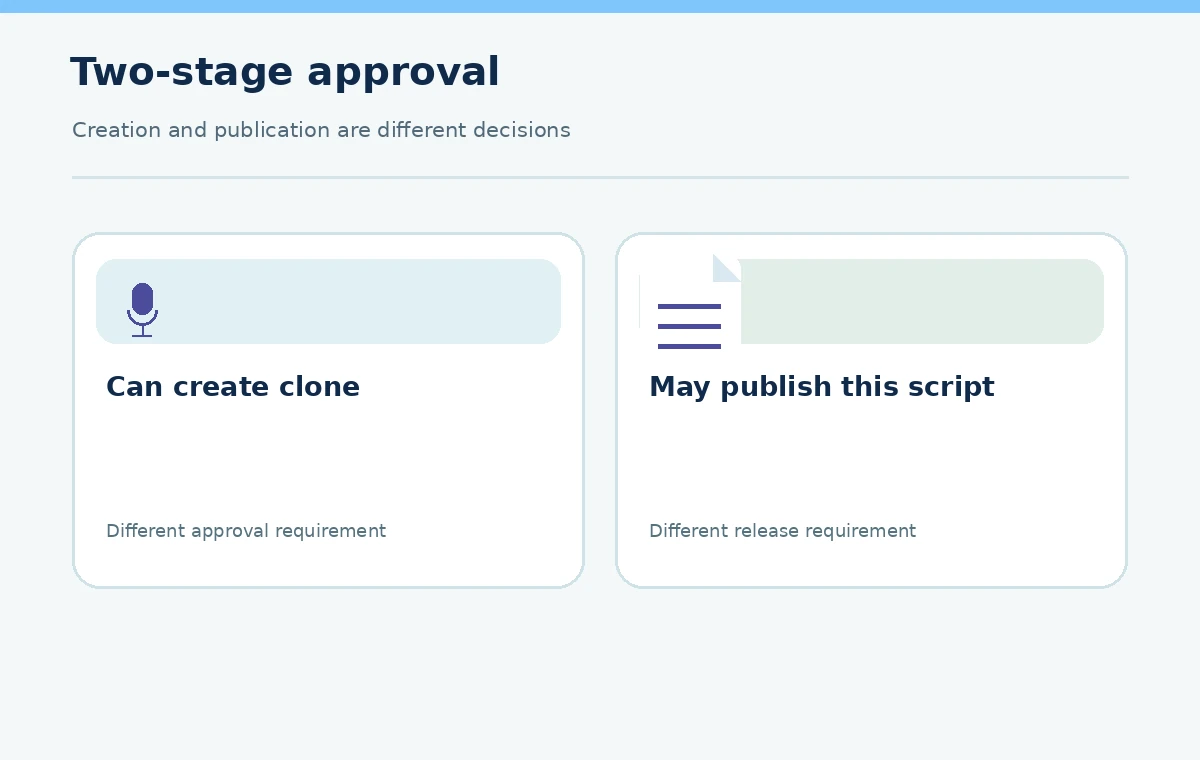
A speaker may agree that a team can build a voice model yet still expect to approve statements attributed to that voice. Create two gates: an authorized creation event and a content approval event. The content gate should show the exact final script, named audience, distribution date and any promotional context. A general approval of a series is not necessarily approval of newly generated claims.
Mark every draft synthetic recording with a clear internal label, and do not let it move into a public publishing folder before approval. Put a human editor between the script author and the generation tool. The editor checks that the content does not impersonate official instructions, invent an endorsement or omit a material qualification.
Review audio for both identity and meaning
Generate a short approved test line containing several distinctive sounds. Ask the speaker to assess whether the voice resembles them in acceptable ways and whether the expressive style is misleading. The producer checks for changed numbers, pauses that alter meaning, unsupported claims and text that may be read differently from what was approved. Save corrections with the script version.
A realistic clone can still mispronounce a brand name or produce a different emotional delivery. Preserve the original performance where possible and replace only approved segments. Do not describe a synthetic reenactment as an original recording. For news, political communications, financial instructions or safety-critical messages, apply a higher review threshold and transparent labeling as appropriate.
Use least-privilege access and an incident plan
Create clones in an organizational account with role-based access where available. Limit who can generate audio, share voice assets, download source samples or authorize public distribution. Review access when contractors leave and remove archived export links that no longer need to be accessible. Keep an audit trail of authorized uses, including the script, user and release destination.
Plan for accidental disclosure or misuse before launch: who can disable sharing, take down audio, contact the speaker and preserve evidence? Confirm the service’s deletion process, but do not promise that deleting a model can recall downloaded files. Set retention dates for samples and approval records that balance privacy with legitimate recordkeeping.

Use a go/no-go checklist for each release
The last reviewer should see the consent scope, in-product verification status, final script, sample rights, reviewer approvals, publication destination and a synthetic-content labeling decision. If one item is uncertain, release remains blocked until an authorized person resolves it. This protects both the speaker and the organization from publishing something plausible but never intended.
During an annual or project-close review, check whether each clone is still needed. Retire unused access, inventory existing audio and document any new permissions. A defensible voice-cloning workflow is built around consent and accountability, not merely the speed of making a believable sample.
How We Research
Our October 27, 2026 source review compared current ElevenLabs verification rules, Descript’s recorded-authorization workflow and Cartesia’s published acceptable-use policy. We derived a consent and release checklist from these primary documents; no legal clearance or product trial was performed. Organizations should obtain their own rights review. Primary sources: ElevenLabs cloning overview; Professional clone ownership; Descript AI Speaker permission guide; Cartesia acceptable use.
Frequently Asked Questions
Possibly, but explicit project-specific consent and the selected provider’s verification rules still apply. A written agreement does not override an in-product identity requirement.
ElevenLabs states the professional clone must be created and verified by the voice owner. The owner may then privately share it using the platform’s supported flow.
Yes. Its custom AI Speaker documentation requires a recorded authorization statement and describes how a collaborator may supply that statement for third-party creation.
No. Previously downloaded or distributed sound files need their own removal process. Inventory and take down outputs separately from the service account.
Pause distribution, preserve the permission and script records, restrict generation access, contact the speaker and evaluate removal and correction obligations under the applicable agreement.