
Why metadata is not the document
A grant reviewer may see a file identifier, filename, byte count, or creation timestamp in an OpenAI response and assume the underlying evidence has been preserved. Those fields describe a file object; they do not reproduce its contents. The Files API provides a separate content retrieval operation for an uploaded file. In a hypothetical museum-grant audit, the editorial record needs the authorized source document rather than a screenshot of the metadata response. A title can be similar across revisions, and a byte count alone is not a signature. Treat the file ID as a locator to be verified against the grant intake record, never as independent proof of what the source says.
Identify the approved file before retrieving it
Start with an internal inventory that records the expected file ID, uploader or ingestion process, project purpose, source filename, and the institutional permission to inspect the document. The file ID is an API identifier, not a human-readable description. Do not select a file merely because its filename resembles an application reference: two revisions may share the same name, while the same file can appear in several workflows. The review should also distinguish an OpenAI Files object from a container-generated file or an indexed vector-store entry; those resources use different endpoints and lifecycle rules. Confirm the intended organization, project credentials, and permitted review scope before requesting bytes.
Read metadata to establish a narrow expectation
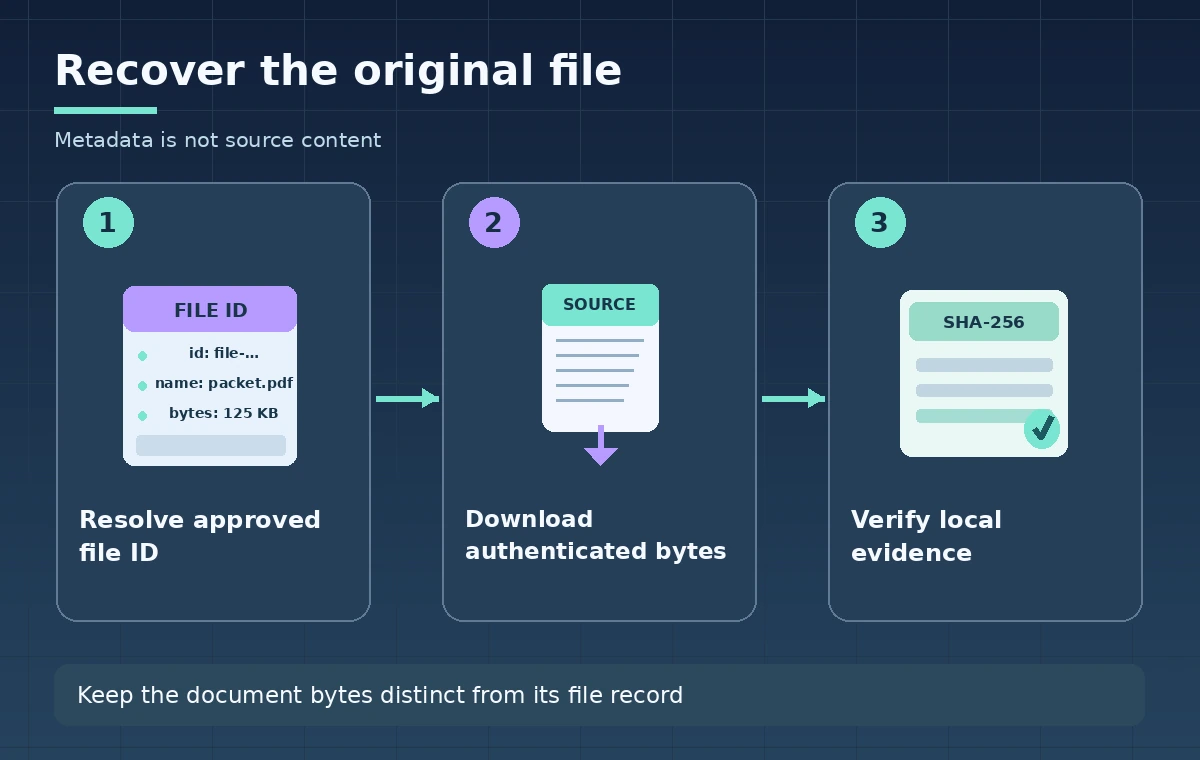
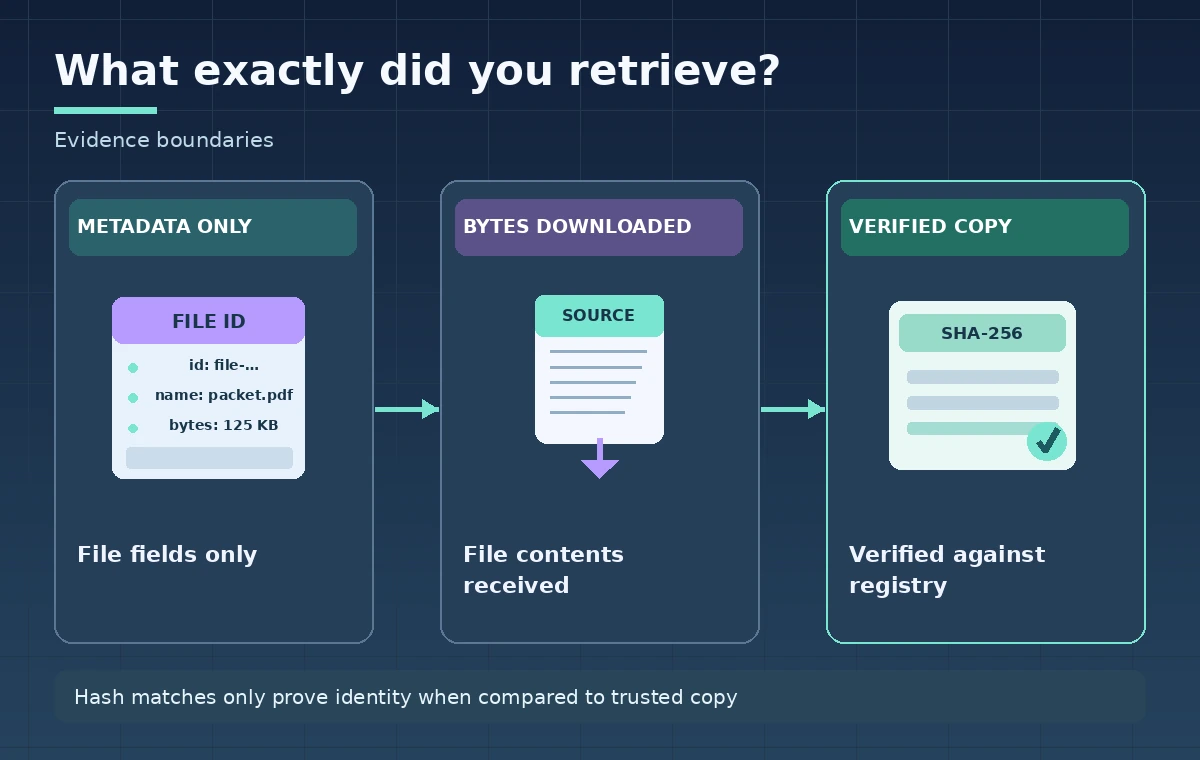
The retrieve-file method returns a File object with fields such as id, filename, bytes, purpose, and potentially an expiration timestamp. Capture the fields needed for the audit in a controlled ledger, noting that a response may not contain every optional field. Metadata can guide checks: a purported PDF should not unexpectedly be a JSONL training input, and the expected source reference should agree with the inventory. It cannot establish that the downloaded file matches a privately held original without comparison. A successful metadata lookup also does not guarantee that the content endpoint will be accessible to the same workflow indefinitely; handle access and expiration as separate checks.
Download through the Files content endpoint
The documented HTTP operation is GET /v1/files/{file_id}/content, authenticated with an authorized API key. Unlike GET /v1/files/{file_id}, this call returns the file contents. Save the response body as bytes to a protected, deliberately named destination, and keep credentials out of shell history, application logs, screenshots, and exported reports. A production downloader should reject unexpected HTTP statuses before treating any response as a file. Avoid writing an error page or JSON error body to a path labeled as the original PDF. The example is conceptual; it does not represent an executed download or an observed service response.
Preserve bytes rather than guessing the format
Do not assume every file is text simply because a documentation example writes to file.jsonl. A grant workflow might contain PDF, plain text, structured JSONL, or another accepted source format. Read or stream the response according to the expected file type; a text() conversion may change binary data or character encoding. Check whether the resulting file can be opened by an approved parser, and quarantine unexpected formats instead of forcing an extension. Keep the original byte stream separate from derived OCR, summaries, and text extractions. A PDF converted to text can be useful for search, but the transformation is another artifact with its own review history.
Verify integrity and the chain of custody
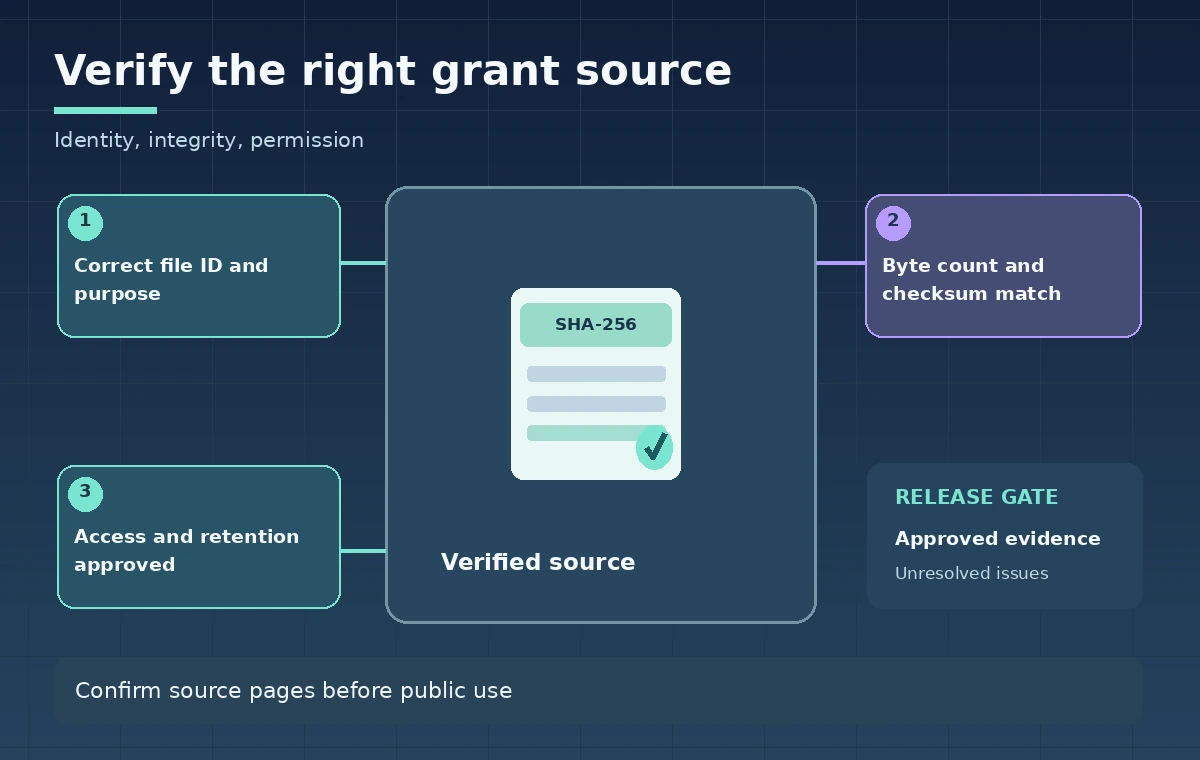
Compute a local SHA-256 checksum on the downloaded bytes and record the digest with the file ID, retrieval date, destination filename, and reviewer. If the institution holds an earlier approved copy, compare hashes with that copy to establish byte identity. A checksum generated only after a download proves consistency for future comparisons; it cannot by itself show that the file matches a claimed external source. Inspect page counts and identifying front matter where applicable, without exposing protected applicant information to public logs. Link every derived caption, extraction, or AI-assisted note back to the source ID and page or section used.
Handle errors, expiry, and unavailable content honestly
A missing file, expired file, permission failure, and malformed response are different conditions. Record the actual response category without inventing a successful recovery, and do not blindly retry with broader credentials. If access has expired or the institution no longer has permission to use the source, the safe outcome may be a gap in the audit rather than a recreated document. The API reference does not promise that arbitrary file types or workflows remain retrievable forever. Maintain your own retention and deletion rules, and reconcile any duplicate copies held by the source repository or publishing system separately from the OpenAI file object.
Use a small hypothetical verification exercise
Imagine an approved grant packet with inventory ID M-42 and an associated file ID. A reviewer retrieves metadata, confirms that the registered filename and purpose are plausible, and then downloads the content to a restricted review folder. The reviewer computes a hash, compares the document’s first page and reference number with the intake ledger, and records a mismatch if any step diverges. A second reviewer should be able to reproduce the identity checks without seeing a live API key. This is a training example, not a report of a tested grant, measured download speed, or actual uploaded document.
Release the finding, not the private source
Before including an AI-derived statement in a public article, preserve the citation to the authoritative source and confirm whether the document may be quoted at all. The audit note should state what was downloaded, which checks passed, and which questions remain unresolved. Keep private attachments, personal information, signed URLs, and request headers out of the publication workflow. A file’s availability through the API is not permission to redistribute its contents. The final editorial decision should be based on the approved document and an accountable review trail, not on the presence of a file ID in a model response.
How We Research
Our primary, named vendor sources reviewed November 11, 2026 are: OpenAI Files: retrieve content; OpenAI Files: retrieve metadata; OpenAI Files API overview. We compared the OpenAI File metadata endpoint with the separate Files content endpoint, then mapped a hypothetical grant-packet recovery through file ID, byte preservation, and independent identity checks. We did not access an account, download a real file, or inspect real grant documents. The narrative, diagrams, sample states, identities, permissions, and failure paths are hypothetical instructional examples, not screenshots, tests, measurements, or user data. Features, quotas, costs, availability, supported configurations, and permissions can change. Verify current documentation, access authorization, security boundaries, and source rights before implementation or publication.
Frequently Asked Questions
No. Metadata and content are separate Files operations; the content endpoint provides the file bytes. Apply the institution’s document-retention and citation policy even if the API still returns the file. An API retrieval alone does not establish the right to republish it.
No. Match it against your intake registry and, where possible, an independently held source copy. Apply the institution’s document-retention and citation policy even if the API still returns the file. An API retrieval alone does not establish the right to republish it.
No. Preserve binary bytes and choose a parser only after identifying the expected format. Apply the institution’s document-retention and citation policy even if the API still returns the file. An API retrieval alone does not establish the right to republish it.
It provides a fingerprint of the bytes you saved for subsequent comparison, not independent proof of origin. Apply the institution’s document-retention and citation policy even if the API still returns the file. An API retrieval alone does not establish the right to republish it.
Record the unavailable evidence and follow your authorized retention and recovery workflow rather than broadening access blindly. Apply the institution’s document-retention and citation policy even if the API still returns the file. An API retrieval alone does not establish the right to republish it.