
Why stopping a job is different from withdrawing its findings
A fictional nonprofit launches a lengthy grant-eligibility review, then discovers that the uploaded criteria were superseded. The immediate goal is to prevent a running analysis from being treated as the current recommendation. In the Responses API, cancelling the background response is an execution-control action, not a decision about whether the grant is eligible. A reviewer should first flag the associated work order as withdrawn, remove it from the publication queue, and preserve the source-version reference that explains the stop. Otherwise, a late webhook or copied draft may still enter an editorial workflow even though its computation ended.
Confirm that this response was started in background mode
The documented cancellation endpoint applies only to responses created with background set to true. A normal foreground response is a different lifecycle: disconnecting its client is not equivalent to asking the background cancel endpoint to stop it. At creation time, save the exact response ID, request timestamp, model identifier, job owner and the source-document version in a controlled ledger. Do not infer an ID from a visible text fragment. The point of this record is to associate a specific running operation with the decision to stop, without copying sensitive grant material into logs.

Read the status before choosing an action
Retrieve the response by its ID and examine status rather than assuming a long-running request is still active. The background-mode guide says requests may be queued or in_progress and can reach terminal states. An already completed response requires an editorial hold and provenance correction, not a promise that cancellation can erase an answer someone has downloaded. A failed or incomplete response likewise needs its recorded terminal outcome. A useful review screen shows the response ID, latest status, initial policy revision and an explicit publication flag; these are separate fields for separate decisions.
Send cancellation to the specific response ID
For an eligible in-flight background job, the official API provides POST /v1/responses/{response_id}/cancel, and supported SDKs expose a cancel method. The caller must authenticate with authorized credentials. Record the request ID and returned response status without printing API keys or entire private prompts. The documentation says a repeated cancellation request is idempotent and returns the final response object, which helps an operator safely reconcile an uncertain network reply. Do not interpret that property as proof that a separate report export, database write or human approval was also cancelled.
Separate cancellation response from downstream effects
A cancellation response concerns the Responses job; it does not revoke an external file link, undo email messages, roll back a human edit, or reverse a charge by itself. If your application copies generated text to a CMS or dispatches tasks, those downstream operations need their own hold or rollback procedure. The same applies to a research dashboard: a stopped job must not retain a green completion badge inherited from an earlier UI state. Mark the output as unavailable for release until an authorized reviewer confirms whether any material was saved and what sources it used.
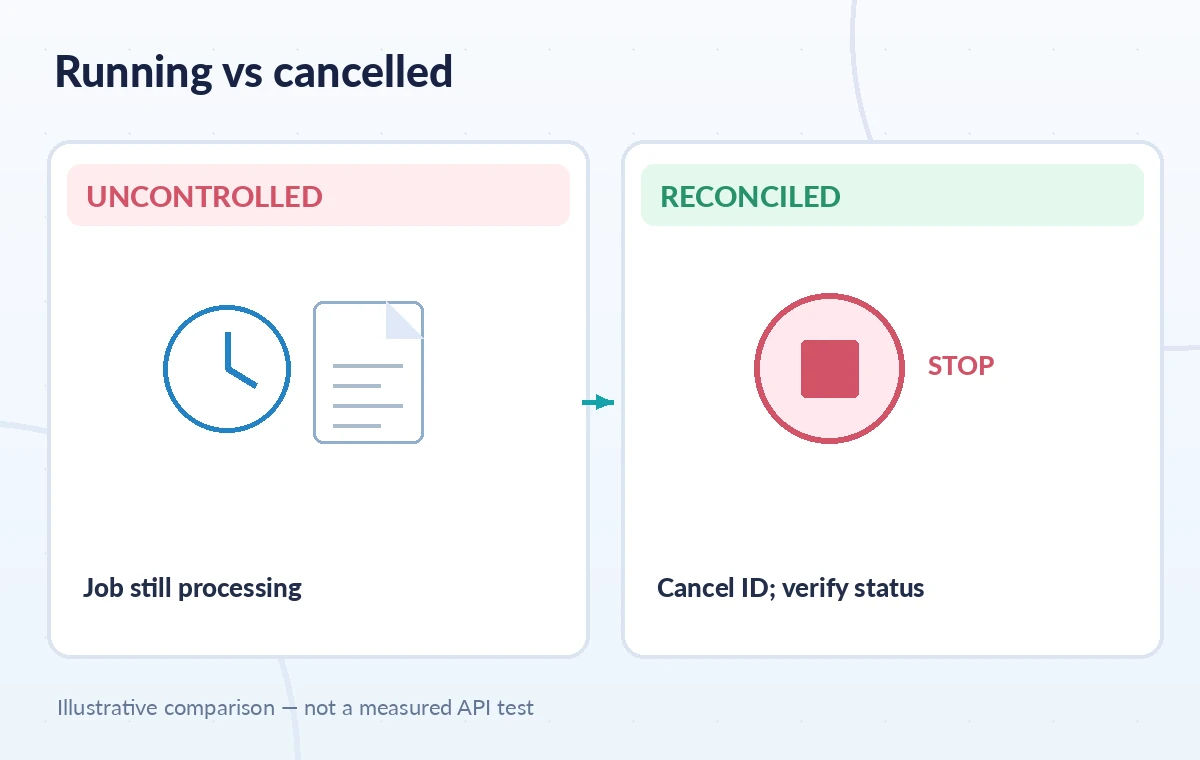
Check the final status and preserve the audit trail
After the request, retrieve the response when appropriate and record the terminal status and time. A returned cancelled status is the clearest signal for the model-side operation, while errors or a lost connection require reconciliation rather than blind retries against guessed IDs. A cancelled response can still contain partial content in a response object; partial text is not an approved research result. The ledger should identify who requested the stop, why the source was withdrawn, and which editorial queue items were blocked, but avoid storing prompts or personal donor data without a retention need.
Account for background retention without inventing deletion
OpenAI documents temporary on-disk storage for background polling, including important differences between store settings, project data controls and retention behavior. Cancellation is not a substitute for a data-retention policy. Some background requests may be temporarily available for polling even with store set to false; the guide also documents behavior for Zero Data Retention projects. Record your project configuration and review the current data-controls page before promising that nothing was stored. An auditor needs to distinguish stopping computation, deleting an application copy, and the platform retention rules for the response object.
Design a release gate for restarted work
When new grant criteria arrive, create a new job with the updated source version rather than silently reusing the cancelled response ID. Require an explicit reviewer sign-off on citation dates, eligibility conditions, unknowns, and the scope of any extracted findings. The CMS should accept only results whose source revision and job status match the approved review ticket. If two jobs race, an old cancelled result must fail the same release gate as a stale completed result. This protects decisions even when operators monitor jobs from multiple consoles.
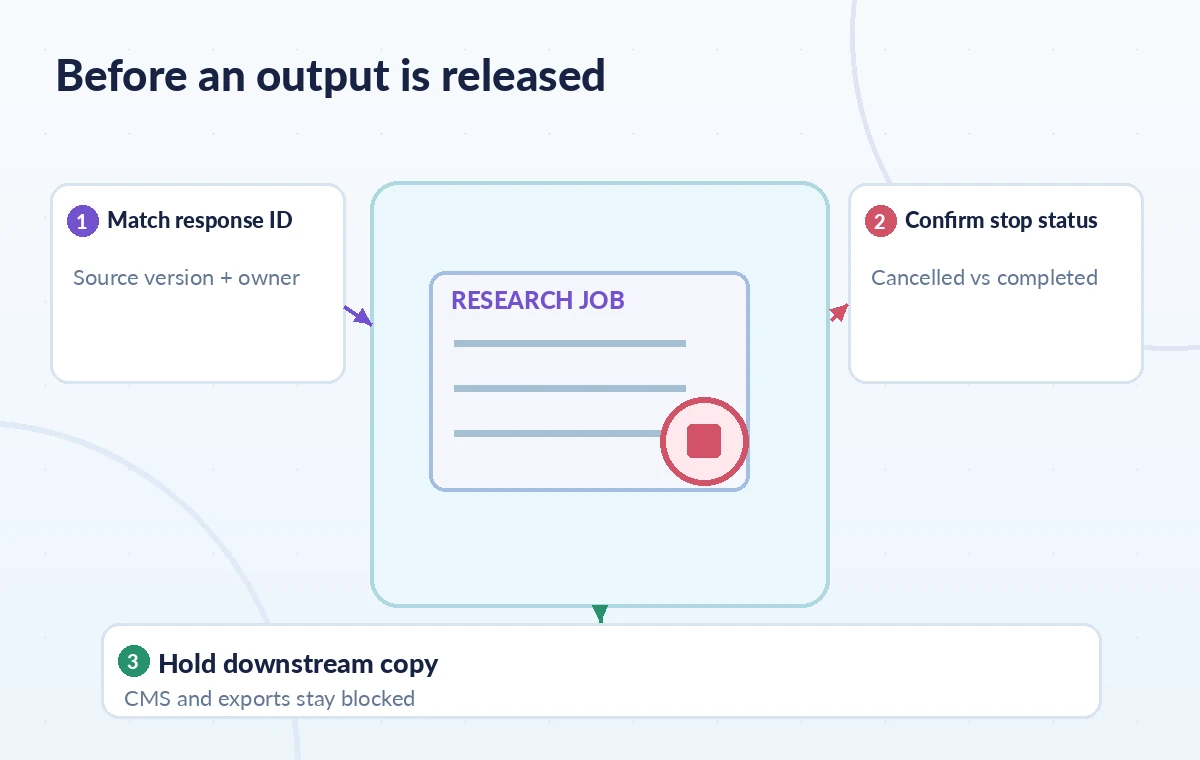
Run a tabletop check before production
Use a fictional grant packet and a non-sensitive test environment to rehearse the states queued, in_progress, completed, and cancelled. Test that the interface does not permit cancellation of the wrong ID and that a network failure triggers reconciliation. Verify that the CMS hold persists when the user reloads the page, and that partial text cannot enter a published post. No timing or cost savings are assumed here: acceptance depends on observed application behavior, correct response-status handling and a documented manual override procedure, not on an imagined model test.
How We Research
For this guide, we compared these official primary sources, consulted on November 10, 2026: OpenAI background mode; Cancel a response endpoint; OpenAI data controls. We traced the named API field or operation to its documented behavior, separated guaranteed platform semantics from hypothetical museum workflows, and checked for related topics already in the LabFin archive. No production API calls, live benchmarks, measured performance, commissioned user trials or real museum data were involved. Names, statuses and diagrams are instructional examples; verify the version, access model and retention settings in your own environment before applying the procedure.
Frequently Asked Questions
No. The official cancel endpoint is for responses started with background=true; foreground requests have a different handling model.
No. Execution control and retention are separate; consult the project data controls and applicable background polling rules.
The API documents cancellation as idempotent. First reconcile the exact response ID and status instead of guessing which job was targeted.
No. Do not promise a refund or zero metering simply because a stop was requested; reconcile usage and billing records.
Not automatically. Treat it as unapproved and require an independent source review and editorial release decision.