
A creator assistant can suggest ten appealing video titles in seconds, but a title is not evidence of audience demand. YouTube Ask Studio is an AI partner inside YouTube Studio that can discuss channel questions, audience comments and performance trends with eligible creators. The editorial challenge is to turn its suggestions into a defensible production plan without inventing view forecasts, pretending comments are a scientific poll or feeding confidential information into a prompt. This guide uses a fictional pottery education channel, maps three plausible viewer interests, and outlines a method to verify each idea against the actual channel. Its examples are not Ask Studio responses from a live account.
Check access, age requirements and the workspace first
YouTube Help says Ask Studio is available to most eligible creators globally through desktop web browsers; certain account types, underage creators and Made for Kids channels are excluded. If the feature is absent, use ordinary Analytics and audience comments instead of inventing a menu path. Open the creator’s own channel workspace and decide who is authorized to review data and handle audience feedback. Don’t share another organization’s confidential marketing plans in prompts. Because the interface can evolve, document the question and the source metric rather than an exact button position that might soon move. This makes the research handoff useful even after a dashboard update.
Write one narrow question for each editorial decision
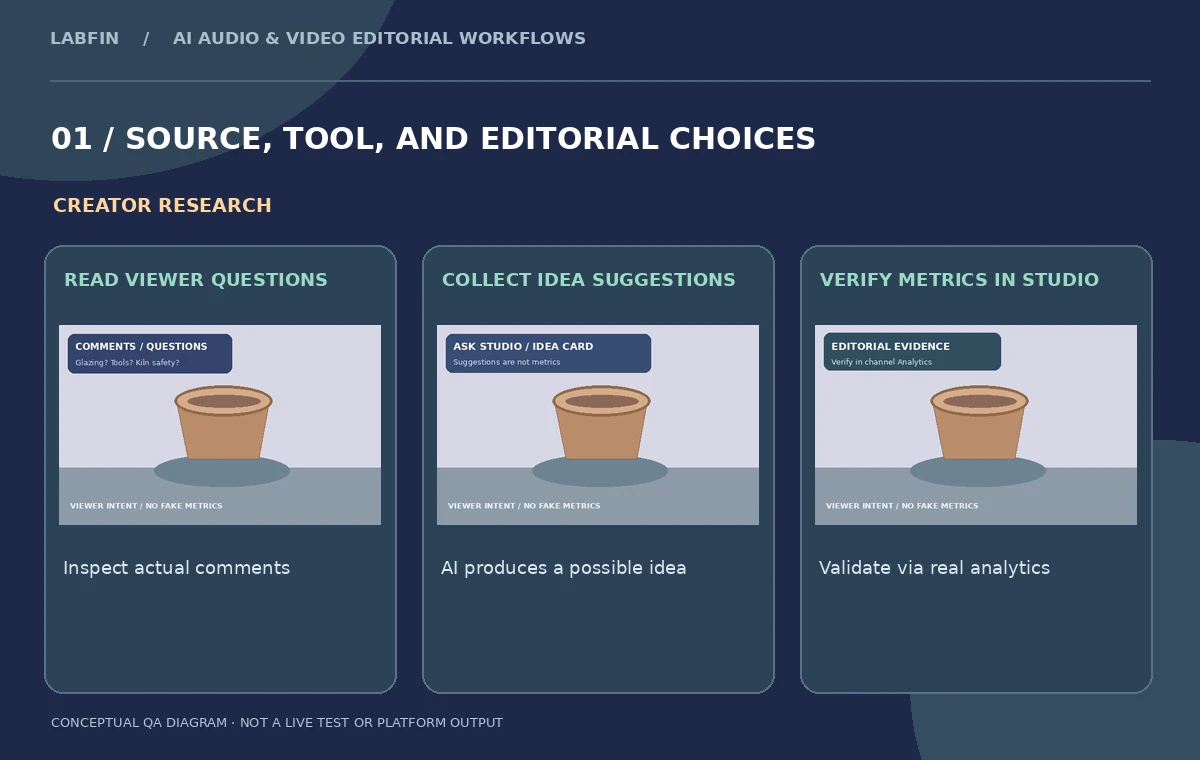
Start with a small question such as “Which themes recur in comments on our last three glazing tutorials?” Avoid asking the assistant to predict an exact number of views for a hypothetical upload. Separate brainstorming prompts from analytic ones: a suggested title is a creative artifact; an answer about returning viewers is an interpretation of channel data. Ask for the period and examples that support a suggested theme. In the fictional pottery channel, glazing, kiln safety and starter tools are candidate clusters, not measured winners. Keep a list of the source videos and their original comment links when available so another editor can inspect whether the assistant understood the audience correctly.
Cross-check any numerical claim in Analytics
YouTube provides performance reports in Analytics, including views, engagement, audience and more detailed report modes. A generated statement that one topic “performs best” is incomplete without a metric, timeframe, traffic source and comparable reference. Check the actual video-level reports before accepting it. Consider whether a popular short has a different audience and distribution pattern from a thirty-minute tutorial. Do not calculate an artificial ranking from imagined data or treat a tool-generated explanation as certified analytics. A sensible report records which metrics were actually available and where there was insufficient data, especially for small channels where a few comments can look like an overwhelming trend.
Distinguish comment themes from audience demand
A comment asking for a pottery glaze recipe can mean curiosity, confusion or frustration with the prior video. Read the surrounding exchange and check whether the request is repeated by distinct viewers. Avoid reproducing usernames or private details in the editorial brief. Group comments by intent: a materials list, a safety warning, a beginner question or a correction to past content. Suggestions are valuable when they reveal a real teaching gap, not simply when the assistant repeats an attractive phrase. For a kiln safety topic, verify actual manufacturer instructions and local safety requirements separately; YouTube engagement data must not become technical safety advice.
Save ideas without mistaking suggestions for commitments
The current official Help page describes saved Idea cards and a saved ideas workspace, as well as the ability to request script feedback on draft, private or unlisted videos in eligible accounts. That is useful for carrying a proposed question into a production meeting. Save the original prompt, suggested hook and editor’s reason for accepting or rejecting the idea. Do not put a fabricated click-through rate or projected audience size on the card. Be explicit whether a title was suggested by AI, derived from an actual viewer phrase, or written by the editorial team. This distinction makes future performance reviews more honest and avoids confusing brainstorming with experiment results.

Review scripts for accuracy before using AI feedback
Ask Studio may give creative best-practice feedback for a script, but a polished recommendation is not a substitute for a subject-matter expert. Our fictional kiln video needs a verified safe procedure, accurate equipment terminology and clear disclaimers about variations among manufacturers. A prompt can ask whether the introduction is understandable, whether viewers get the answer soon enough or whether a chapter title is vague. It cannot authorize a dangerous operating procedure. Preserve a version of the script before changes so editors can separate language improvements from new factual claims. Where guidance conflicts with a verified manufacturer manual, the verified technical source wins.
Account for conversation retention and sensitive material
YouTube Help describes Ask Studio conversation history as retained for around thirty days and notes that product-quality reviewers may process de-identified interactions. Saved ideas are a separate content object and can persist longer. The safest workflow is to avoid pasting passwords, private customer notes, unpublished commercial terms or sensitive personal information. Build the editorial brief from allowed channel insights and public examples. If an idea relies on personal viewer testimony, obtain any necessary consent before quoting it publicly. Treat a generated summary as internal working material until a human editor has checked its accuracy, privacy implications and whether it fairly represents the channel’s audience.

Choose a release experiment with observable results
Select one topic with an explicit viewer problem, production scope and verification plan. A starter-tools tutorial might answer which equipment a beginner truly needs, while a glazing episode could address one recurring misconception. Draft a promise that can be satisfied on screen, choose a truthful title and thumbnail, and define what feedback would help improve the next video. After publishing, inspect actual analytics over a meaningful interval instead of attributing all changes to Ask Studio. Keep a decision log that says why the topic was chosen, what source evidence supported it and what remained speculative. The diagrams here illustrate the research pathway; no account or channel data was accessed for this guide.
How We Research
This YouTube Ask Studio guide is independent editorial guidance grounded in official documentation: YouTube Help: Learn about Ask Studio; YouTube Help: Get started with Analytics. The illustrated scenario is a fictional small pottery channel comparing viewer questions about glazing, kiln safety and simple tools before deciding its next instructional video. We checked the vendor-described capabilities and important eligibility conditions, then mapped a sequence of editorial reviews that readers can repeat with their own authorized media. The images are original teaching diagrams, not product UI screenshots, generated exports, results of a live account test, or measured benchmarks. We did not upload private recordings, access a paid vendor account, run a real A/B experiment, measure performance, or verify hypothetical timecodes. Retain source assets, check current plan availability and privacy settings, and review exported media and metadata before publication.
Frequently Asked Questions
The official Help page describes desktop-browser access for eligible creators.
No. Suggestions are creative guidance, not a view guarantee or verified forecast.
Eligible creators can request feedback on draft, private or unlisted videos, according to YouTube Help.
The Help page describes roughly 30-day conversation retention; saved Idea cards are separate.
Actual channel evidence, a clearly defined viewer problem and a realistic editorial ability to answer it.